Croatian Cases Explained: How to Learn All Seven as a Heritage Speaker
Originally published on Substack, in the Saturday Letter from Zagreb, as part of the series The Language You Carry.
English once had cases.
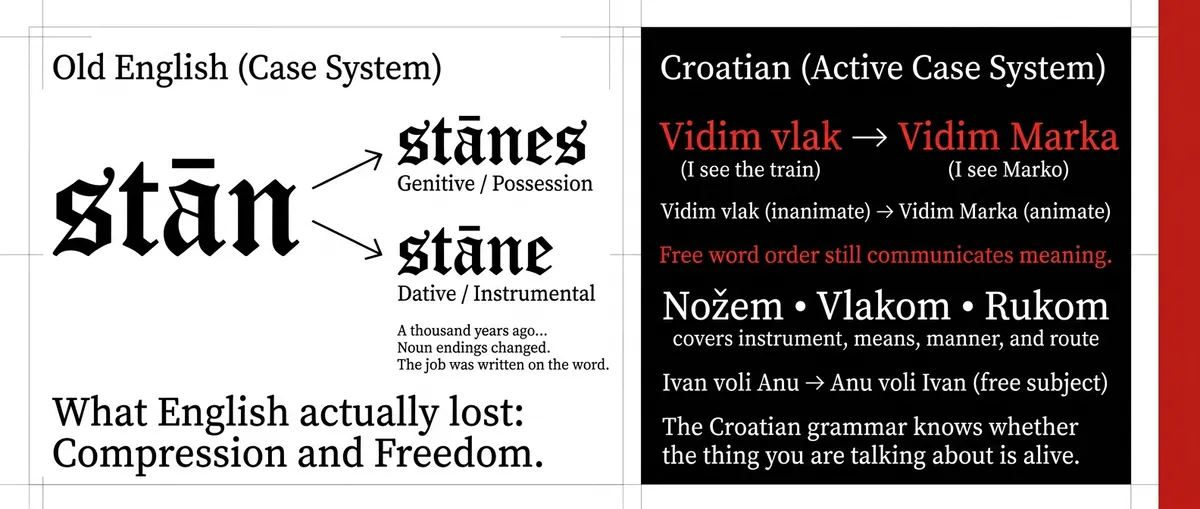
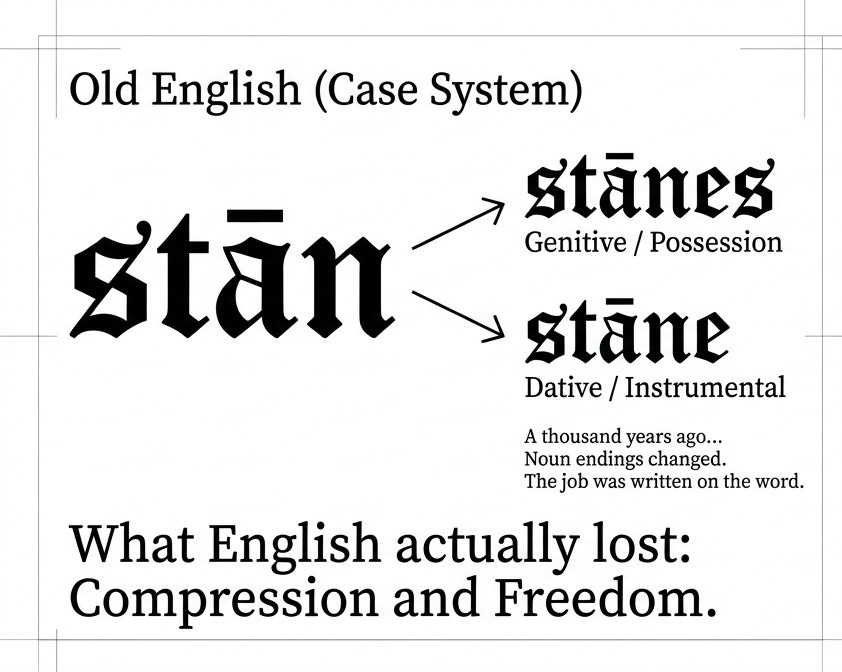
A thousand years ago a noun in English changed its ending according to what it was doing in the sentence. Stān, a stone, was stān when the stone was the subject, stānes when something belonged to the stone, stāne when something was given to it or done with it, and in the plural stānas, stāna, stānum. This was a language built the way Croatian is built, with the job of each word written on the word itself. And then, across a few hundred years, it stopped.
Almost nobody who speaks English today knows this. And meanwhile, in the other part of my working life, I watch people whose grandparents came from Sinj and Vis open a Croatian grammar, meet a table with seven columns in it, and close the book, as if they have met something no English speaker could ever be expected to manage. The language they speak every day had the same table once. It still keeps a piece of it, as you will see in a moment.
What actually happened to English
Here is the fact, and I want to give it to you in the words of two heritage-language scholars rather than my own, because they are making a larger point that concerns you directly.
Two linguists who study heritage speakers, Tanja Kupisch and Jason Rothman, use exactly this example. English once had endings on its nouns, as German still does today. Why did it lose them? Because children never learn their parents’ language as a perfect copy. Each generation picks it up a little differently from the one before, and over many generations those small differences add up until the language has changed (Kupisch and Rothman).
Then they make the point that matters for you. What happens in a family that emigrates is the same thing. A grandmother in Toronto speaks Croatian, her son speaks it a little differently, and her granddaughter differently again. The only real difference is speed. English took five hundred years to lose its endings. A family’s Croatian can change as much in fifty, because outside the house everybody speaks English. When a language is the big one all around you, it changes slowly. When it lives only in the kitchen, it changes fast. Same process, different circumstances.
Sit with the asymmetry in how we talk about those two.
When English lost its case endings, nobody called it broken. Nobody said that Chaucer’s speech was an incomplete acquisition of the language of Beowulf. It was described as change, which is what it was, and the resulting language was described as English, which is what it is.
And you still have case, by the way
Before I tell you what cases do, I want to remove the idea that they are foreign to you.
You use a case system every day. In English. You have used it since you were three and you have never once thought about it.
He saw the dog. The dog saw him. His dog.
Three forms of one word, and the form changes according to what the word is doing in the sentence. That is case. Not a metaphor for case, not something like case. Case.
I and me. She and her. We and us. They and them. Who and whom, in the mouths of people who still bother.
English kept its case system in the six or seven words that get used most often, which is exactly where languages usually keep the old machinery, and threw it away everywhere else. And no English speaker experiences him as an obstacle, because nobody ever put it on a table.
You are not learning a new kind of thinking. You are extending, to the rest of the vocabulary, a thing you already do with pronouns.
What the endings buy
So what does a language get for the trouble?
Three things, and the third one is the one nobody tells you.
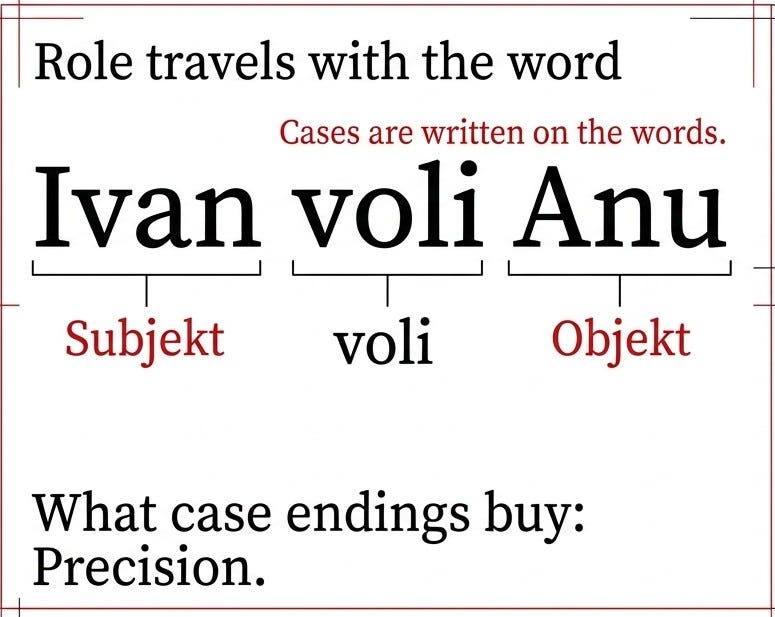
The first is that the role travels with the word. In Croatian, Ivan voli Anu tells you who loves whom because the endings say so. Ivan is in the nominative and Anu is in the accusative, and those endings are attached to the people, not to the seating plan.
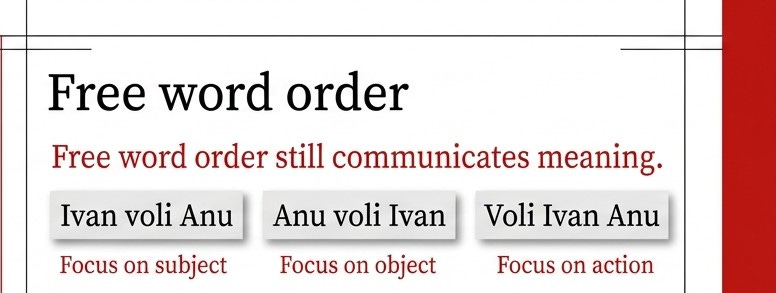
The second follows immediately and is the part I would put on a poster. Because the endings are carrying the roles, the word order is free to do something else.
Ivan voli Anu. Anu voli Ivan. Voli Ivan Anu. Three sentences, the same proposition, the same participants in the same relation, and three different centres of gravity. In the first, we are talking about Ivan. In the second, we are talking about Anu, and Ivan is the news. In the third, the loving itself has moved to the front.
English cannot do this, and the reason is not that English is careless. It is that English has already spent its word order. Having lost the endings, English had to put the roles into the order of the words, and once the order is carrying the roles it cannot also carry the emphasis. John loves Ann and Ann loves John are not two emphases. They are two different events.
So English, needing to do the thing Croatian does by moving a word, has to build machinery. It has the passive: Ann is loved by John. It has clefts: it is Ann that John loves. It has heavy stress: John loves ANN. All of which work, and all of which cost you a construction where Croatian costs you nothing.
That is what the seven columns are for. They are not a tax. They are what pays for the freedom you keep noticing in Croatian sentences and cannot reproduce.
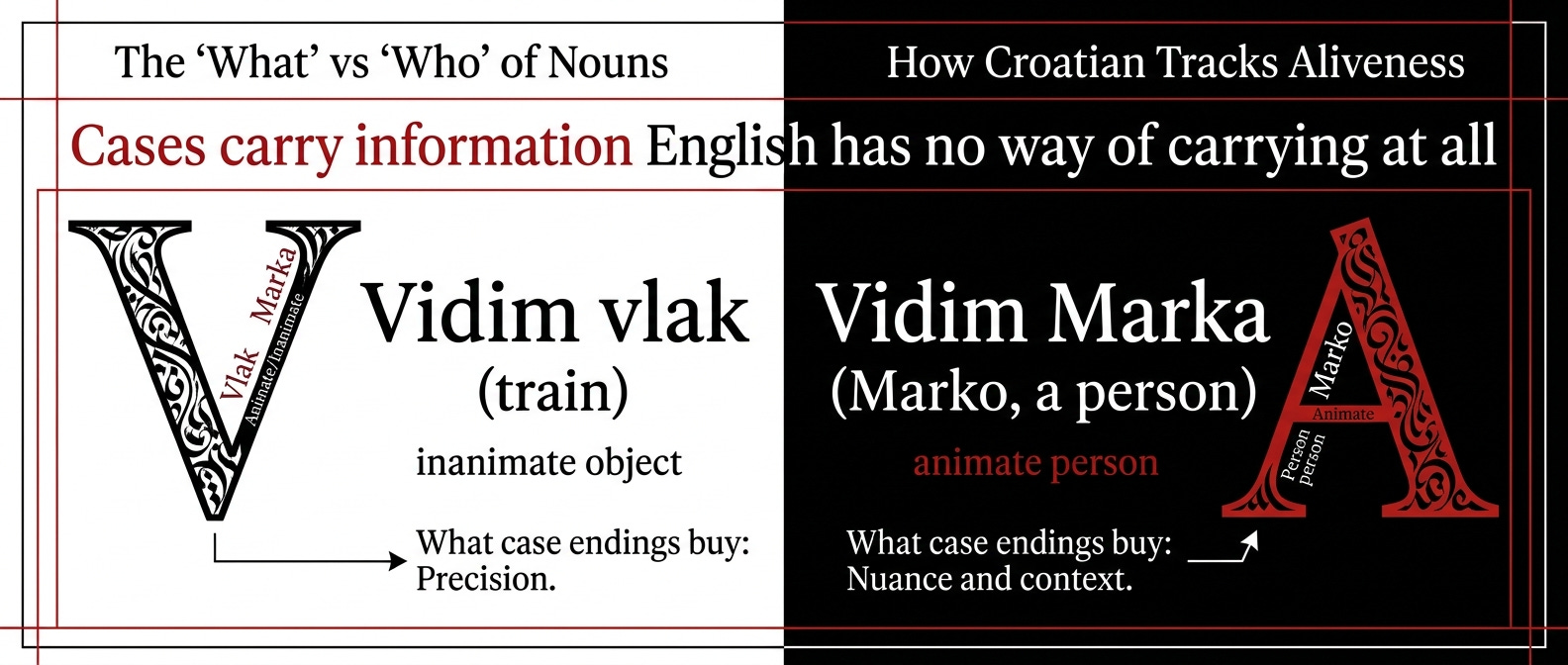
And the third thing is that cases carry information English has no way of carrying at all.
Here is my favourite example, and it is in the standard Croatian grammar, stated so plainly that most people read past it. In masculine nouns, the accusative singular of an inanimate noun looks like the nominative. The accusative singular of an animate noun looks like the genitive (Silić and Pranjković 98).
Vidim vlak. I see the train. Vidim Marka. I see Marko.
The Croatian grammar knows whether the thing you are talking about is alive.
Not the vocabulary. Not the context. The ending. Every time a masculine noun turns up as the object of a verb, the language makes you declare, in the shape of the word, whether the thing has a life. English has no equivalent and no way of building one without adding words.
Silić and Pranjković add something that I find touching in a technical way. Where two cases look identical, they insist on saying that they are identical in expression only, not in content, and they put an exclamation mark on it. The forms have collapsed. The categories have not. The grammar is quietly holding a distinction that the endings stopped marking, in the same way that English still knows the difference between the two yous it no longer has.
The instrumental, which does the most work for the least effort
If you want one case to show you what compression looks like, take the instrumental.
Nožem. With a knife. Vlakom. By train. Olovkom. In pencil. Rukom. By hand.
English needs a preposition for each of those and has to choose the right one, and the choices are not predictable, and every learner of English on earth gets them wrong. Croatian uses one ending and no preposition at all, and the ending covers the instrument, the means, the manner and the route.
That is a language doing in four letters what another language does with a small committee of prepositions.
What English actually lost, honestly
I want to be careful here, because there is a romantic version of this argument that is not true and that I will not sell you.
English did not become less expressive when it shed its endings. Anything Croatian can say, English can say. It says it with prepositions and fixed order and auxiliaries and stress, and the result is a language of enormous range which has produced, by any measure, one of the two or three greatest literatures of the world. Nobody should feel sorry for English.
What English lost is compression and freedom. It now takes more words to say the same thing, and its word order is spoken for, so emphasis has to be handled by other means.
And what it gained, and this is the honest other half, is that it became learnable. A language with no case endings is enormously easier to acquire in adulthood, which is one of several reasons it went round the world. There is a trade here and English took one side of it and Croatian took the other, and neither of them was wrong.
But you are not choosing between them. You are learning the one your family had, and it happens to be the one that kept the endings, and the endings are why it can do what you keep hearing it do.
The companion mystery
I will end the free half by naming the other thing you fear, because it belongs with this one and I will give it a letter of its own.
Bernard Comrie’s definition is the one everybody uses: aspects are different ways of viewing the internal temporal constituency of a situation (Comrie 3).
Croatian makes you choose one of those ways every single time you use a verb. Not sometimes. Every time. There is no neutral option, no way of saying a verb without also saying how you are standing in relation to the event.
Which is the same architecture as the cases, in the verb rather than the noun. This language does not let you leave things unspecified. It makes you say who did what to whom, whether the object was alive, and whether the action was a whole or a flow, and it makes you say all of it in the endings, in one breath, without slowing down.
That is not a wall between you and Croatian.
That is what Croatian is.
Why the table defeats you specifically
Start with the diagnosis, because the sequence follows from it.
The standard teaching order for the Croatian cases exists for reasons that have nothing to do with how anybody uses them. It is a school order, inherited, arranged so that the paradigm looks tidy on a page.
For a learner starting from zero, that is merely inefficient. For you, it is actively destructive, and here is why.
You arrive with chunks. Whole phrases, complete and correct, that have been in your mouth since childhood. U školi. Na moru. Nema kruha. Daj mi. Idem doma. S mamom. O tome. You do not know what any of those are, grammatically. You know them the way you know how to walk downstairs.
Every one of those is a case form.
And then you open a book, and it starts with a table, and it asks you to build the whole system from the ground up, in an order that has no relationship to the pieces you are already holding. And the experience is of being a beginner in your own language, which is not only demoralising, it is factually wrong, and it is the single commonest reason I see heritage learners give up in the first two months.
You are not building the system. You are labelling a system you already partly run.
The order I would actually teach
Here it is, and I have arrived at it by watching what unlocks speech rather than what completes a paradigm.
First, the accusative. Because it is the case of wanting and buying and loving and seeing, which is most of what a person says in a day. Because for a very large class of nouns it is identical to the dictionary form, so a great deal of it is free. And because for feminine nouns the change is a single vowel, from -a to -u, which is the cheapest grammatical rule in the language for the amount of speech it buys.
Hoću kavu. Vidim Marka. Volim more.
Second, the locative. Because it is where you already have the most chunks, because it is glued to a small set of prepositions rather than floating free, and because those prepositions are the ones you cannot avoid for a single day.
Learn it as a package with its prepositions, never separately. Not the locative and then the words that take it, but u + locative, na + locative, o + locative, as three units. U Zagrebu. Na moru. O tome.
Third, the genitive. This is the workhorse and it is where the real payoff sits. Possession, absence, quantity, the object of most prepositions, whatever follows a number above four, and the partitive.
And you already have half of it. Nema kruha is genitive. Čaša vode is genitive. Iz Zagreba is genitive. Every one of those has been in your mouth for forty years.
Fourth, the instrumental. One case, one ending, enormous coverage, and almost no prepositions to memorise. For the effort, it repays better than anything else on this list.
Fifth, the dative. And I would teach it deliberately alongside the locative rather than separately, because in the overwhelming majority of nouns the two are formally identical, and pretending otherwise makes you learn one thing twice.
And the vocative last, taught not as a case at all but as a social act. It is the case for calling somebody by name, which is a thing you do at the beginning of a relationship rather than in the middle of a sentence, and it deserves to be handled with the material on address rather than with the grammar.
The relief nobody gives you
Now the arithmetic, because the fear is arithmetical and the arithmetic is on your side.
Look at what the standard grammar actually says about a masculine inanimate noun. The accusative singular is identical to the nominative. The locative singular is identical to the dative. In the plural, the vocative is identical to the nominative, and the locative and the instrumental are identical to the dative (Silić and Pranjković 98).
Count what is left. Seven cases, two numbers, fourteen slots, and for that noun you are learning something like eight distinct forms, several of which you already produce without thinking.
The table has seven rows because the language has seven functions. It does not have seven rows because you have to memorise seven things.
This is the single most useful fact I can give you about Croatian morphology and it is sitting in plain sight in a grammar that most learners never open, because they have been given a table by somebody else and told to be frightened of it.
Harvest before you study
Here is the method that goes with the sequence, and it is the opposite of what a course would tell you.
Before you learn a case, collect the instances of it you already have.
Sit down with a piece of paper and write out every fixed phrase you have ever said in Croatian. Not sentences you could construct. Phrases that arrive whole. Greetings, requests, things your mother said, things you say to a dog.
Then sort them. You will find, and this surprises everybody, that you are holding thirty or forty case forms already, correctly inflected, in the right prepositions, with the right endings, entirely unexamined.
And then learn the pattern from your own examples rather than from the book’s. U školi, u kući, u sobi. There is the rule, in three phrases you have owned since you were six, and it will stay because it was never new.
This is why heritage learners who study in the ordinary order find it so slow and so humiliating. They are being taught, as new information, things they can already say. Reverse it, and the same person moves at a speed that startles them.
Two habits that do more than any table
Learn every preposition with its case, permanently welded. Never u on its own. Always u + locative for place and u + accusative for motion, learned as two separate words if that helps. The prepositions are a small closed set and they govern most of the case use you will ever need, and learning them properly is a weekend’s work that pays for a decade.
Learn every verb with the case it takes. In a dictionary you will see čekati koga, sjećati se čega, pomoći komu, and those little words are not decoration, they are the verb’s shape. A verb learned without its case is a verb you will guess at every time you use it.
Do those two things and a large part of the case system stops being a decision. It becomes something attached to words you already know.
And now the thing that should relax you completely
Case errors are the cheapest mistakes in Croatian.
I want to be precise about this because it runs against everything a learner feels. Put the wrong case ending on the right word, in a sentence with sensible word order, and you will be understood. Every time. The listener will register nothing, or will register a faint foreignness that they will attribute to your accent and forget within the sentence.
Compare that with the mistakes that actually cost you. A calque from English, where every word is Croatian and the sentence means nothing here. A word you do not have, so the sentence stops. A pronoun that tells your aunt she is a stranger to you.
Those block communication or damage relationships. A wrong genitive does neither.
And yet the case table is the thing that stops people learning, and the calques are the thing nobody works on, which is exactly the wrong way round, and it is the wrong way round because a table looks like an exam and a calque does not.
If I could redistribute the anxiety of every heritage learner I have taught, I would take about eighty per cent of the fear currently attached to the cases and move it to vocabulary, and everybody would be speaking within a year.
One last thing
I want to go back to the stone.
What English had in stān, stānes, stāne was not only a set of endings. It was a way of building a sentence, in which the words carry their own jobs with them and can therefore stand wherever the speaker wants them. English gave this up, and the people who speak it today do not even know it was ever there.
You do not need to know it either, in the sense of knowing it from a book. You have been hearing it since before you could read, and that recognition will not come from a table.
It will come the first time you hear somebody put a word at the front of a sentence for emphasis and you feel the emphasis rather than parsing it. That is the moment the cases stop being seven columns and start being what they are, which is the thing that lets this language move a word without breaking it.
English cannot do that any more. It gave it up, for good reasons, a long time ago, and it has done very well without it.
Your family kept it.
Tihana Klepačis an Associate Professorin the Department of English at the Faculty of Humanities and Social Sciences, University of Zagreb, with about twenty years of teaching experience. She is the founder of TalkTime Croatian, where she teaches Croatian to heritage speakers and diaspora learners through grammar, vocabulary, pronunciation and culture.
She writes the free weekly Saturday Letter from Zagreb and hosts the slow-Croatian podcast Ćakula Café and a youtube channel Talk Time: Learn Croatian With a Cultural Twist.
Works Cited
Comrie, Bernard. Aspect: An Introduction to the Study of Verbal Aspect and Related Problems. Cambridge UP, 1976.
Kupisch, Tanja, and Jason Rothman. “Terminology Matters! Why Difference Is Not Incompleteness and How Early Child Bilinguals Are Heritage Speakers.” International Journal of Bilingualism, vol. 22, no. 5, 2018, pp. 564–82.
Silić, Josip, and Ivo Pranjković. Gramatika hrvatskoga jezika za gimnazije i visoka učilišta. Školska knjiga, 2005.
Keep learning Croatian with Tihana
Start here, free
Learn Croatian: Where to Start— How I teach, and which programme to start with.
The Free Masterclass— An introduction to the 4-Pillar Method and the logic of Croatian grammar.
The Konoba Test— A short quiz on where you are actually standing in Croatian.
Saturday Letter from Zagreb— A weekly essay on language, culture and belonging, free in your inbox.
Listen and watch
Ćakula Café podcast, on Spotify— Slow Croatian for heritage speakers and diaspora adults at A2–B1.
Ćakula Café, on Apple Podcasts— The same podcast, for listeners on iPhone and Mac.
Ćakula Café, on Castbox— The same podcast, for listeners who prefer Castbox.
TALK TIME on YouTube— Free Croatian lessons and films, with cultural context.
Podcast episodes on Substack— Audio companions to the Saturday Letters.
Courses and books
Croatian Entry Point— A1 self-study: eight weeks of culture-driven lessons, lifetime access.
The Croatian Quadrant™— A1–A2 flagship live programme, one cohort a year; join the waitlist.
Level Up Croatian— A2 self-study: daily fifteen-minute lessons in weekly themes.
Short Stories in Croatian— Ebook for A2–B1: nine original stories with audio, glossary and grammar notes.
Croatian Nexus— Post-A2 live seminars: where the language becomes literature.
More Saturday Letters
The Silence Between Generations— What is lost when a language is not passed on, and what can still be recovered.
Coming Home in a Language You Half Remember— The returnee's wall at the counter, and why the language is closer than you think.
Inat— The word your grandfather lived by, and where it came from.
The Word That Will Not Cross— Why čežnja is not longing and fjaka is not laziness.
Does Croatian Make You Think Differently?— What is real, and what is beautiful nonsense, in the idea that a language shapes a mind.
The Kitchen Was a Language Policy— Why Croatian was, or was not, passed down to you.
What English Does to Your Croatian While You Sleep— Why your grandmother's Croatian did not stay frozen the day she left.
Why You Feel Like a Different Person in Croatian— Why volim te weighs more than I love you.
You Are Not a Tourist in Your Own Language— The emotional case for coming home one register at a time.
The Konoba Test: Where Are You Actually Standing?— Why "what level is my Croatian" is the wrong question.
The Small Words That Give You Away— Why flawless Croatian can still mark you as a stranger: pa, ma, daj and the third rakija.
The Country Inside the Word Kaj— How the old language of the north became a place you carry.
Slavonia: The Gateway Dialect— The oldest Croatian štokavian is hiding in the east.
Who Gets to Tell the Story— Postcolonial theory, a nineteenth-century pamphlet and your grandmother's Croatian.
Tihana as a scholar: interviews in Croatian
Tribina „Čitanje kazališta“ before the premiere of Svjetlo pada (Zagreb Youth Theatre)— Tihana on British drama, in Croatian, at Zagrebačko kazalište mladih.
Tko se boji Virginie Woolf? (mi)— Tihana on Virginia Woolf, in Croatian, with Bookaravision.
Roald Dahl, autor scenarija za Hitchcocka a da to niste znali— Tihana on Roald Dahl, in Croatian, with Bookaravision.
Press and reviews
Behind the Language: Talk Time Croatian— Interview with Tihana Klepač by Rebecca Wicker, The Strategic Linguist, July 2026.
Student reviews on Google— What learners say about studying with Tihana.
Follow
- Custom HTML/CSS/JavaScript