I Understand Croatian but Can’t Speak It. Here’s Why.
The sentence I hear most often from students arrives in many versions, but underneath it is always the same. I understand everything. I just can’t say anything. Someone in Toronto, in Stuttgart, in a small town in Ohio, listens to an aunt on the phone, follows the jokes at a wedding, knows exactly when the conversation has turned to them. And then a question comes, a simple one, a kako si ti?, and what comes out of the mouth is English. Or nothing.
If this is you, the first thing I want to say is that you are not broken, and you are not lazy, and your memory is fine. What you are describing is one of the best documented patterns in the study of heritage languages. Linguists who work with heritage speakers, Maria Polinsky and Silvina Montrul among the best known, describe again and again the same profile: comprehension that is strong, sometimes near native, and production that lags far behind it. You are not an exception. You are the rule.
But it helps to understand why, because once you see the mechanism, the gap stops feeling like a personal failure and starts looking like what it is, a very particular kind of unfinished work.
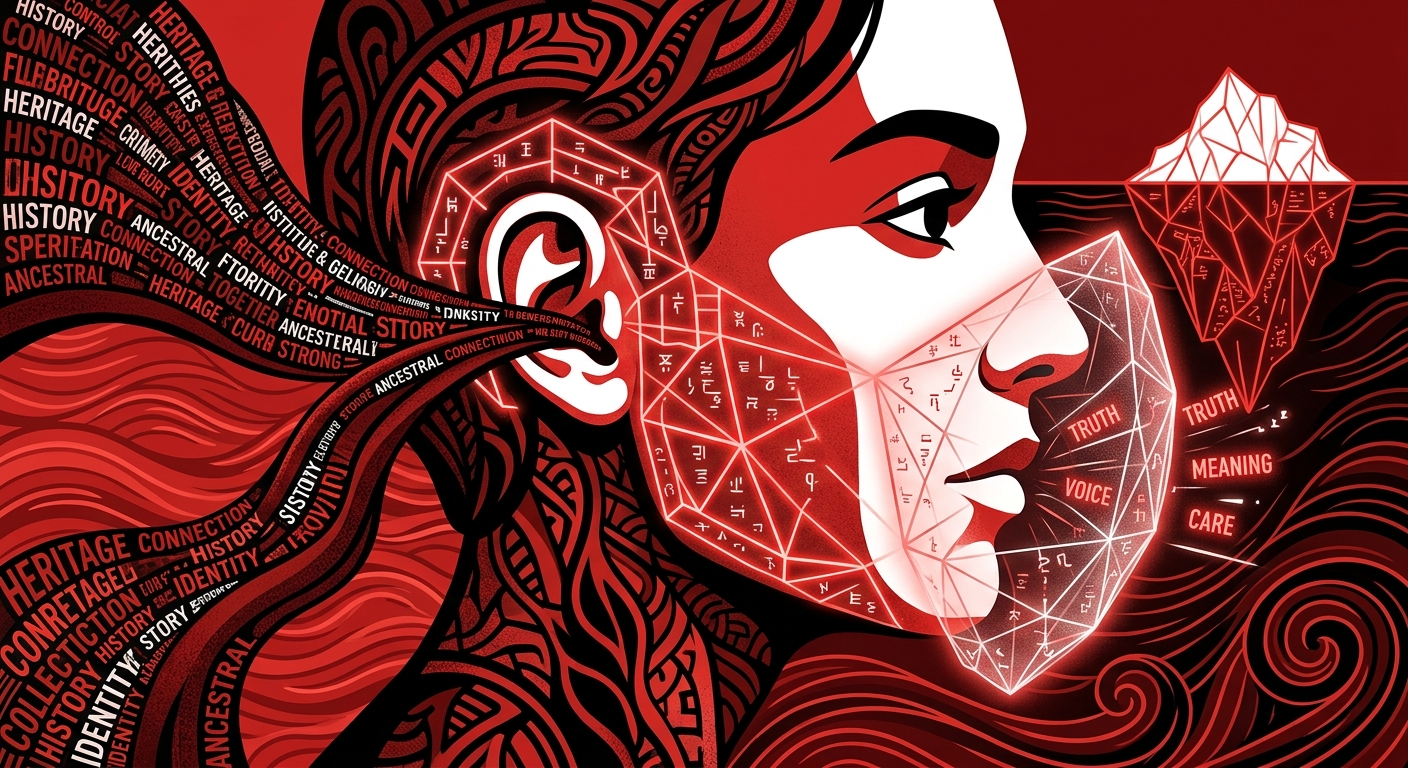
Understanding and speaking are not the same skill run in two directions. When you listen, the sentence comes to you already built. Somebody else chose the words, put the nouns into the right case, decided on the verb. Your brain only has to recognise, and recognition is generous. It forgives. It fills gaps from context, from tone of voice, from the face of the person speaking. You can understand nisam ga vidjela od Božića without ever once having to decide, alone and in real time, that ga must come second, that od asks for the genitive, so Božić becomes Božića, that the ending must be feminine because you are a woman.
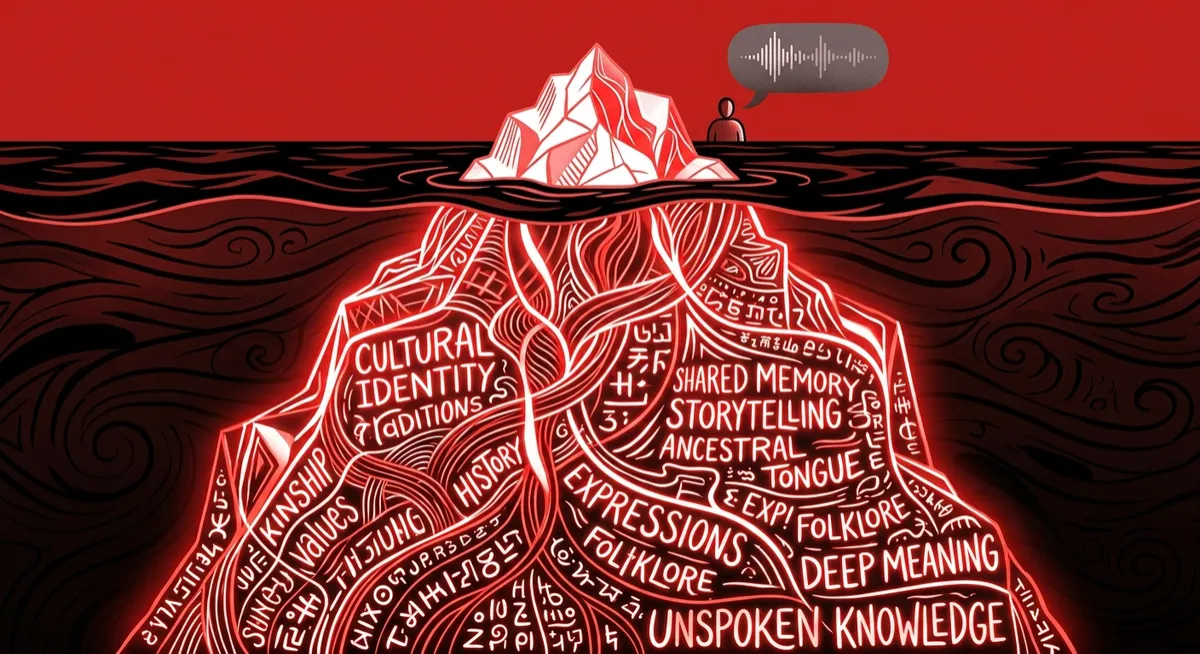
When you speak, all of these decisions are yours, and they come at once, under the pressure of a person waiting. Croatian asks a great deal at that moment. Seven cases, three genders, aspect on almost every verb, and small clitic words that must stand in exactly the right place. A child growing up in Croatia makes these choices tens of thousands of times before school. A child growing up in a Croatian family abroad often made them far fewer times, because at some point, usually around school age, the answering started to happen in English. The listening continued. The speaking stopped. And so the two systems grew unevenly, one fed every day, the other left without food.
There is a second thing, less often said. What you understand, you understand in a place. Your Croatian lives in the kitchen, at the table on Sunday, in the voice of a grandmother, in the words for food and family and reproach. In cognitive linguistics we would say that language is stored not as a list of words with rules attached, but as patterns tied to the situations in which we met them. This is why you may find you can say jesi jeo? without thinking, and then go completely silent when you need to describe your job. The Croatian is there. It is simply living in rooms you have not yet visited with it.
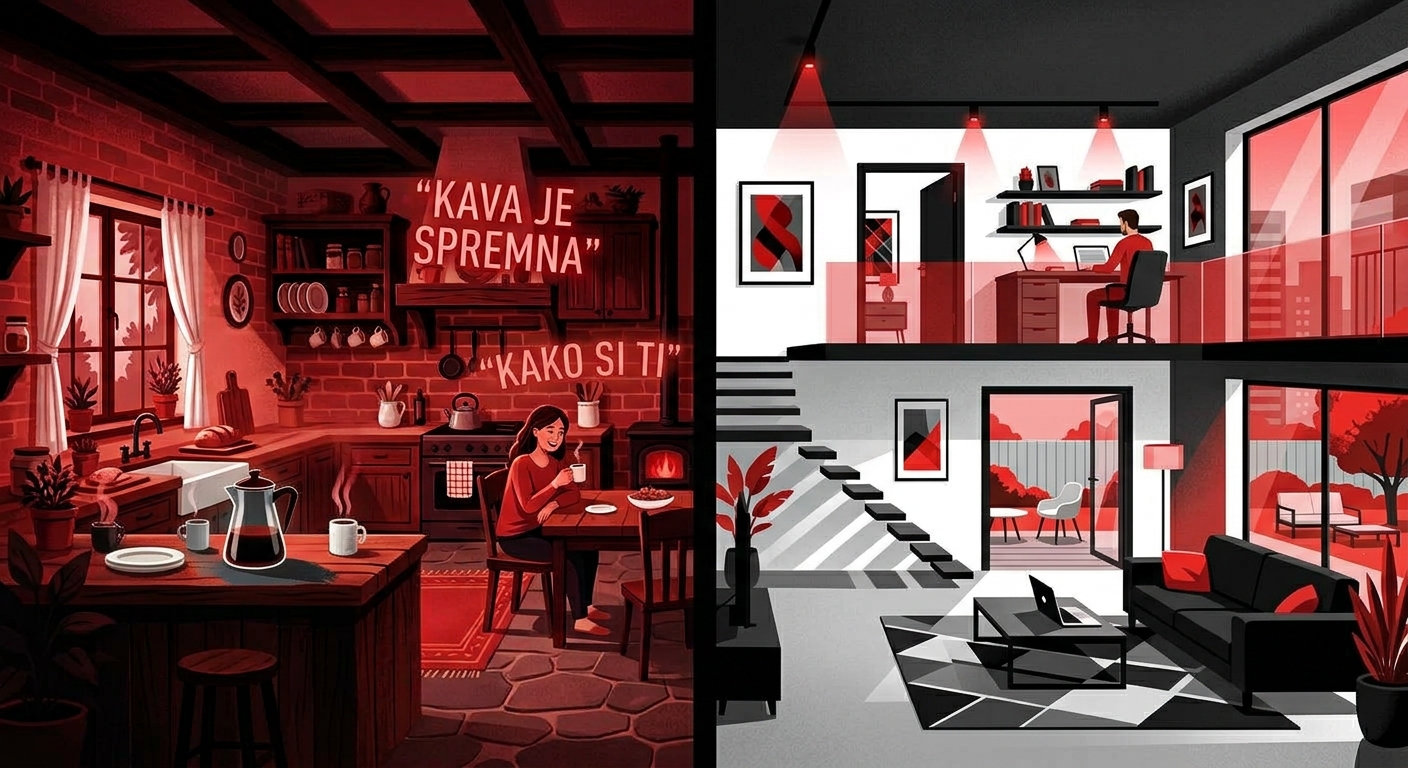
I know this from my own life, too, though from the other side. I grew up in Opatija between Čakavian and the Zagreb speech of my parents, moving between the two every day. Each one had its own rooms, its own people, its own things that could be said easily in it and things that could not. Every speaker has this. For a heritage speaker the difference is only that the rooms of Croatian are few, and the door to most of them was closed early.
So what do you actually do?
You do not start from zero, and you must not let anyone put you there. A beginner’s course that teaches you ovo je stol will bore you and, worse, it will confirm the quiet belief that you know nothing, which is false. What you need is the opposite movement: to begin from what you already understand and to make it yours to produce. This means speaking from the first lesson, and speaking about the things you already have, your family, your memories, the food, the visits, before anything else. It means meeting grammar not as a wall you must climb before you are allowed to talk, but as the explanation of things you have heard all your life, so that a, to je zato rekla baka becomes a small private discovery each week. And it means building, slowly, new rooms for your Croatian: work, opinions, the news, the conversations an adult wants to have.
And it means being patient with the shame, because there usually is shame, even if nobody names it. Answering in English is not shyness. It is protection. It takes time, and a room where mistakes are expected rather than noticed, before the protection can be put down.
This gap between understanding and speaking is exactly what my free masterclass, Why Croatian Feels Impossible, is about. I explain there in more detail why it happens, and why it is not your fault, and what the way out looks like for an adult. If you recognised yourself in this text, that is the best place to begin.
And if you would like to see how I teach and where you would fit, start here: Learn Croatian Online: If You Want to Learn With Me, Start Here.
Keep learning Croatian with Tihana
Listen and watch
Ćakula Café podcast, on Spotify — Slow Croatian for heritage speakers and diaspora adults at A2–B1.
Ćakula Café, on Apple Podcasts — The same podcast, for listeners on iPhone and Mac.
Ćakula Café, on Castbox — The same podcast, for listeners who prefer Castbox.
TALK TIME on YouTube — Free Croatian lessons and films, with cultural context.
Podcast episodes on Substack — Audio companions to the Saturday Letters.
Start here, free
Learn Croatian: Where to Start — A beginner’s orientation for adults learning Croatian.
The Free Masterclass — An introduction to the 4-Pillar Method and the logic of Croatian grammar.
The Konoba Test — A short quiz on where you are actually standing in Croatian.
Saturday Letter from Zagreb — A weekly essay on language, culture and belonging, free in your inbox.
Courses and books
Croatian Entry Point — A1 self-study: eight weeks of culture-driven lessons, lifetime access.
The Croatian Quadrant™ — A1–A2 flagship live programme, one cohort a year; join the waitlist.
Level Up Croatian — A2 self-study: daily fifteen-minute lessons in weekly themes.
Short Stories in Croatian — Ebook for A2–B1: nine original stories with audio, glossary and grammar notes.
Croatian Nexus — Post-A2 live seminars: where the language becomes literature.
More Saturday Letters
The Silence Between Generations — What is lost when a language is not passed on, and what can still be recovered.
Coming Home in a Language You Half Remember — The returnee’s wall at the counter, and why the language is closer than you think.
Inat — The word your grandfather lived by, and where it came from.
The Word That Will Not Cross — Why čežnja is not longing and fjaka is not laziness.
Does Croatian Make You Think Differently? — What is real, and what is beautiful nonsense, in the idea that a language shapes a mind.
The Kitchen Was a Language Policy — Why Croatian was, or was not, passed down to you.
What English Does to Your Croatian While You Sleep — Why your grandmother’s Croatian did not stay frozen the day she left.
Why You Feel Like a Different Person in Croatian — Why volim te weighs more than I love you.
You Are Not a Tourist in Your Own Language — The emotional case for coming home one register at a time.
The Konoba Test: Where Are You Actually Standing? — Why “what level is my Croatian” is the wrong question.
The Small Words That Give You Away — Why flawless Croatian can still mark you as a stranger: pa, ma, daj and the third rakija.
The Country Inside the Word Kaj — How the old language of the north became a place you carry.
Slavonia: The Gateway Dialect — The oldest Croatian štokavian is hiding in the east.
Who Gets to Tell the Story — Postcolonial theory, a nineteenth-century pamphlet and your grandmother’s Croatian.
Follow