How Much Croatian Do You Actually Have? A Level Cannot Tell You
Your phone rings, and the number is one you do not know. Somewhere between the second ring and the third you have already decided what kind of speaker you are today. Some days you answer. Other days you let it go, and tell yourself you will call back later, in English, when there is time.
Now take the same afternoon a few hours on, at your aunt's table, where three people are talking over each other and a fourth is arguing with the radio. You catch a word in five, a name, a place, a curse, and you build the rest out of faces and hands and the tone of the room. You are guessing, and you are better at it than you think.
Same person, same Croatian. And if I asked you for your level, you would give me one word, and that word would be wrong for at least one of those two rooms.
I have been sitting with this for a long time, because of what my students tell me, which is never a boast. They gather what is going on from the words they know, and the rest is guessing from context, and that guessing is the best they get. Then they ask me what level that is, apologetically, as though the missing word were a gap in their character. I do not think it is. I think the question has been asked in the wrong shape.
https://talktimecro.com/konoba-test
What a level cannot see
A level is a single number laid over something that is not a single thing. This is not a new observation. In 1980 Michael Canale and Merrill Swain proposed that communicative competence is made of several distinct parts: grammatical competence, sociolinguistic competence and strategic competence (Canale and Swain). Knowing the case endings is one part. Knowing which register a clerk at a municipal office expects is another. Knowing how to keep a conversation alive when you have lost half of it is a third. A person can be strong in one and thin in another, and a single level has to average them into something that describes nobody.
For heritage speakers the averaging does particular damage, because the unevenness is not random. It has a direction.
Silvina Montrul reports a pattern across several studies of heritage and second language learners. In Bowles's comparison, heritage learners beat second language learners on every implicit oral measure, 78.8 against 46.7 on oral imitation and 95.9 against 47.9 on oral narration, and lost only on the metalinguistic test, 57.4 against 72.4 (Montrul 282). Elsewhere she records that heritage speakers "showed exactly the opposite pattern" to second language learners on gender, with higher accuracy in oral production than in written tasks (Montrul 280).
Read those numbers as a description of a house. Somebody who grew up with Croatian at the edges of their life has often been given the back rooms, the kitchen and the hallway and the table, and was never shown the front of the house, where the language turns formal and the people behind the desk do not know your grandmother. A classroom ladder starts at the front door. It meets you in the one place you were never taken, and reports back that you are low.
Maria Polinsky describes what happens to such a person from the other side. Teachers, she writes, "often hold contradictory expectations of heritage speakers," expecting that they "should already know everything" and, at the same time, believing "the stereotype that heritage speakers do everything wrong, speak 'corrupted' language" (74-75). Both expectations arrive at the same person, sometimes within the same hour. No wonder people stop trusting their own sense of where they stand.
Six rooms instead of one number
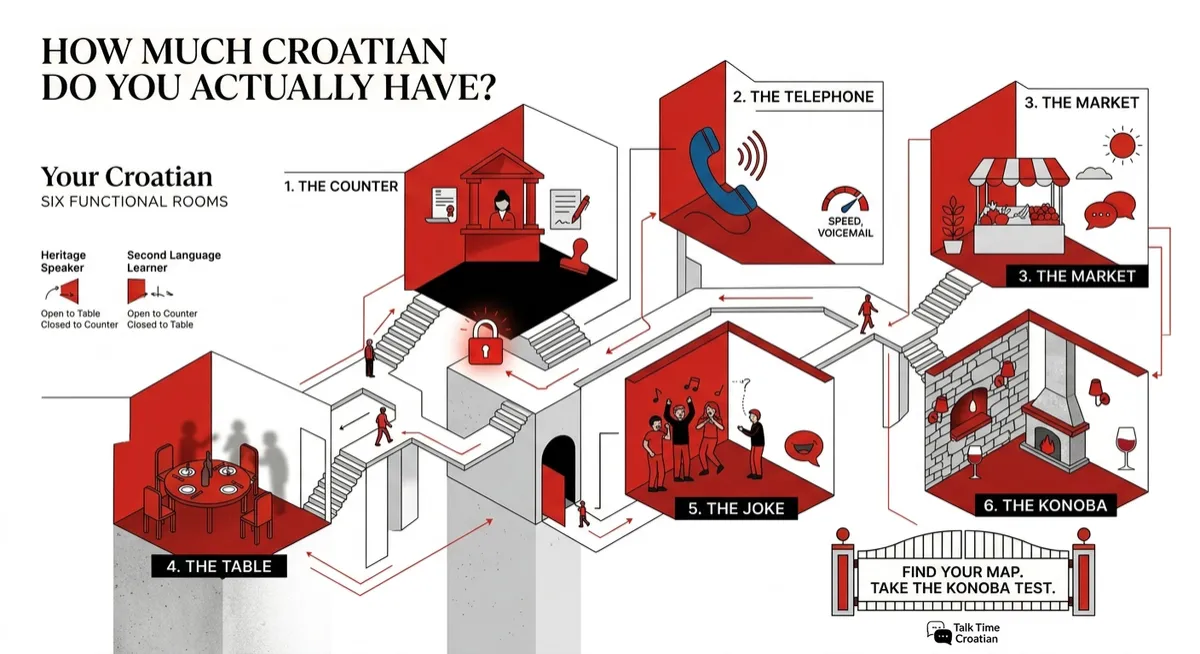
So I stopped asking what level are you and began asking which rooms can you walk into. There are six that I keep returning to, because they are the six where, in my experience, the language gets tested for real.
The first is the counter. The bank, the matični ured, the clerk who goes off the script you rehearsed. Nobody at Sunday lunch ever spoke to you like this, and this is exactly why it frightens even people who have heard Croatian all their lives.
The second is the telephone. An unknown number, a landlord, the boiler. No lips to read, nothing to point at, and the speed is never yours.
The third is the market. The woman with the tomatoes tells you the weather is a scandal and the government worse, and she is not selling anything just then, she is offering you company. Whether you can give a little lament back is a different skill from whether you can buy tomatoes.
The fourth is the table, with three people talking at once and the dialect thick. The fifth is the joke, the one made for Croatians and not for learners, where the room laughs and you are a beat behind, or not behind at all. The sixth I named after the place where it usually happens, the konoba, because somewhere around the second glass someone finally teases you, and in Croatia that is how you learn you are no longer a guest. Nobody mocks a guest.
Each of these rooms is open, half open, or goes quiet, and the pattern across all six tells you far more than a letter and a number ever will. It also tells you something kinder. Some people who call themselves beginners turn out to have a few rooms open, usually the ones nearest home, and the front locked, which makes them a speaker with a wing missing and not a person at the beginning, and a very different person to teach.
The shapes people turn out to have
Set the six rooms side by side and a handful of shapes keep returning. I gave them names, because a thing you can name is a thing you can stop being ashamed of.
There is the Inverted Map, at ease at the table and mute at the counter, which is the one the research above would lead you to expect. There is the Receptive Giant, who takes in far more than they say, and whose trouble is that speaking is a separate skill, learned separately, and the giant has simply never been asked to walk. There is the Classroom Climber, who came up the textbook way and did it well, whose cases are clean and whose counter holds, and who goes quiet only where the real-time work of making meaning with another person begins. There is the Sunday-Croatian Plateau, wide in the room of food words and endearments and blank in the rest, a language that was never asked to leave the house. And there is the Even Intermediate, competent and slightly effortful everywhere, none of the doors slammed and none of them wide.
Some people, and I want to say this plainly, are at the beginning. The map says so without ceremony, and then it points to the two doors, the counter and the telephone, that open with a small number of fixed phrases said often enough that they stop being a performance.
One door, not six
What changes once you can see your map is the size of the task. Before, the work is enormous and vague: improve my Croatian. After, it is small and obvious: this one door, this one thing, for ninety days.
One door, not six. I have come to think this is why so many people stay where they are for twenty years. They try to move everything at once, so nothing moves.
What the one thing is depends on the gap. For some people it is register, and the task is to read formal Croatian aloud for ten minutes a day until the written language lives in the mouth. For the Receptive Giant it is production: thirty seconds of Croatian audio, then say aloud, in your own words, what it was about, to nobody, recorded, and let it be bad. For the person whose doors all open it is depth, one long conversation a week with people who will not slow down for you, until disagreement and teasing and interruption cost you nothing.
What the test is, and what it is not
I turned all of this into a short test, and I called it the Konoba Test. It is eight questions, about three minutes, and you answer as you are today, not as you wish to be. It is not a grammar test and will not ask you to conjugate anything. It does not give you a level, because the whole argument above is that a level has never told anyone anything they could use.
I should be exact about what it is. It is a teaching map, built from what I see in my own students and from the research I have cited here. It is not a validated psychometric instrument, and I would not want it used as one. It is a way of putting words to something you probably already suspect.
It will ask for your first name and your email, because the map is sent to you by email so that you can keep it. At the end the map points to a next step. Sometimes that step is one of my programmes, and sometimes the honest answer is a habit and not a course. You will see which.
If you take it, tell me what you find. I would like to know which door it named for you, and whether it surprised you.
Tihana Klepač is an Associate Professor at the University of Zagreb's Department of English and the founder of TalkTime Croatian. She teaches the Croatian Quadrant™, a structured, culturally immersive course designed to help learners stop translating and start thinking in Croatian. Find out more at https://talktimecro.com.
Works Cited
Canale, Michael, and Merrill Swain. "Theoretical Bases of Communicative Approaches to Second Language Teaching and Testing." Applied Linguistics, vol. 1, no. 1, 1980, pp. 1-47.
Montrul, Silvina. The Acquisition of Heritage Languages. Cambridge UP, 2016.
Polinsky, Maria. Heritage Languages and Their Speakers. Cambridge UP, 2018. Cambridge Studies in Linguistics 159.