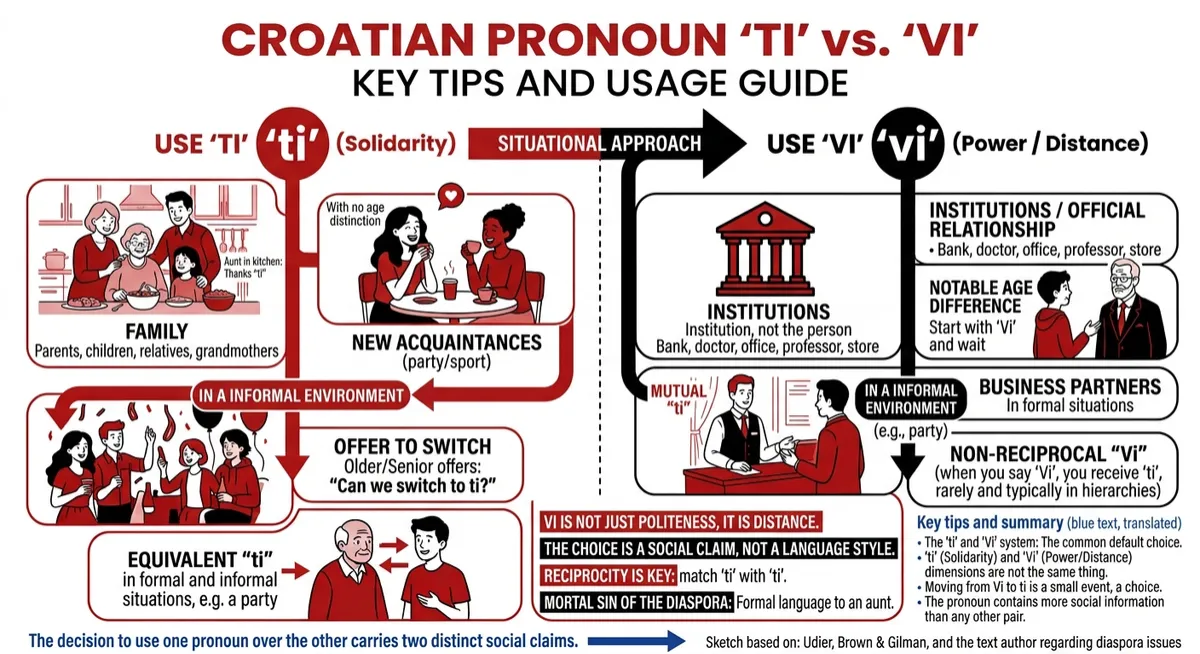
Ti or Vi?
A man I taught some years ago flew from Chicago to meet his father's family for the first time.
He had prepared. He had done a year of evening classes and he had drilled the polite forms, because he wanted, above everything, not to be the American who came over and was rude. And on the first afternoon, in a kitchen in Slavonia, his father's sister put a plate in front of him and he thanked her.
Hvala Vam.
And he watched her face do something he could not read and did not forget.
He told me about it three years later, and he was still wincing. He had used the formal form. To his own aunt. In her own kitchen. And he had done it out of respect, which is precisely what made it worse, because what she heard was not politeness.
What she heard was: I do not consider myself one of you.
I want to spend this letter on the two smallest words in Croatian, because they carry more social information than any other pair in the language, because they are the single most common place I see diaspora speakers fall through, and because the mistake almost all of you are primed to make is the one that looks like good manners.
Why English speakers get this exactly backwards
English has one you. It has had one you for so long that most speakers do not experience this as a loss.
But English still has to do the work that a second pronoun does elsewhere, and it does it lexically. Politeness in English lives in words and constructions: would you mind, could I possibly, sorry to bother you. Which means that in English, politeness is a dial. You can turn it up as far as you like, and turning it up further is never wrong, only occasionally comic.
So an English speaker learning a T and V language arrives with a rule already installed. When in doubt, be more formal. Formality is safe. Formality is the setting you cannot be criticised for.
And in Croatian that rule is wrong in a way that has no equivalent in English, because the Croatian pronoun is not a politeness dial at all.
It is a claim about the relationship.
Vi does not mean I am being polite to you. It means you and I are not close.
And when you say that to somebody who has just decided you are family, you have not been excessively courteous. You have contradicted them.
The two dimensions underneath
The foundational account of all this is now sixty-five years old and has never been improved on. Roger Brown and Albert Gilman looked across the European languages and found that the pronouns of address encode two dimensions, and that those two dimensions are not the same thing (Brown and Gilman).
The first is power, and it is asymmetrical.If A is older than B, B is not older than A. If A employs B, B does not employ A. And the pronoun usage that expresses this relation is asymmetrical too, non-reciprocal, with the greater receiving V and the lesser receiving T. Historically that was the whole system: the servant said V, the master said T, and nobody thought about it.
Brown and Gilman make one observation about this that I have never forgotten. The individual's first experience of subordination to power and of the reverential V, they write, comes in his relation to his parents. In a person's own history, the recipients of the non-reciprocal V are parent figures.
The second dimension is solidarity, and it is symmetrical.The relations that produce it are the ones that run both ways: same family, same school, same profession, same town. And the norms of address that express it are reciprocal, with V, in their formulation, becoming more probable as solidarity declines.
So one dimension is about who is above whom, and the other is about how close you are, and both of them are riding on the same two words.
Which is why the choice feels so heavy. You are not selecting a register. You are making two social claims at once, in the first second of a conversation, in a system where you have no experience of being wrong.
And why nobody can just tell you the rule
Here is where I want to bring in Croatian scholarship, because the most useful thing I know about this problem was found by a colleague and it will make you feel considerably better.
Sanda Lucija Udier studied how pragmatic competence develops in learners of Croatian, and she took forms of address as her prototypical case, precisely because they are the thing everybody thinks is simple. She surveyed twenty-seven university lecturers of Croatian. Native speakers. Professionals. People who teach this for a living.
Every one of them wrote down the same general rule: ti for informal communication, Vi for formal.
And then, in Udier's words, they simultaneously displayed different practices and attitudes (Udier 168). Their answers show, she writes, that a usage which appears universally accepted and simple has a great many different realisations (169).
Read that again.Twenty-seven professional teachers of the language agreed on the rule and disagreed on the practice, and each of them had been going about their life assuming that what they personally did was the rule.
That is why no textbook has taught you this. Not because textbook writers are lazy, but because the thing you want written down is not a rule, it is a set of overlapping local practices which native speakers run by feel and have never had to articulate.
Udier makes a second point: speaking of learners with very strong Croatian, she notes that high linguistic competence does not mean pragmatic competence is equally developed (178).You can have a large vocabulary, correct cases, good aspect, and no idea what to call your aunt.
And a third, which is about you specifically. Heritage speakers, she writes, have most often used Croatian only within their family and their emigrant community outside Croatia, and frequently command only a non-standard variety (176).
Sit with what that means for the pronouns. The ti and Vi system you have is the one that operated inside one household, in one city, among a fixed set of people, all of whom had settled the question about each other decades before you were born. You have never run the system against a stranger. Against a clerk. Against a professor, a priest, a doctor, a neighbour of your mother's, a woman twelve years older than you at a wedding.
You do not have a broken system. You have a complete system with an extremely small population in it.
What actually governs it here
So let me tell you what I think Croatians are actually doing, with the caveat that Udier's twenty-seven lecturers would each amend this in their own direction.
Setting is doing more work than the person.An institution, any institution, defaults to Vi: the bank, the surgery, the office, the school, the town hall. That default holds even when the person opposite is visibly younger than you. It is the room speaking, not the person.
A generation of age gap defaults to Vi, and the gap that counts is the perceived one.If somebody could plausibly be your parent, you start with Vi and wait.
Reciprocity is the tell, and it is the single most useful thing on this page.Listen to what they call you. Croatians in ordinary interactions are overwhelmingly symmetrical, soif a stranger of similar age says ti to you, you say ti back, immediately, without deliberating. The asymmetrical version, where one person gives ti and receives Vi, still exists between adults and children and in a few old professional hierarchies, andwhen it appears between two adults it is a statement, and usually not a friendly one.
And family is ti.Almost without exception, in living usage, across the whole country, in both directions, including to a grandmother you have never met, including to an uncle who is eighty. This is the place where the English instinct actively damages you, and it is the place where the damage is not recoverable in the moment, because the person has just been told they are a stranger to you.
There were households, a century ago, where children said Vi to their parents. Some of your great-grandparents may have done it. It is gone, and in the mouth of a returning grandchild it does not read as archaic charm. It reads as distance.
The choreography of the switch
One more piece and then I will stop, because this is the part that has no equivalent in English at all and therefore no instinct attached.
Moving from Vi to ti is an event. It is not a drift.
Somebody proposes it, usually out loud, sometimes with a glass in hand, and there is a small moment of ceremony however casually it is done. Možemo na ti.We can go to ti.
And the proposing is not free. The older person offers it to the younger. The senior offers it to the junior. The woman, in most of the country and most of the time, offers it to the man. Offering upward is a claim, and while nobody will be cruel to you about it, everybody will notice.
Which gives you, if you are a diaspora Croatian in your forties meeting your mother's cousins, a genuinely awkward geometry. You are an adult, which points one way. You are the child of the family, which points another. You are a guest, which points a third. And you are the one at the table who does not know the rules, which is the only one of the four that the others can see.
Which is why so many of you go quiet
And here is the human cost, which is the actual reason for this letter.
I have watched a great many people solve this problem by not speaking.
The calculation runs quickly and invisibly. The pronoun is the second word out of my mouth. I cannot get to the second word without deciding. I do not know how to decide.Therefore I will let somebody else start the sentence, and I will smile, and I will answer in short phrases where the verb does not commit me.
And the person opposite, who knows nothing about any of this, experiences a relative from abroad who is pleasant and reserved and does not say much.
Which is precisely the coldness the whole strategy was designed to avoid.
The man from Chicago and his aunt are the same story from the other side. He reached for the form that felt respectful, and it landed as distance. Then, for two days afterwards, he barely spoke, because he was frightened of doing it again. And what she remembers is not theHvala Vam.
What she remembers is that her brother's son came all the way from America and was quiet in her kitchen.
There is a repair for both halves of that, and it is not complicated, and it is where I am going to spend the rest of this letter.
Want to practise this with me?
If you would like to practise how to address people in Croatian, I teach it inside Croatian Nexus (post-A2 live seminars), and in short daily lessons in Level Up Croatian. If you are not sure where you stand, start with the free masterclass or the Konoba Test.
Works Cited
Brown, Penelope, and Stephen C. Levinson.Politeness: Some Universals in Language Usage. Cambridge UP, 1987.
Brown, Roger, and Albert Gilman. "The Pronouns of Power and Solidarity."Style in Language, edited by Thomas A. Sebeok, MIT Press, 1960, pp. 253–76.
Kuna, Branko. "Morfosintaksa i pragmatika hrvatske imenske formule ženskih osoba."Fluminensia, vol. 26, no. 2, 2014, pp. 71–90.
Udier, Sanda Lucija. "Razvijanje pragmatičke kompetencije u hrvatskome kao inome jeziku."Lahor, vol. 19, no. 1, 2018, pp. 159–83.
This letter was originally published in Saturday Letter from Zagreb, my newsletter for Croatian heritage speakers and diaspora learners.
Tihana Klepačis an Associate Professorin the Department of English at the Faculty of Humanities and Social Sciences, University of Zagreb, with about twenty years of teaching experience. She is the founder of TalkTime Croatian, where she teaches Croatian to heritage speakers and diaspora learners through grammar, vocabulary, pronunciation and culture.
She writes the free weekly Saturday Letter from Zagreb and hosts the slow-Croatian podcast Ćakula Café and a youtube channel Talk Time: Learn Croatian With a Cultural Twist.
Keep learning Croatian with Tihana
Start here, free
Learn Croatian: Where to Start— A beginner's orientation for adults learning Croatian.
The Free Masterclass— An introduction to the 4-Pillar Method and the logic of Croatian grammar.
The Konoba Test— A short quiz on where you are actually standing in Croatian.
Saturday Letter from Zagreb— A weekly essay on language, culture and belonging, free in your inbox.
Listen and watch
Ćakula Café podcast, on Spotify— Slow Croatian for heritage speakers and diaspora adults at A2–B1.
Ćakula Café, on Apple Podcasts— The same podcast, for listeners on iPhone and Mac.
Ćakula Café, on Castbox— The same podcast, for listeners who prefer Castbox.
TALK TIME on YouTube— Free Croatian lessons and films, with cultural context.
Podcast episodes on Substack— Audio companions to the Saturday Letters.
Courses and books
Croatian Entry Point— A1 self-study: eight weeks of culture-driven lessons, lifetime access.
The Croatian Quadrant™— A1–A2 flagship live programme, one cohort a year; join the waitlist.
Level Up Croatian— A2 self-study: daily fifteen-minute lessons in weekly themes.
Short Stories in Croatian— Ebook for A2–B1: nine original stories with audio, glossary and grammar notes.
Croatian Nexus— Post-A2 live seminars: where the language becomes literature.
More Saturday Letters
The Silence Between Generations— What is lost when a language is not passed on, and what can still be recovered.
Coming Home in a Language You Half Remember— The returnee's wall at the counter, and why the language is closer than you think.
Inat— The word your grandfather lived by, and where it came from.
The Word That Will Not Cross— Why čežnja is not longing and fjaka is not laziness.
Does Croatian Make You Think Differently?— What is real, and what is beautiful nonsense, in the idea that a language shapes a mind.
The Kitchen Was a Language Policy— Why Croatian was, or was not, passed down to you.
What English Does to Your Croatian While You Sleep— Why your grandmother's Croatian did not stay frozen the day she left.
Why You Feel Like a Different Person in Croatian— Why volim te weighs more than I love you.
You Are Not a Tourist in Your Own Language— The emotional case for coming home one register at a time.
The Konoba Test: Where Are You Actually Standing?— Why "what level is my Croatian" is the wrong question.
The Small Words That Give You Away— Why flawless Croatian can still mark you as a stranger: pa, ma, daj and the third rakija.
The Country Inside the Word Kaj— How the old language of the north became a place you carry.
Slavonia: The Gateway Dialect— The oldest Croatian štokavian is hiding in the east.
Who Gets to Tell the Story— Postcolonial theory, a nineteenth-century pamphlet and your grandmother's Croatian.
Tihana as a scholar: interviews in Croatian
Tribina „Čitanje kazališta“ before the premiere of Svjetlo pada (Zagreb Youth Theatre)— Tihana on British drama, in Croatian, at Zagrebačko kazalište mladih.
Tko se boji Virginie Woolf? (mi)— Tihana on Virginia Woolf, in Croatian, with Bookaravision.
Roald Dahl, autor scenarija za Hitchcocka a da to niste znali— Tihana on Roald Dahl, in Croatian, with Bookaravision.
Press and reviews
Behind the Language: Talk Time Croatian— Interview with Tihana Klepač by Rebecca Wicker, The Strategic Linguist, July 2026.
Student reviews on Google— What learners say about studying with Tihana.