Is It Too Late to Learn Croatian? The Bilingual Brain Does Not Keep Score
There is a box at the bottom of my enrolment form. It says, more or less: is there anything you would like me to know?
Most people leave it empty. The ones who write something almost never write about their Croatian. They write about their heads.
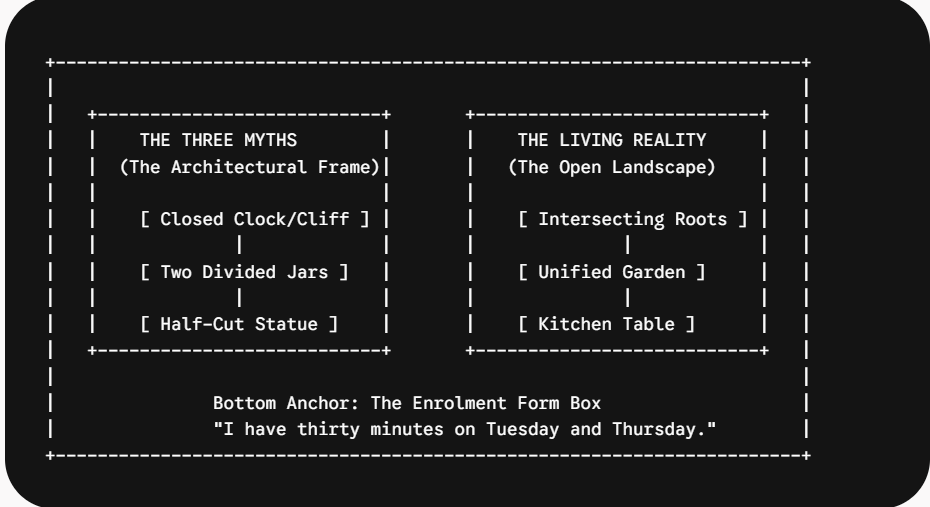
And after a few years of reading that box, I can tell you that what comes back is three sentences, over and over, in slightly different words, from people in Toronto and Perth and Buenos Aires who have never met each other.
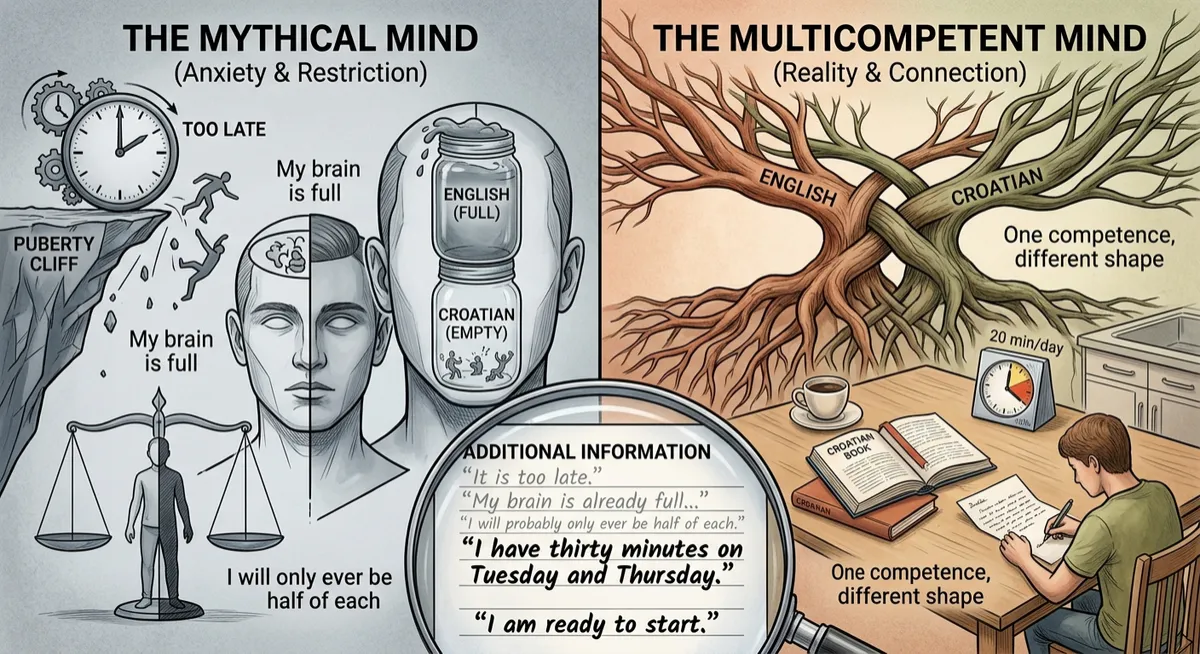
I think I have left it too late.
My brain is already full of another language.
I will probably only ever be half of each.
I want to take those three apart today, because I have read them too many times to treat them as personal anxieties. They are folk beliefs about the bilingual mind, and every one of them is either false or so much narrower than it sounds that believing it in the general form is a mistake.
And I am not going to do it with encouragement. I have no interest in telling you that you can do anything you set your mind to, because you cannot, and you know you cannot, and being told otherwise by a stranger is worth nothing. I am going to do it with the research, including the parts of the research that go against me.
The First Sentence: “It is too late”
The folk version of this has a cliff in it. Somewhere around puberty a door closes, and after that you are a tourist in every language you did not have as a child.
The research version is much more interesting and much less useful to anybody selling anything, including me.
Monika Schmid designed a study that I think is the cleverest thing anybody has done on this question, and the cleverness is in who she compared. The usual design pits adult learners against monolingual natives, and the adult learners come off worse, and everybody concludes that the difference is age.
Schmid added a third group. She took twenty long-term L1 attriters: people who grew up with German as their first language, monolingually, in childhood, and then emigrated and spent decades using English instead. Those people have no age-related deficit in German. They acquired it as children. But they are bilinguals whose German has been under pressure for years.
Then she compared them against twenty highly advanced late learners of German, matched for proficiency and for how much German they used daily, and against twenty predominantly monolingual controls (Schmid 386).
And here is what she found, and I am going to give it to you exactly rather than in the shape I would prefer.
In some areas of grammar, obligatory word order among them, the late learners looked like the native speakers who had drifted. In other areas, particularly noun phrase morphology, the attriters and the monolinguals behaved one way and the late learners behaved another. Schmid reads this as consistent with some form of maturational constraints on language learning (386).
So there is something. I am not going to pretend there is not. There appear to be specific corners of grammar where a person who came to a language in adulthood behaves differently from a person who had it as a child, and no amount of effort has been shown to close every one of them.
But look at the shape of that finding, because the shape is the point.
It is not a cliff. It is not a wall. It is a set of particular features, in particular corners of the morphology, which a researcher had to design a rather elaborate study to isolate. And in a great deal of the rest of the grammar, the advanced adult learner and the native speaker who has lived abroad for thirty years are doing the same thing.
Which means the line you have drawn in your head, between the natives on one side and the learners on the other, does not run where you put it. The people you think of as the real Croatians include a very large number who, on the measures that supposedly separate you from them, look exactly like you.
I would also say this. Nothing in that literature is about whether you can have a conversation with your aunt, read Ujević, cry at a funeral in the right language, or be understood at a counter in Sinj. It is about whether a linguist with a well-designed test can detect a difference in the treatment of certain noun phrases. Those are not the same question, and you have been letting the answer to the second one decide the first.
The Second Sentence: “My brain is full”
This one is not so much false as incoherent, and the incoherence is worth seeing because it is doing a lot of damage.
Behind it sits a picture: two languages, two containers, one head, limited space. Which is why people say things like if I put Croatian in, my English will suffer, or I do not have room for another case system.
François Grosjean put the correction in the title of a paper in 1989, and the title is the whole argument: Neurolinguists, beware! The bilingual is not two monolinguals in one person.
Vivian Cook gave the positive version of it a name that has organised the field ever since:
Multicompetence: the knowledge of more than one language in the same mind. — Vivian Cook
Not two competences stacked in one skull. One competence, of a different kind, with its own shape, which is not the shape of a monolingual’s and was never going to be.
There is no container. There is no full. The question your enrolment form was asking is not answerable because it is not a question.
And here is where I have to be honest against my own interest
Because at exactly this point in the argument, the person selling the course usually produces the cognitive benefits. Bilinguals have better executive control. Bilingualism protects against dementia. Learn Croatian and improve your brain.
I am not going to do that, and I want to tell you why in some detail, because the honesty is worth more to you than the sales pitch.
That literature is in trouble.
In 2015, Angela de Bruin, Barbara Treccani and Sergio Della Sala published a paper in Psychological Science that did something rather brutal and rather brilliant. They looked at conference abstracts on bilingualism and executive control from 1999 to 2012, and then checked which of those studies were subsequently published in journals.
What they found was that studies whose results fully supported the bilingual advantage were most likely to be published, followed by studies with mixed results, while studies challenging the bilingual advantage were published least of all. And this discrepancy, they report, was not due to differences in sample size, tests used, or statistical power (de Bruin, Treccani and Della Sala 99).
In other words, a good deal of the evidence against the advantage was run, and presented at conferences, and then never made it into print, while the evidence for it sailed through.
Since then, a meta-analytic review of the adult evidence has appeared in Psychological Bulletin with the whole question restored to its title, which is itself a statement about where the field had got to (Lehtonen et al.). And Mark Antoniou, reviewing the whole dispute for the Annual Review of Linguistics, writes that some investigators have failed to find evidence of a bilingual advantage, others have suggested it may be entirely spurious, proponents have continued to defend it, and that a heated debate has ensued and the field has now reached an impasse (Antoniou 395).
An impasse. Not a settled benefit that I can sell you.
And I want to say plainly that I am glad about this, and not only because I dislike overclaiming.
If you needed a bonus in executive function to justify learning your grandmother’s language, then the case for learning your grandmother’s language was already lost. You are not doing this for your prefrontal cortex. You are doing it because there is a room you cannot get into and people in it you can only half hear, and no cognitive side effect would make that better or worse.
The answer to my brain is full is not and it will make you smarter. The answer is that brains do not work like that, and you already know they do not, because you have watched a child pick up a second language in a playground without unlearning the first.
The Third Sentence: “I will only ever be half of each”
This is the one that does the most damage, and it is the one where I get angriest, so let me be careful.
The sentence assumes a yardstick. Half of each implies a whole of each, and a whole of each means a monolingual baseline: a person with one language, complete, unmarked, standing at 100 per cent. Measured against two of those, you will always be a fraction.
But that yardstick was chosen by somebody, and it was not chosen by you, and there is no reason on earth why the monolingual should be the unit of measurement for a mind that has two languages in it.
Tanja Kupisch and Jason Rothman made the argument in the specific case of people like you, and I have quoted their sentence before because I have not found a better one:
“A grammar acquired the way yours was acquired is not incomplete. It is complete and different as a matter of circumstance.” — Tanja Kupisch & Jason Rothman
Different, not deficient. Organised by a history you did not choose, and whole in itself.
And there is a second half to this that I want you to have, because it is more practical than it sounds. Jan Hulstijn distinguishes between the everyday spoken core of a language, which every native speaker shares regardless of schooling, and the literate, formal, register-heavy language that only school and print and profession build. Your kitchen gave you the first. No school gave you the second, because there was no school.
Which means that when you feel like half, you are usually reporting an accurate observation about register vs. capacity and drawing a false conclusion about yourself. The register is missing. You are not.
What I Wish People Wrote in the Box
So those are the three sentences, and here is what they have in common.
Every one of them is a claim about capacity. Too late, too full, only ever half. And every one of them, when you go to the literature, turns out to be either wrong or so much narrower that carrying it around in the general form is like refusing to swim because you once read that the sea has currents.
What actually predicts whether an adult gets somewhere with a language is not in any of those sentences. It is not in the neurology at all. It is dosage, and it is time, and it is whether you arrange your life so that the language is in it on Tuesday as well as on Sunday.
None of which is inspiring, and all of which is available to you at any age, which is rather the point.
So if you ever find yourself sitting in front of that box, throw those three out. Stop writing about what your mind cannot contain, and write what is actually true instead:
“I have thirty minutes on Tuesday and Thursday.”
“I can say what happened in the kitchen, but not what happened in the newspaper.”
“I am ready to start.”
Stop trying to learn the way a child does
Here is the mistake at the centre of most adult language study, and it comes directly out of the myths in the free half.
If you believe the door closed at puberty, then the logical response is to try to sneak back through it. To imitate the child’s route. Immersion without explanation, absorbing rather than analysing, repetition until it sticks, and above all vocabulary, thousands of individual words, drilled on cards, because that is what a child appears to do.
It is the wrong strategy, and not because it is childish. Because it is built for a learner with resources you do not have and none of the resources you do.
A child learning a first language has, conservatively, several thousand hours of input before producing a sentence anybody would call correct, delivered by adults who repeat themselves endlessly, in situations where the meaning is visible, with no shame attached to error and no alternative language available.
You have none of that. You have, if you are lucky and organised, four hours a week and a job.
But you have four things that child does not have, and every one of them is worth more per hour than the thing you are trying to imitate.
The four things you have
You can be told the rule. A five-year-old cannot use an explanation of verbal aspect. You can. For a system like Croatian case or Croatian aspect, one clear page of explanation, properly understood, will do more than several hundred flashcards, because it gives you a generative pattern rather than a list of instances. This is the single largest advantage adults have and most adult learners refuse to use it, because somebody told them grammar was old-fashioned.
You have a conceptual network already built. You know what a mortgage is, what irony is, what a funeral is for. A child learning these words is learning the concepts at the same time. You are attaching a new label to a concept you have had for thirty years, which is a far smaller job, and it means abstract vocabulary is much easier for you than the vocabulary of the nursery.
You can notice. You can compare, ask why, spot that a construction resembles one you already know, and consciously test a hypothesis. Children cannot do any of this and do not need to. You can, and it converts every conversation into potential data.
And if you are a heritage speaker, you have the phonology. This is the thing that cannot be bought and that most of you are not counting. The sound system, the rhythm, often the accent of a particular village, laid down before you could read. Adult learners from outside spend years on this and most never get it.
And the one thing you do not have
The real adult disadvantage is not neurological. It is that you are ashamed in a way a four-year-old is not.
A child produces nonsense loudly and repeatedly in front of adults and suffers nothing. You will avoid an entire shop for a month rather than repeat a sentence that went badly. That is the actual gap between you and the child, and no amount of flashcards addresses it.
So design around it rather than pretending it is not there. Practise where the stakes are zero, out loud, alone, before you practise where they are not. Choose one interlocutor who is patient and use them relentlessly. And understand that every technique below which feels socially uncomfortable is doing more for you than every technique that feels safe.
What is wrong with the flashcard
Nothing is wrong with spaced repetition. The scheduling research is solid: spacing your reviews and forcing yourself to retrieve rather than recognise really does beat rereading. Keep that.
The problem is the unit.
A flashcard with kruh on one side and bread on the other teaches you a pair. It builds a bridge between two words, which means it trains, thousands of times, the exact habit you are trying to get rid of, which is going through English to get to Croatian. And it teaches the word in a form it almost never appears in, stripped of case, of preposition, of the phrase it lives inside.
So change the unit and keep the schedule.
Put phrases on the card, not words. Put the whole collocation. Put a sentence you actually heard somebody say, with the situation noted beside it. Put the Croatian on both sides where you can, with a picture or a definition rather than an English gloss. And when you review, say it aloud, because a card you recognise silently has trained recognition and nothing else.
The order of work for a heritage learner
This is where the adult and heritage advantages change the sequence, and where most people waste their first year.
Diagnose before you buy anything. Get somebody to establish what you already have, because heritage speakers are almost never where a course assumes. You may have the phonology of a native and the vocabulary of a six-year-old and no formal register at all. That is not a level. That is a profile, and a course built for a beginner will spend six months on sounds you have had since you were three while never touching the thing you actually lack.
Then take the systems explicitly. Case, aspect, the verb. Not as exercises, as explanations you sit with until they make sense. Two hours of proper understanding of aspect is worth a year of guessing.
Then read, aloud, above your level. This is the only efficient route into the register that no kitchen supplies, and it is the one thing on this list that will still be paying you in ten years.
Then produce, early and badly. Adults over-consume input and under-produce, because input is comfortable and output is exposure. Whatever ratio you are currently running, move it toward production.
And put the language in your week, not in your weekend. Access depends on how often a thing is called on and how recently. Twenty minutes on six days beats three hours on one, and it is not close. This is the least glamorous sentence in the letter and it is the one that decides the outcome.
Honest numbers, by decade
I am asked constantly what to expect at a given age, and the honest answer has two parts.
The first part is that the research on maturational constraints is about ultimate attainment in specific grammatical detail, tested under laboratory conditions, in the fine corners of morphology (Schmid 386). It is not about whether you will be able to live in the language.
The second part is what I have actually watched.
In your thirties and forties, with dosage in the week, the ceiling is high enough that you will stop being able to see it. What limits people at that age is invariably time and arrangement, never capacity, and I have never once seen an adult in that bracket fail for a reason that had anything to do with their brain.
In your fifties and sixties, the same, with two differences. Retrieval under time pressure is slower, which shows up in conversation rather than in reading, and it responds well to the frequency of use rather than to effort. And people in that bracket are usually more self-conscious, not less, which is the actual brake.
In your seventies and beyond, I have taught people who made real progress and people who did not, and the difference between them was almost entirely how much of their week the language occupied and whether anybody was waiting to talk to them in it. Which is exactly the same variable as at forty, arriving in a different body.
At every age, the thing that decides it is whether the language is a part of your life or a project you are doing about your life.
One last thing
I want to go back to the box on the enrolment form.
In some years I have wondered whether to remove it, because of what people put in it and what it costs them to write. And I have kept it, because the sentences people write there are the actual obstacle, far more than any case ending, and I would rather know.
But I will tell you what I wish people wrote in it.
Not I think I left it too late, which is a guess about neurology dressed as a confession. Something more like: I have four hours a week, my grandmother was from Imotski, I understand more than I can say, and I would like to be able to talk to my uncle before he dies.
That is a person a teacher can help. The other one is a person arguing with a rumour about their own head.
Next week: what actually happens inside a family when the language stops being passed on, what the research says is lost, and how much of it can still be recovered while there is somebody left to ask.
Works Cited
Antoniou, Mark. “The Advantages of Bilingualism Debate.” Annual Review of Linguistics, vol. 5, 2019, pp. 395–415.
Cook, Vivian. “Evidence for Multicompetence.” Language Learning, vol. 42, no. 4, 1992, pp. 557–91.
de Bruin, Angela, Barbara Treccani, and Sergio Della Sala. “Cognitive Advantage in Bilingualism: An Example of Publication Bias?” Psychological Science, vol. 26, no. 1, 2015, pp. 99–107.
Grosjean, François. “Neurolinguists, Beware! The Bilingual Is Not Two Monolinguals in One Person.” Brain and Language, vol. 36, no. 1, 1989, pp. 3–15.
Hulstijn, Jan H. Language Proficiency in Native and Non-Native Speakers: Theory and Research. John Benjamins, 2015.
Kupisch, Tanja, and Jason Rothman. “Terminology Matters! Why Difference Is Not Incompleteness and How Early Child Bilinguals Are Heritage Speakers.” International Journal of Bilingualism, vol. 22, no. 5, 2018, pp. 564–82.
Lehtonen, Minna, et al. “Is Bilingualism Associated with Enhanced Executive Functioning in Adults? A Meta-Analytic Review.” Psychological Bulletin, vol. 144, no. 4, 2018, pp. 394–425.
Schmid, Monika S. “The Debate on Maturational Constraints in Bilingual Development: A Perspective from First-Language Attrition.” Language Acquisition, vol. 21, no. 4, 2014, pp. 386–410.
Tihana Klepač is an Associate Professor at the University of Zagreb’s Department of English and the founder of TalkTime Croatian. She teaches the Croatian Quadrant™, a structured, culturally immersive course designed to help learners stop translating and start thinking in Croatian. Find out more at talktimecro.com.
This letter was originally published in Saturday Letter from Zagreb, my newsletter for Croatian heritage speakers and diaspora learners.
Keep learning Croatian with Tihana
Listen and watch
Ćakula Café podcast, on Spotify — Slow Croatian for heritage speakers and diaspora adults at A2–B1.
Ćakula Café, on Apple Podcasts — The same podcast, for listeners on iPhone and Mac.
Ćakula Café, on Castbox — The same podcast, for listeners who prefer Castbox.
TALK TIME on YouTube — Free Croatian lessons and films, with cultural context.
Podcast episodes on Substack — Audio companions to the Saturday Letters.
Start here, free
Learn Croatian: Where to Start — A beginner’s orientation for adults learning Croatian.
The Free Masterclass — An introduction to the 4-Pillar Method and the logic of Croatian grammar.
The Konoba Test — A short quiz on where you are actually standing in Croatian.
Saturday Letter from Zagreb — A weekly essay on language, culture and belonging, free in your inbox.
Courses and books
Croatian Entry Point — A1 self-study: eight weeks of culture-driven lessons, lifetime access.
The Croatian Quadrant™ — A1–A2 flagship live programme, one cohort a year; join the waitlist.
Level Up Croatian — A2 self-study: daily fifteen-minute lessons in weekly themes.
Short Stories in Croatian — Ebook for A2–B1: nine original stories with audio, glossary and grammar notes.
Croatian Nexus — Post-A2 live seminars: where the language becomes literature.
More Saturday Letters
The Silence Between Generations — What is lost when a language is not passed on, and what can still be recovered.
Coming Home in a Language You Half Remember — The returnee’s wall at the counter, and why the language is closer than you think.
Inat — The word your grandfather lived by, and where it came from.
The Word That Will Not Cross — Why čežnja is not longing and fjaka is not laziness.
Does Croatian Make You Think Differently? — What is real, and what is beautiful nonsense, in the idea that a language shapes a mind.
The Kitchen Was a Language Policy — Why Croatian was, or was not, passed down to you.
What English Does to Your Croatian While You Sleep — Why your grandmother’s Croatian did not stay frozen the day she left.
Why You Feel Like a Different Person in Croatian — Why volim te weighs more than I love you.
You Are Not a Tourist in Your Own Language — The emotional case for coming home one register at a time.
The Konoba Test: Where Are You Actually Standing? — Why “what level is my Croatian” is the wrong question.
The Small Words That Give You Away — Why flawless Croatian can still mark you as a stranger: pa, ma, daj and the third rakija.
The Country Inside the Word Kaj — How the old language of the north became a place you carry.
Slavonia: The Gateway Dialect — The oldest Croatian štokavian is hiding in the east.
Who Gets to Tell the Story — Postcolonial theory, a nineteenth-century pamphlet and your grandmother’s Croatian.
Follow