Is It Too Late to Learn Croatian as an Adult?
The apology is the part I want to talk about, because it is doing more work than she thinks. It carries an assumption about how language lives in a brain, and that assumption is mostly wrong, though not in the comfortable way people expect me to say it is wrong.
I teach at the Faculty of Humanities and Social Sciences in Zagreb, in the building that also houses Croaticum, and I teach Croatian privately to adults living abroad. So I have two reasons to have read the research on this question, and one reason to be suspicious of my own conclusions, which is that I sell the thing I am about to tell you is possible. I will try to be accurate about where the evidence is strong, where it is thin, and where it says something I would rather it did not.
"The mere fact that a learner has not learned something, for example, due to lack of time or motivation, does not necessarily mean that s/he cannot." — Monika Schmid
What the critical period actually claims
The idea that a window closes has a real study behind it, and the study is better than its reputation. Hartshorne, Tenenbaum and Pinker analysed data from 669,498 native and non-native English speakers and estimated that grammar-learning ability "is preserved almost to the crux of adulthood (17.4 years old) and then declines steadily." That number, 17.4, is the one that travels. It is usually reported as a deadline.
It is not a deadline. What their model estimates is the rate at which grammar is acquired, not the ceiling on what can be acquired, and the authors are unusually explicit that these are different questions. Their own methodological argument is that "measuring the ultimate attainment of learners who started at different ages cannot by itself reveal changes in underlying learning ability." A slower rate over more years is not the same as a closed door. It is a longer road.
The rest of the age literature is messier than the headline suggests. Monika Schmid points out that the famous discontinuity in Johnson and Newport's data disappears if you move the age cutoff from fifteen to twenty (387), and that while "there is an undisputed correlation between age and ultimate attainment, the causative effect of age as an independent variable cannot be proven by these kinds of studies" (387). Age travels with everything else that matters: how much input you get, in what contexts, with what motivation, over how many years, with what sense of who you are becoming (388). And, in the sentence I would put above the desk of every adult learner who has quietly given up, "the mere fact that a learner has not learned something, for example, due to lack of time or motivation, does not necessarily mean that s/he cannot" (390).
Now the part I would rather skip.
Schmid designed a study specifically to test whether late learners have something structurally different in their grammar, and she designed it well. She compared twenty highly advanced late learners of German with twenty first-language attriters, people who had grown up speaking German and then lived an average of thirty-seven years abroad, some using German only two or three times a year (406). The attriters were indistinguishable from monolinguals on all eleven morphological and syntactic features measured in free speech (406). The late learners, matched for proficiency, were not. On grammatical gender the gap is brutal: monolinguals made .03 errors per thousand words, attriters .11, late learners 5.32 (402). Not one late learner reached the attriters' range on gender (407). Her conclusion is that there "may be a qualitative difference between speakers who learn a language in childhood and those who learn it later in life" (407).
I am not going to soften that. If your question is whether an adult beginning Croatian from nothing at fifty will produce gender and case in spontaneous speech the way a Zagreb native does, the honest answer from the best-designed study I know is: probably not, and the gap will show most in exactly the places Croatian is most demanding.
But that is not most of the people who write to me. And the distinction between those two groups is the whole argument.
You are probably not a beginner
Silvina Montrul draws the line precisely. A heritage speaker is someone who acquired a minority home language naturalistically in early childhood, and who "possesses productive or receptive ability" in it (20). Someone with a family or cultural connection but no childhood exposure "is in fact no different from the second language learners" (19). Maria Polinsky adds the term for the people reading this: those who "choose to relearn their home language in the instructed setting of a language classroom" become heritage language re-learners (7), and she notes the trend has been growing across a number of countries.
"Heritage speakers sound much more native than even the most proficient adult learners... The childhood in which Croatian was spoken around you was not wasted."
This matters because the Schmid finding I just quoted does not apply to you if you are in that group. Her attriters and her late learners were all people who acquired their languages fully, or from zero, after seventeen. Nobody in either study was a diaspora child who heard Croatian at the table until school age and then lost the thread. That is a different starting condition, and the research on it says something quite specific.
What the ear keeps
Start with the finding that is strongest and narrowest, and resist the temptation to widen it.
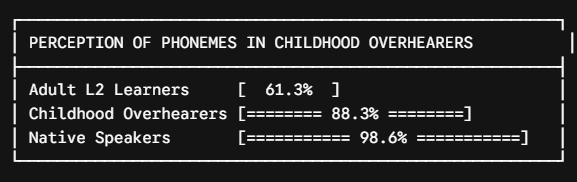
Polinsky states it flatly: "Heritage speakers sound much more native than even the most proficient and advanced L2 learners… In fact, the phonetic advantage is among the most important properties that separate heritage speakers and L2 learners" (116). The numbers behind that sentence are worth sitting with. On a Korean phoneme perception task, second language learners scored 61.3 percent correct; childhood overhearers, people who had heard the language as children but never spoken it, scored 88.3; childhood heritage speakers 89.4; native speakers 98.6 (154).
Read the third and fourth columns again. People who only ever overheard the language performed closer to native speakers than to adult learners.
The deepest version of this comes from an old study Polinsky rescues from before the term existed. Tees and Werker tested English-speaking adults who had been exposed to Hindi in their first couple of years, who had learned their first words in Hindi, and who had had little or no exposure since. They discriminated the dental and retroflex sounds as well as native Hindi controls (qtd. in Polinsky 153). Montrul reports the same pattern in Korean adoptees relearning Korean in class, who despite having no productive ability at all before enrolling were significantly better at Voice Onset Time discrimination than adult learners, and she concludes that "remnants of the L1 must lie in the mind in some sort of representation, and that total L1 loss is unlikely in these cases" (39).
So the childhood in which Croatian was spoken around you was not wasted, and it did not evaporate. Something was laid down and it is still there.
Four honest qualifications, because this literature gets over-quoted.
The overhearer advantage did not replicate for production in Korean; only heritage speakers with actual speaking experience outperformed adult learners, while overhearers did not (Polinsky 124). Pallier and colleagues found no trace of Korean at all, behaviourally or in neuroimaging, in twenty Korean adults adopted into French families between three and ten (qtd. in Montrul 39). The perceptual advantage tracks proficiency rather than arriving free with birth (Polinsky 155). And the heritage accent is real and audible: in Polinsky's matched-guise study, fifteen Moscow raters listening to seven-second clips identified heritage speakers as living outside Russia 83.5 percent of the time (120). Even in sound systems, she writes, heritage speakers are "not identical" to their monolingual counterparts (350).
The advantage is real, it is measurable, and it is not a free pass.

What does not survive, and why that is the interesting part
Here the picture flips, and it flips in a way that tells you what to do.
Heritage speakers have trouble with exactly the morphology that encodes a relationship between two things. Polinsky puts it plainly: exponents of case and agreement "are known to be severely affected," and the damage is worse in nominal than in verbal morphology (197). Within agreement there is a hierarchy: person survives nearly intact, number is somewhat vulnerable, and "the main errors in heritage speakers' production are observed in agreement in gender" (205–206).
Croatian has seven cases and three genders, so this ought to be catastrophic. It is worth looking at what actually happens.
Hlavac and Stolac analysed 9,318 noun phrases from a hundred second-generation Croatian-Australians and found that 91 percent carried target case marking, which led them to note that there is "little evidence to support the oft-mentioned hypothesis that oblique case marking is a category that undergoes attrition" (543). The finer picture is less flattering: nominative 100 percent, accusative 95, genitive 86, instrumental 86, dative 79, and locative 74, the most vulnerable of all (524). And where forms went off target, 92 percent of the time they moved to a case further to the left on Ďurovič's implicativity hierarchy, collapsing toward the nominative and accusative (523, 525–526). Gender held up better than the theory predicts: of 356 consonant-final feminine nouns, eleven were declined as masculine, giving isti stvar and skoro svaki noć (527).

Montrul adds the detail that changes how this should be taught. When heritage speakers get gender wrong, "they have more problems with lexical assignment than with the syntactic rule of agreement" (211). Kupisch and Rothman find the same asymmetry in their French and Italian data. The rule is intact. It is the noun-by-noun entry that has holes in it. Those are two completely different problems, and only one of them requires learning a system from scratch.
The verb: where cognitive linguistics earns its keep
Croatian aspect is generally described as the hardest thing in the language, and Jasna Novak Milić and Marica Čilaš Mikulić, both at my faculty, call it "one of the hardest, if not the hardest part of the Croatian language" for non-native speakers (43). Their explanation is the one I would give, and it is a cognitive-linguistic one.
Aspect is not a property sitting inside the verb waiting to be looked up. It is, in the definition they adopt from Comrie and others, pogled na situaciju, a view of a situation, a subjective category (44). Which is why Croatian grammars can describe aspect exhaustively and still leave a learner with nothing usable: they "describe verbal aspect, but do not offer rules by which a non-native speaker could learn its use" (44).
Their favourite demonstration is a pair of sentences. Svakoga dana pročitam novine, every day I read the paper, is fine. Svakoga dana pročitam enciklopediju, every day I read the encyclopaedia, is not. Nothing grammatical separates them. What decides is the size of the object and the plausibility of finishing it, which is to say, what you know about newspapers and encyclopaedias (46). Correct aspect use, they conclude, requires "broad knowledge of the world seen through the prism of the Croatian language" (43).
That is a strong claim and I think it is right. Aspect is where Croatian asks you to construe an event before you can encode it, and construal is learned the way you learn a culture, slowly and by exposure, not by memorising a table. Their teaching principle follows from this: work od rečenice prema glagolu, from the sentence toward the verb (49), and introduce the distinction first through telicity, which they treat explicitly as cognition rather than grammar, "part of a person's conceptualisation of the world, of their cognitive abilities" (48).
The sobering line is theirs too, and it is the most honest sentence in the literature I read for this: wobbles in aspect use "are frequent even in non-native speakers whom we consider excellent speakers of Croatian, and are sometimes the only indicator that we are dealing with a non-native rather than a native speaker" (52).
And yet. In the Australian corpus, out of more than 15,000 verbs, exactly ten had aspect marking incongruent with their content, and every one of them was a perfective standing where an imperfective belonged (Hlavac and Stolac 533–534).
Sit with that pair of facts. Aspect is the hardest thing to teach, and it is almost the last thing to break. Whatever is eroding in diaspora Croatian, it is not the deep construal system. That was laid down early and it holds.
Your Croatian has not gone. It has contracted toward its centre
The best description I have found of what actually happens to a heritage language comes from Hanne Skaaden's chapter on Croatian speakers in Norway, and she reaches it through Cognitive Grammar. She takes from Langacker the position that "lexicon, morphology, and syntax form a continuum of symbolic units serving to structure conceptual content for expressive purposes," and from Laura Janda that "grammatical elements function more to organize ideas than to specify them" (qtd. in Skaaden 291).

Then she applies entrenchment. After migration, exposure to Croatian is restricted while the dominant language's impact is massive, and the result is what she calls a two-way-street effect: frequently activated units become easier to reach, infrequently activated ones become harder (291–292). And the consequence she draws is the one that explains what my students actually report: "structures that are shared with the societally dominant language may activate more easily than those that are specific to the heritage language" (292). English has prepositions and possessive pronouns. Croatian has case. Guess which one comes to the tongue first after thirty years in Melbourne.
Her data on the dative make this concrete. Treating the dative as a radial category with dati/davati at its prototype and a network of extensions around it, she found that homeland speakers used the dative with nearly forty different verbs, while first-generation migrants used it with seventeen. Migrants leaned on the prototype, which accounted for 29.8 percent of their datives against 5.7 percent for homeland speakers, while the antonym- and metonym-triggered uses at the edges of the network were almost absent (294–295).
Nothing was deleted. The network contracted toward its prototype.
I find this the single most useful idea in the whole literature, because a contracted network is not a damaged one. It is an under-exercised one, and its periphery is reachable from its centre. It also predicts what should be taught: not the prototype your students already have, but the edges they have lost, which is precisely the material that a grammar syllabus organised by case tends to skip.
And one more number from that chapter, for anyone who thinks generation is destiny. Measured in datives per hundred clauses, the strongest second-generation speaker scored 13.1, outperforming most of the first-generation migrants in the sample (302). Whatever determines the outcome, it is not which generation you were born into.
So what does determine it
Not age. The evidence points relentlessly at input, and it is more specific than "practise more."
Schmid found that both very frequent and very infrequent use of the first language may accelerate its attrition, with intermediate users maintaining best, because very frequent users in a diaspora are receiving unreliable input from other bilinguals (396). Polinsky and Scontras report that both cumulative lifetime exposure and current exposure predict grammatical outcomes, so recency matters independently of history. And they draw on Gollan and colleagues to make the point that community size affects proficiency independently of raw exposure, which means "increased exposure to the heritage language will only get heritage speakers so far; they also need exposure from a variety of sources."
The sharpest demonstration is Kupisch and Rothman's. They compared German-dominant heritage speakers of French, schooled in French, with German-dominant heritage speakers of Italian, schooled in German. The French group performed at or near monolingual levels across gender assignment, gender agreement, adjective placement, generic noun phrases and Voice Onset Time. The Italian group did not, scoring 33 percent on generics. The difference: the French group had the language as the daily medium of instruction from many different speakers; the Italian group had it as the weekly object of instruction, often from one teacher. Their conclusion is that for schooling to have lasting effects, "input needs to be continuous and come from a variety of different native speakers."
I teach a two weekly class. So let me say what that finding means for me. Weekly classes, on this evidence, is not sufficient input on its own, and I have watched enough people plateau to believe it. What weekly classes can be is the spine that holds together six other things: the podcast on the commute, the phone calls with an aunt, the novel you are reading badly, the group chat you are brave in. If the classes are the only Croatian in your week, the research says you should expect the Italian result, and so should I.
There is better news on whether instruction helps at all. Montrul and Bowles found explicit instruction beneficial to heritage learners, with gains actually higher than for second language learners (Montrul 290). Song and colleagues raised children's accuracy on Korean case markers from 25 percent to 66.3 percent, with 56 percent retained nine weeks later (289–290). Montrul's summary is that heritage learners, like second language learners, "benefit from form-focused instruction in the classroom" (293).
And the honest counterweights: Potowski and colleagues found gains greater for the second language learners than the heritage learners (291); Albirini found elementary-level heritage learners of Arabic scoring 23.55 percent on negation against lower-proficiency second language learners' 69.73 (293–294); and nobody knows whether any of these gains survive the end of the course, a gap Montrul names herself (305, 310).
The test you have been failing is the wrong test
This is the finding I most want diaspora readers to have, because it reframes a private humiliation as a measurement error.
Heritage speakers and adult learners fail in mirror-image ways depending on how you assess them. Montrul, Foote and Perpiñán found second language learners more accurate on written gender tasks while heritage speakers "showed exactly the opposite pattern, higher accuracy in oral production than in the written tasks" (Montrul 280). In Bowles's study, heritage learners beat second language learners on every implicit oral measure, 78.8 against 46.7 on oral imitation and 95.9 against 47.9 on oral narration, and lost only on the metalinguistic test, 57.4 against 72.4 (282).
Your knowledge is oral and implicit. Most Croatian courses, most textbooks, and every grammar test you have ever taken measure the written and metalinguistic. If you once sat in a class, could not conjugate on paper, and concluded you were bad at Croatian, you were not measuring your Croatian. You were measuring the one modality in which your kind of knowledge does not show up.
Kupisch and Rothman add a small devastating detail: heritage speakers often report struggling with the instructions in language experiments, instructions that second language learners find perfectly clear.
Why it feels too late even when it is not
There is a layer under all of this that is not linguistic, and pretending otherwise would be dishonest.
Polinsky writes that heritage speakers "are often reminded of their linguistic inadequacies, which can make them feel less secure and more reluctant to speak in their home language," and then the sentence that made me put the book down: "While L2 learners are celebrated for each small step they take toward their second language, heritage speakers are seldom praised on what they do right and are invariably reprimanded on minute inaccuracies in their speech" (79). She is careful to say this rests on her own interviewing rather than large-scale survey data, and I will be careful to repeat that. What follows is her seven-word account of the spiral: "The less they practice, the rustier is their performance" (80).
For Croatian there is harder evidence, and it is uncomfortable for those of us who live here. In a study of Croatian speakers in Lower Saxony, second-generation speakers reported having been corrected, and having been mocked or criticised, significantly more than the first generation, specifically when speaking Croatian in Croatia. For their German in Germany, no such generational difference appeared (Kresić Vukosav and Šimičić 230).
Read that again. The place where diaspora Croatians get shamed for their Croatian is Croatia. Not Germany. Us.
I teach in Zagreb, one corridor from Croaticum, and I think we should be ashamed of that finding. Kupisch and Rothman argue that the term "incomplete acquisition" is itself part of the damage, that it "unwittingly privileges monolingualism" as the should-be default, and they write the sentence I would like every relative at every family lunch to absorb: "HSs are not broken."

What you inherit, and what you are owed
Ben Rampton took apart the idea of the native speaker in five pages in 1990, and his list of what the term smuggles in is still the cleanest thing written on it. Among the assumptions: that a language is inherited by birth into a group, and, the one that does the damage, that "inheriting a language means being able to speak it well" (97). His answer is blunt: "Being born into a group does not mean that you automatically speak its language well" (98). And, aimed at the people doing the correcting: "Nobody's functional command is total: users of a language are more proficient in some areas than others" (98).
In place of nativeness he offers expertise, which is learned rather than given, and two kinds of language loyalty: inheritance, which "occurs within social boundaries," and affiliation, which "takes place across them" (99). Both, he insists, are negotiated rather than fixed, which cuts both ways, because a claim on an inheritance can be contested by the people guarding it. And then the sentence that I think settles the question this article is named after: "it is perfectly possible for someone to regard a language learned at age 35 in college as a part of his or her group inheritance" (100).
Jan Hulstijn arrives from a different direction and lands near the same place. Because native speakers share only what he calls basic language cognition and differ enormously above it, "'the' native speaker does not exist, except that all native speakers share BLC" (28). His prediction for late learners is split, and I will give you both halves. The limit: basic language cognition "will generally not be attainable in the domains of pronunciation or with respect to the production of some grammatical features in spontaneous, unmonitored speech" (48). The opening: "Late L2 learners can become as proficient in HLC as L1ers of the same intellectual, educational, professional and cultural profile, despite some deficiencies in their L2 BLC" (48). And the consequence, which he states without flinching: it is possible for a late learner "to be more proficient than many low-profile L1ers" (48).
So here is the answer, as precisely as I can put it. What is unlikely to come back fully is the unmonitored, accentless, gender-perfect spontaneous speech of someone who never left. What is fully available to you, at fifty-three, is everything else: reading Šenoa, writing a letter you are not ashamed of, following an argument at a family table and joining it, holding a register that most monolingual speakers of Croatian never acquire either.
Aneta Pavlenko has spent a career on what languages do inside a bilingual mind, and two of her findings belong here. Words in the language of your childhood are linked to the memories encoded in it, which is why they "feel 'real'" in a way later languages do not (194). And, against every folk assumption about ageing brains, "we maintain some degree of brain plasticity throughout our lives" (306).
She tells one story I have not been able to stop thinking about. Chagall acquired Russian in adolescence and wrote poetry in it, then acquired French at twenty-four and never could. It was in 1935, when he was nearing fifty, that an encounter with Vilna's Yiddish culture woke his nostalgia and sent him back to the intimate language of his childhood as something he could write in. "From then on he wrote poetry in both languages" (295).
He was not too late. He was forty-eight, and he had simply not yet met the thing that made him want it enough.
Write to me if you want to talk about where yours has gone.
Svako dobro, Tihana
Tihana Klepač is an Associate Professor at the University of Zagreb’s Department of English and the founder of TalkTime Croatian. She teaches the Croatian Quadrant™, a structured, culturally immersive course designed to help learners stop translating and start thinking in Croatian. Find out more at: talktimecro.com.
Works Cited
Gardner, Robert C., and Wallace E. Lambert. "Motivational Variables in Second-Language Acquisition." Canadian Journal of Psychology, vol. 13, no. 4, Dec. 1959, pp. 266–72.
Hartshorne, Joshua K., Joshua B. Tenenbaum, and Steven Pinker. "A Critical Period for Second Language Acquisition: Evidence from 2/3 Million English Speakers." Cognition, vol. 177, 2018, https://doi.org/10.1016/j.cognition.2018.04.007.
Hlavac, Jim, and Diana Stolac. "Features in the Croatian Speech of Three Generations of Croatian-Australians." Diaspora Language Contact: The Speech of Croatian Speakers Abroad, edited by Jim Hlavac and Diana Stolac, De Gruyter Mouton, 2021, pp. 493–551.
Hulstijn, Jan H. Language Proficiency in Native and Non-native Speakers: Theory and Research. John Benjamins, 2015. Language Learning and Language Teaching 41.
Kresić Vukosav, Marijana, and Lucija Šimičić. "Some Aspects of Language Contact among Croatian-Speakers in Lower Saxony, Germany." Diaspora Language Contact: The Speech of Croatian Speakers Abroad, edited by Jim Hlavac and Diana Stolac, De Gruyter Mouton, 2021, pp. 217–49.
Kupisch, Tanja, and Jason Rothman. "Terminology Matters! Why Difference Is Not Incompleteness and How Early Child Bilinguals Are Heritage Speakers." International Journal of Bilingualism, vol. 22, no. 5, 2018, pp. 564–82, https://doi.org/10.1177/1367006916654355.
Montrul, Silvina. The Acquisition of Heritage Languages. Cambridge UP, 2016.
Novak Milić, Jasna, and Marica Čilaš Mikulić. "Glagolski vid u inojezičnome hrvatskome – izazov na mnogim razinama." Pp. 43–55.
Pavlenko, Aneta. The Bilingual Mind: And What It Tells Us about Language and Thought. Cambridge UP, 2014.
Polinsky, Maria. Heritage Languages and Their Speakers. Cambridge UP, 2018. Cambridge Studies in Linguistics 159.
Polinsky, Maria, and Gregory Scontras. "Understanding Heritage Languages." Bilingualism: Language and Cognition.
Rampton, M. B. H. "Displacing the 'Native Speaker': Expertise, Affiliation, and Inheritance." ELT Journal, vol. 44, no. 2, Apr. 1990, pp. 97–101.
Schmid, Monika S. "The Debate on Maturational Constraints in Bilingual Development: A Perspective from First-Language Attrition." Language Acquisition, vol. 21, no. 4, 2014, pp. 386–410, https://doi.org/10.1080/10489223.2014.892947.
Skaaden, Hanne. "Tu i tamo se gađam padežima – 'Here and There I Struggle with My Cases'. Croatian Migrant Speakers in Norway and Their Use of the Dative." Diaspora Language Contact: The Speech of Croatian Speakers Abroad, edited by Jim Hlavac and Diana Stolac, De Gruyter Mouton, 2021, pp. 285–317.
Keep learning Croatian with Tihana
Listen and watch
Ćakula Café podcast, on Spotify — Slow Croatian for heritage speakers and diaspora adults at A2–B1.
Ćakula Café, on Apple Podcasts — The same podcast, for listeners on iPhone and Mac.
Ćakula Café, on Castbox — The same podcast, for listeners who prefer Castbox.
TALK TIME on YouTube — Free Croatian lessons and films, with cultural context.
Podcast episodes on Substack — Audio companions to the Saturday Letters.
Start here, free
Learn Croatian: Where to Start — A beginner’s orientation for adults learning Croatian.
The Free Masterclass — An introduction to the 4-Pillar Method and the logic of Croatian grammar.
The Konoba Test — A short quiz on where you are actually standing in Croatian.
Saturday Letter from Zagreb — A weekly essay on language, culture and belonging, free in your inbox.
Courses and books
Croatian Entry Point — A1 self-study: eight weeks of culture-driven lessons, lifetime access.
The Croatian Quadrant™ — A1–A2 flagship live programme, one cohort a year; join the waitlist.
Level Up Croatian — A2 self-study: daily fifteen-minute lessons in weekly themes.
Short Stories in Croatian — Ebook for A2–B1: nine original stories with audio, glossary and grammar notes.
Croatian Nexus — Post-A2 live seminars: where the language becomes literature.
More Saturday Letters
The Silence Between Generations — What is lost when a language is not passed on, and what can still be recovered.
Coming Home in a Language You Half Remember — The returnee’s wall at the counter, and why the language is closer than you think.
Inat — The word your grandfather lived by, and where it came from.
The Word That Will Not Cross — Why čežnja is not longing and fjaka is not laziness.
Does Croatian Make You Think Differently? — What is real, and what is beautiful nonsense, in the idea that a language shapes a mind.
The Kitchen Was a Language Policy — Why Croatian was, or was not, passed down to you.
What English Does to Your Croatian While You Sleep — Why your grandmother’s Croatian did not stay frozen the day she left.
Why You Feel Like a Different Person in Croatian — Why volim te weighs more than I love you.
You Are Not a Tourist in Your Own Language — The emotional case for coming home one register at a time.
The Konoba Test: Where Are You Actually Standing? — Why “what level is my Croatian” is the wrong question.
The Small Words That Give You Away — Why flawless Croatian can still mark you as a stranger: pa, ma, daj and the third rakija.
The Country Inside the Word Kaj — How the old language of the north became a place you carry.
Slavonia: The Gateway Dialect — The oldest Croatian štokavian is hiding in the east.
Who Gets to Tell the Story — Postcolonial theory, a nineteenth-century pamphlet and your grandmother’s Croatian.
Follow