Where to Actually Learn Croatian as a Diaspora Croatian
Type "learn Croatian" into a search bar and here is what comes back: a government page written in the particular Croatian that exists only on government pages, two or three language schools in Zagreb, an app that will teach you the word for apple, and a forum thread from 2011 in which somebody asks exactly what you are asking and nobody answers.
None of it tells you the one thing you actually need to know, which is which of these was built for somebody in your situation and which was built for somebody else entirely.
So let me say where I am standing before I start. I teach at the Faculty of Humanities and Social Sciences at the University of Zagreb, which is also the building that houses Croaticum, so several of the institutions in this article are colleagues of mine, one corridor away from my office. I also teach Croatian privately to adults living abroad, which makes me one of the options on this list, and by far the smallest. I will try to be accurate about all of it, including the places where what I do is the wrong answer for you.
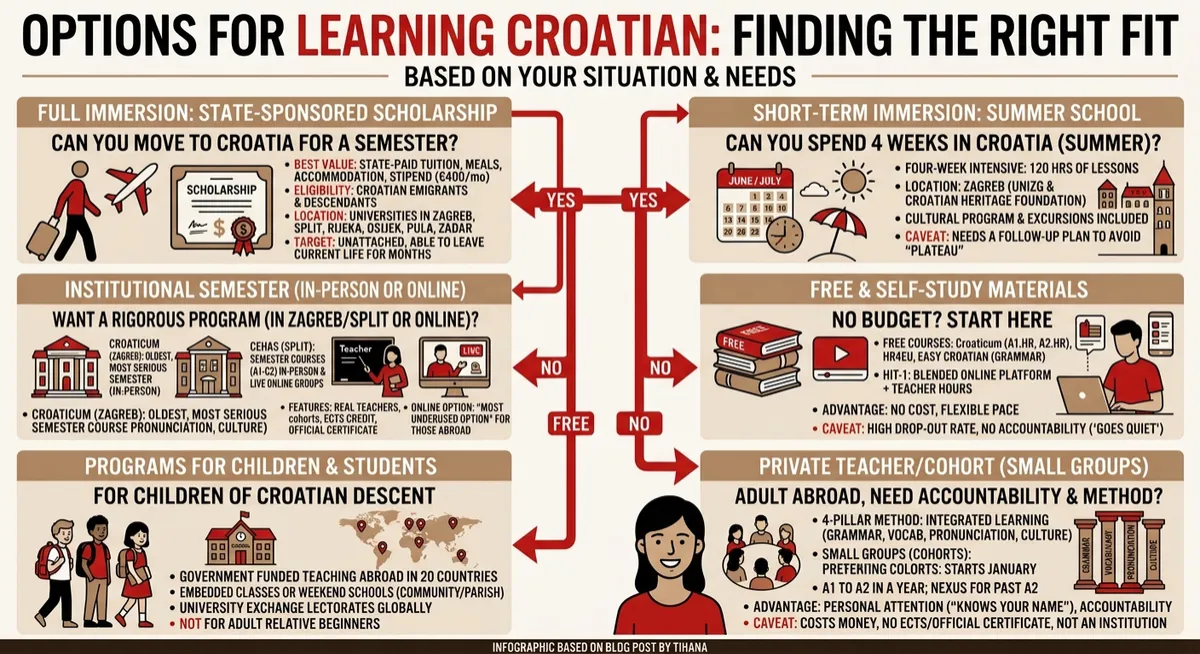
If you can come to Croatia for a semester, the state will pay you to
This is the part of the landscape most people never hear about, and it is the most generous thing on the list.
The Ministry of Demography and Immigration, Ministarstvo demografije i useljeništva, awards scholarships to Croatian emigrants, their descendants, and their family members, for learning Croatian in Croatia. The 2025/2026 package covers the course itself, subsidised meals, subsidised student accommodation where places are available, and a monthly stipend of 400 euros, raised from 300. The courses run at the humanities faculties in Zagreb, Split, Rijeka, Osijek and Pula, and at the University of Zadar. The state budgeted just over a million euros for it this academic year.
The ministry notes that most recipients come from South America. That single fact tells you a great deal about which parts of the diaspora have kept both the paperwork and the will, and about how much room there is for the rest of you.
This is the best value in the entire landscape and almost nobody I teach can take it. It asks you to leave your life for months. If you are twenty-three and unattached, apply this year. If you are fifty-one with a mortgage and a job in Melbourne, read on.
If you have a summer, there is a four-week school in Zagreb
The University School of Croatian Language and Culture is run jointly by the University of Zagreb and Hrvatska matica iseljenika, the Croatian Heritage Foundation. In 2026 it runs from 23 June to 17 July: four weeks, 120 school hours, five hours a day from Monday to Friday, for participants over seventeen. The academic programme costs 800 euros, the cultural programme a further 250, and a shared room in a hall of residence 220. Alongside the grammar there are lectures on Croatian culture and history, museum visits with people who know what they are looking at, and excursions to Plitvice and Zagorje. Scholarships for it exist through the same ministry.
Four weeks of daily Croatian will change your ear. It will not, on its own, change your grammar, and I say this as someone who has watched people come home from summer schools elated and then plateau by October, because four weeks of intensity followed by ten months of nothing is not a method. Go, and go with a plan for what happens in September.
If you want a full semester and you can be in Zagreb or Split
And here is the part almost nobody abroad seems to know: CEHAS also teaches online, live, at every level, seventy teaching hours a semester, in groups of five to fifteen. If you want an institution, a real teacher, ECTS credit, and a document at the end of it, and you cannot leave your country, that is currently the most underused option in this entire article. I am telling you about a competitor. It is the right answer for some of you.
If you have no money for this at all
Croaticum built two free online courses, A1.HR and A2.HR, eighty units of forty-five minutes each, with the interface and instructions available in English and Spanish, aimed explicitly at the descendants of Croatian emigrants. You sign in with a Google account and begin. HR4EU is free too, and so is Easy Croatian, which explains the grammar in long patient sections written by someone who clearly loves the problem.
There is also HiT-1, run by the University of Zagreb together with Hrvatska matica iseljenika and the university computing centre, which pairs an online platform with twenty-four compulsory teaching hours with an actual lecturer. In 2026 it runs from 2 March to 24 May and again from 14 September to 6 December.
These are good materials. Some of them are excellent. I recommend the free Croaticum courses to people every week and I will keep doing it.
But I want to be honest about what free costs you, because it is not nothing. When there is no teacher, no cohort, and no Tuesday evening at which you are expected, the course does not fail. It just goes quiet, and so do you, and six months later the tab is still open on your laptop at unit nine. Nobody notices when you stop. That is the whole problem with self-study for adults, and it has nothing to do with discipline or intelligence.
If it is your children who need this rather than you
Separately, the ministry maintains thirty-four exchange lectorates of Croatian language and literature at foreign universities, plus three centres for Croatian studies in Australia, Canada and the United Kingdom, across twenty-five countries. If you live near one, there may be a Croatian class two kilometres from your house that you have never heard of.
All of this is designed around children and enrolled students. If you are forty-seven and the Croatian in your family went quiet somewhere around 1968, this is not your door, although it may well be your daughter's.
If you are an adult, cannot move, and have already tried the free courses twice
This is my part of the map, so read it with the appropriate suspicion.
I teach adults abroad through a method I call the 4-Pillar Method, which means grammar, vocabulary, pronunciation and culture are taught together inside every lesson rather than as four separate subjects, one of which quietly gets dropped. The Croatian Quadrant takes people from A1 to A2 over a year, live, with one cohort a year starting in January. Croatian Nexus is for people already past A2 who can hold a conversation but still feel the grammar running its checks in the background, and it works through literature, history, music and writing rather than through more exercises. There is a free masterclass that explains the method properly, and if you want the longer version of where to begin, I wrote Learn Croatian: Where to Start for exactly that.
Now the honest part. I am one person, not an institution. I cost more than free and less than a semester in Zagreb. I give you no ECTS credit and no certificate that the Croatian state recognises, so if you need a document for a citizenship file, an employer or a university, go to Croaticum or CEHAS and do not think twice about it. I work with small groups, which means I am often full. And I have opinions about how this language should be taught, which is useful if you share them and tiresome if you do not.
What I offer that the institutions structurally cannot is that I know your name, I know why you are doing this, and I notice on the Thursday you do not turn up.
The question that actually decides it
People ask me which of these is best, and it is the wrong question. The state scholarship is objectively the most generous. Croaticum is the most rigorous. The free courses cost nothing. All of that is true and none of it will help you choose.
The question is which one you will still be doing in March.
Croatian gets learned in the ordinary weeks, the ones where you are tired and it is raining and you go anyway. January enthusiasm carries nobody past February. Every option above works for the person whose life it genuinely fits, so choose the one that fits yours, and be suspicious of the one that merely flatters your intentions.
And if you are still not sure, write to me at [email protected]. I will tell you honestly when the answer is somebody else on this list. I have sent people to Croaticum before and I will do it again. What matters to me is that you get the language back, whoever hands it to you.
Svako dobro, Tihana
Tihana Klepač is an Associate Professor at the University of Zagreb’s Department of English and the founder of TalkTime Croatian. She teaches the Croatian Quadrant™, a structured, culturally immersive course designed to help learners stop translating and start thinking in Croatian. Find out more at:talktimecro.com.