The One Who Wouldn't Switch
In a great many of those houses there was a sound, and if you grew up inside one you will know it before I have finished the sentence.
A woman at a stove, talking. She turns her head towards her husband and the sentence comes out in Croatian. She turns her head towards you, in the same breath, without a pause, and the next sentence is in English.
Stop there for a moment, because what is happening in that doorway is not nothing.
For eighteen years the language was in that room. Every day. At volume. Fluent, fast, unhesitating, full of jokes you could hear landing. And in eighteen years, almost none of it was ever aimed at you.
That is not neglect. Nobody sat down and decided it. There was no meeting, no vote, no evening where the family agreed that Croatian would go to the adults and English would go to the children. And yet it ran that house for two decades with the consistency of legislation.
I want to give it its proper name today, because the name changes what you are allowed to feel about it. That was a language policy. And the reason you can or cannot speak Croatian now has almost nothing to do with how much anybody in your family loved Croatia.
The one link that decides it
Start with the man who spent his life on this question.
Joshua Fishman built a scale of eight stages describing how badly a language has been disrupted and, therefore, where the work of saving it has to begin. Stage eight is a language kept alive by a handful of elderly speakers. Stage one is a language with full cultural autonomy, its own schools, its own government offices, its own upper reaches.
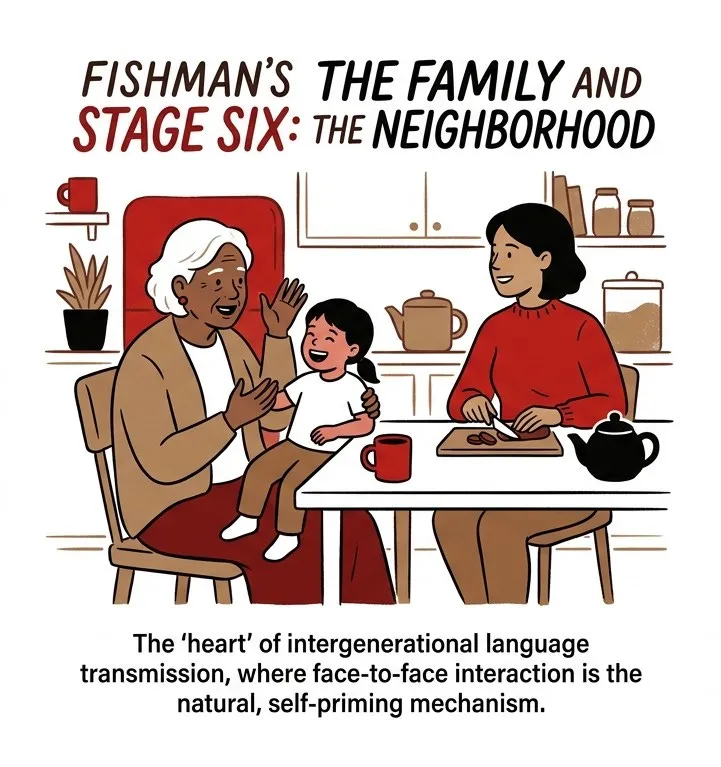
And sitting in the middle, at stage six, is this: the family, the neighbourhood, the community. The ordinary daily business of one generation speaking to the next.
Fishman does not describe it as one stage among eight. He describes it as “the heart of the entire RLS venture,” and the reason he gives is worth quoting properly, because it is the whole argument in one sentence:
it is inescapably true that the bulk of language socialisation, identity socialisation and commitment socialisation generally takes place through intergenerationally proximate, face-to-face interaction and generally takes place relatively early at that. (Fishman 20)
Now the part that is harder to hear. Fishman’s claim is not that stage six is important. His claim is that without it nothing else counts:
if this stage is not satisfied, all else can amount to little more than biding time, at best generation by generation, without a natural, self-priming social mechanism having been engendered thereby. (21)
Biding time. That is the phrase for everything that happens above the family when the family link is broken.
What this says about the Saturday school
I want to be careful here, because I am about to say something that could sound cruel about a great many well-meaning institutions, including some that people gave their weekends to for thirty years.
Fishman is unsparing about the stage just below the family, which he calls stage seven: the endless public events, the concerts, the lectures, the courses, the folklore evenings, the anniversaries, the radio programmes. He calls them, without malice, rallies of the last Mohicans. They enthuse the already enthusiastic. And then:
It is hard for a thousand ‘old-timers’ who attend an absolutely first rate ‘pageant for Xish’ to believe that on the morning after Xish is still no better off than it was on the night before. (Fishman 20)
He says the same about media and official recognition, and his line on it is the one I would put above the desk of anyone running a diaspora organisation:
It is doubtlessly harder to build Xish neighbourhoods and to assist Xish-speaking families than to broadcast in Xish on the television. (25)
And about schools, he is blunter still, warning against the academic reflex of treating education as the universal solution, and adding that “The Irish experience alone should disabuse us of that fallacy” (24).
None of this means thefolklorgroup was a waste, or the Croatian Saturday school, or the parish, or thetamburica. I do not think that and neither did he. What it means is narrower and more useful. Those things can carry a language forward only if there is already a house somewhere in which the language is being spoken to a child on an ordinary Tuesday, for no occasion at all.
The pageant cannot do the Tuesday’s work. Nothing can do the Tuesday’s work except the Tuesday.
Then the children go to school
So the whole thing rests on the home. Which brings us to the finding that explains what actually happened in yours.
In the late 1980s, Lily Wong Fillmore ran a study with no funding at all, which she called, drily, the No-Cost Study on Families. Volunteers across the United States interviewed around eleven hundred language-minority families. She analysed a thousand and one of them, and asked a simple question: had the language of the home changed since the children started preschool, and in which direction?
Just over half the families, 50.6 per cent, reported a negative change, meaning a shift away from the home language and into English. In her comparison group, whose children had attended preschools conducted entirely in the home language, the figure was 10.8 per cent (Wong Fillmore 333).
Break it down further and it gets sharper. Among families whose children were in English-only preschools, 64.4 per cent reported the shift. Among those whose children were in home-language programmes, 26.3 per cent. And positive change, meaning the home language actually strengthening, was reported by 42.1 per cent of the home-language families and by 2.8 per cent of the English-only ones (333).
Fifteen times more often.
And there is a detail in that table which I think is the most important number in the whole study, and which is not what the reader expects. Bilingual programmes, the ones designed precisely to protect the first language, only partly did. Nearly half those families, 47.2 per cent, still reported the shift. Wong Fillmore writes it plainly: “Sad to say, bilingual education does not appear to offer children enough protection from language shift” (333).
Even the good version was not enough. That is not a story about anyone’s choices. That is a story about the size of the force.
Why the child does it
Here is where the blame you have been carrying, or aiming at your parents, should start to come apart.
The shift almost never begins with the parents. It begins with the child, and Wong Fillmore’s account of why is the least sentimental and most humane thing I have read on the subject:
Language-minority children are aware that they are different the moment they step out of their homes and into the world of school. They do not even have to step out of the house. They have only to turn on the television and they can see that they are different in language, in appearance, and in behavior, and they come to regard these differences as undesirable. They discover quickly that if they are to participate in the world outside the home, something has to change. (342)
And then the sentence that dissolves the moral framework entirely:
Although young children neither know nor care about prestige and status, they do care about belonging and acceptance. (342)
Nobody is choosing against Croatian. A four-year-old has no position on Croatia. A four-year-old has worked out, in about a fortnight, that there is a room they want to be inside, and a password for getting in, and that the password is not the language their mother uses at the stove. Fifty years ago Robert Gardner and Wallace Lambert gave a name to the desire to become like the people who speak a language, and called it integrative motivation, and treated it as the great engine of language learning (Gardner and Lambert). It is. It is also, pointed the other way, the great engine of language loss.
Wong Fillmore notes that children reach this conclusion “whether they are in all-English classes or bilingual classes” (342). They are not reading the timetable. They are reading the room.
What actually gets lost
And now the passage. I have read a great deal for this series and this is the one I keep coming back to, and I am going to give it to you whole:
What is lost is no less than the means by which parents socialize their children: When parents are unable to talk to their children, they cannot easily convey to them their values, beliefs, understandings, or wisdom about how to cope with their experiences. They cannot teach them about the meaning of work, or about personal responsibility, or what it means to be a moral or ethical person in a world with too many choices and too few guideposts to follow. What is lost are the bits of advice, theconsejosparents should be able to offer children in their everyday interactions with them. Talk is a crucial link between parents and children: It is how parents impart their cultures to their children and enable them to become the kind of men and women they want them to be. When parents lose the means for socializing and influencing their children, rifts develop and families lose the intimacy that comes from shared beliefs and understandings. (Wong Fillmore 343)
She has a phrase elsewhere for what a parent is reduced to when the shared language thins out. They learn enough of the new language, she says, “to deal with, if not communicate with, the children” (338).
If you have ever watched a grandparent and a grandchild manage each other politely across a kitchen table with about forty words between them, you have seen it. Nobody is unkind. Nothing is wrong. And there is a whole person on each side of that table who cannot get to the other one.
The forces on your parents
So why did they not just hold the line?
Some of them did, and I will come to that. But look honestly at what was pressing on the ones who did not.
Fishman, who spent his career among minority communities and had no illusions about them, writes that “The social meaning of being a minority is that one is forced to spend almost all of one’s resources on damage control, i.e. on merely staying alive within a reality that is not of one’s own making and not even under one’s own substantial ability to influence” (31). He notes that the traditional family itself “has been eroded by the very same universalising macro-forces that erode small languages and caring neighbourhoods” (29). And he observes, without judgement, that language shift spreads because it works, because it has “proved itself to be rewarding,” and that “People cannot be tricked into supporting” the alternative (18).
But the sharpest part is this, and it is the part almost nobody in the diaspora knows.
They were told to do it.
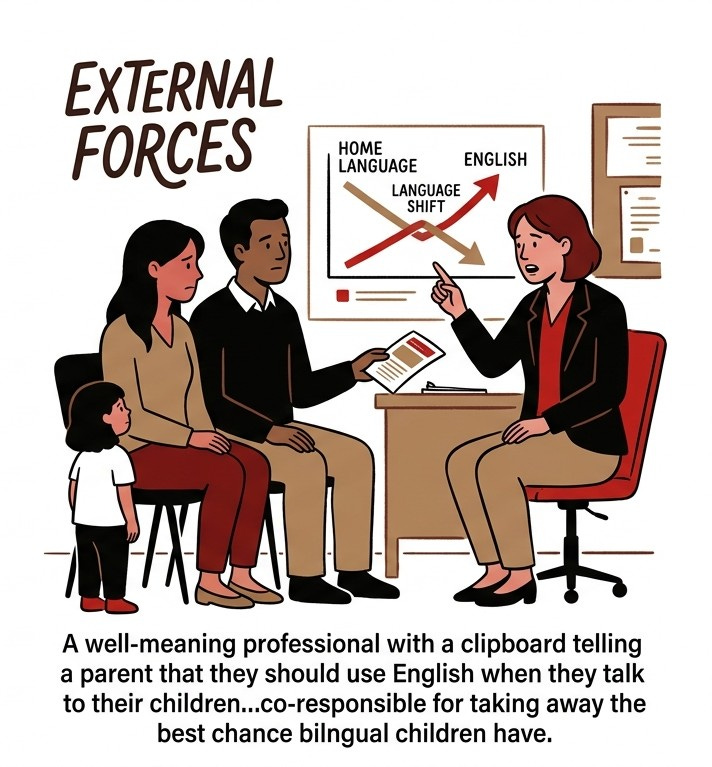
Wong Fillmore ends her article with a warning aimed directly at the profession: “Teachers should be aware of the harm they can do when they tell parents that they should encourage their children to speak English at home, and that they themselves should try to use English when they talk to their children” (345–46).
That advice was given, constantly, for decades, by teachers, by speech therapists, by paediatricians, to frightened immigrant parents who had every reason to believe that people with qualifications knew more than they did about raising a child in a country they had just arrived in. Annick De Houwer, writing thirty years later, is not gentle about it. She calls such advice “ethically reprehensible and legally unacceptable” (De Houwer 76–77), and says that professionals who give it are “co-responsible for taking away the best chance bilingual children have to grow up harmoniously: Supportive and rich language input from expert speakers who love them” (77).
Read that last phrase again. Expert speakers who love them. That is what your grandmother was, and somebody in a school office told her to stop.
So when you go looking for the moment Croatian left your family, do not look for a failure of loyalty. Look for a parents’ evening. Look for a doctor’s appointment where somebody worried aloud about the child’s English. Look for a well-meaning professional with a clipboard telling a woman who spoke four dialects of Croatian that she was holding her son back.
Mixed marriages, shame, and the one who held the line
Three more forces, and then I will turn.
The mixed marriage is the commonest, and it is rarely anybody’s fault either. When one parent does not speak Croatian, the household language becomes the language both adults share, because that is the only sentence everybody at the table can be inside. And there is a line quoted by Elizabeth Lanza, from a handbook for bilingual families, that has stayed with me since I first read it. When a family fails to establish the minority language, “someone will lose their linguistic identity, and it is usually the mother” (qtd. in Lanza 46).
Usually the mother. Sit with that.
Then shame, which does not need much explanation to this readership. Croatian carried, in many places and many decades, an accent and a set of assumptions that a parent had spent years learning to shed and had no intention of hanging around their child’s neck.
And then, in some families, there was the one who held the line. Abakawho simply would not do it, who answered English withmolim?until you gave up, who was regarded by the rest of the family as slightly difficult about this one subject. If your Croatian exists at all, it very often comes from exactly one person, and that person was usually considered a bit stubborn at the time.
You might, at some point today, work out who yours was.
Four pillars, and where transmission actually lives
A word about the method, because this letter locates itself in it very precisely.
Transmission is not one of the four. Transmission is thefloor. It is the condition under which any of the four can be handed to anybody, and when it goes, all four go together and in the same generation.
But notice which pillar it most resembles. Not grammar and not vocabulary, which is why the Saturday school could not save it. Culture. Because passing a language on is not a teaching act at all. It is a room where the language is used for real purposes by people who are not thinking about the language. Fishman knew this and said it better than I can, listing what it is that the family actually transmits: “conversation, games, stories, songs, proverbs and felicitous expressions, verbalised emotion, verbal ritual and verbal play” (29).
Nobody can put that on a syllabus. That is the whole difficulty, and it is also, if you are still in a position to build one, the whole opportunity.
The number, and the mercy
I will close the open half with two things from De Houwer.
The first is a number that should be better known than it is. In a survey of 2,250 families in Flanders, covering 5,335 children whohearda home language from one or both parents, a quarter of those children did not speak it. They only spoke the societal language. The same proportion turns up again in Australia, in Canada, and among adolescents in the United States (De Houwer 75).
A quarter. Of children who had the language spoken to them, at home, by a parent, every day.
Which tells you that hearing it is not enough, and never was, and that whatever happened in your house was happening in a quarter of the houses on that street.
And the second thing is the sentence she ends on, and it applies to more people reading this than she could have imagined:
The good news is that Harmonious Bilingualism is possible even after families have had negative experiences. (De Houwer 79)
Not that the lost years come back. They do not. But that the relationship between a family and its language is not settled once, in 1974, in a kitchen, by a decision nobody knew they were making.
It can be reopened. Which is what the rest of this letter is about.
Works Cited
Lambert, Wallace E. “Culture and Language as Factors in Learning and Education.”Education of Immigrant Students, edited by Aaron Wolfgang, Ontario Institute for Studies in Education, 1975, pp. 55–83.
Tihana Klepač is an Associate Professor at the University of Zagreb’s Department of English and the founder of TalkTime Croatian. She teaches the Croatian Quadrant™, a structured, culturally immersive course designed to help learners stop translating and start thinking in Croatian. Find out more at talktimecro.com.
Originally published on the Saturday Letter from Zagreb.
Keep learning Croatian with Tihana
Listen and watch
Ćakula Café podcast, on Spotify — Slow Croatian for heritage speakers and diaspora adults at A2–B1.
Ćakula Café, on Apple Podcasts — The same podcast, for listeners on iPhone and Mac.
Ćakula Café, on Castbox — The same podcast, for listeners who prefer Castbox.
TALK TIME on YouTube — Free Croatian lessons and films, with cultural context.
Podcast episodes on Substack — Audio companions to the Saturday Letters.
Start here, free
Learn Croatian: Where to Start — A beginner’s orientation for adults learning Croatian.
The Free Masterclass — An introduction to the 4-Pillar Method and the logic of Croatian grammar.
The Konoba Test — A short quiz on where you are actually standing in Croatian.
Saturday Letter from Zagreb — A weekly essay on language, culture and belonging, free in your inbox.
Courses and books
Croatian Entry Point — A1 self-study: eight weeks of culture-driven lessons, lifetime access.
The Croatian Quadrant™ — A1–A2 flagship live programme, one cohort a year; join the waitlist.
Level Up Croatian — A2 self-study: daily fifteen-minute lessons in weekly themes.
Short Stories in Croatian — Ebook for A2–B1: nine original stories with audio, glossary and grammar notes.
Croatian Nexus — Post-A2 live seminars: where the language becomes literature.
More Saturday Letters
The Silence Between Generations — What is lost when a language is not passed on, and what can still be recovered.
Coming Home in a Language You Half Remember — The returnee’s wall at the counter, and why the language is closer than you think.
Inat — The word your grandfather lived by, and where it came from.
The Word That Will Not Cross — Why čežnja is not longing and fjaka is not laziness.
Does Croatian Make You Think Differently? — What is real, and what is beautiful nonsense, in the idea that a language shapes a mind.
The Kitchen Was a Language Policy — Why Croatian was, or was not, passed down to you.
What English Does to Your Croatian While You Sleep — Why your grandmother’s Croatian did not stay frozen the day she left.
Why You Feel Like a Different Person in Croatian — Why volim te weighs more than I love you.
You Are Not a Tourist in Your Own Language — The emotional case for coming home one register at a time.
The Konoba Test: Where Are You Actually Standing? — Why “what level is my Croatian” is the wrong question.
The Small Words That Give You Away — Why flawless Croatian can still mark you as a stranger: pa, ma, daj and the third rakija.
The Country Inside the Word Kaj — How the old language of the north became a place you carry.
Slavonia: The Gateway Dialect — The oldest Croatian štokavian is hiding in the east.
Who Gets to Tell the Story — Postcolonial theory, a nineteenth-century pamphlet and your grandmother’s Croatian.
Follow