She's One of Ours
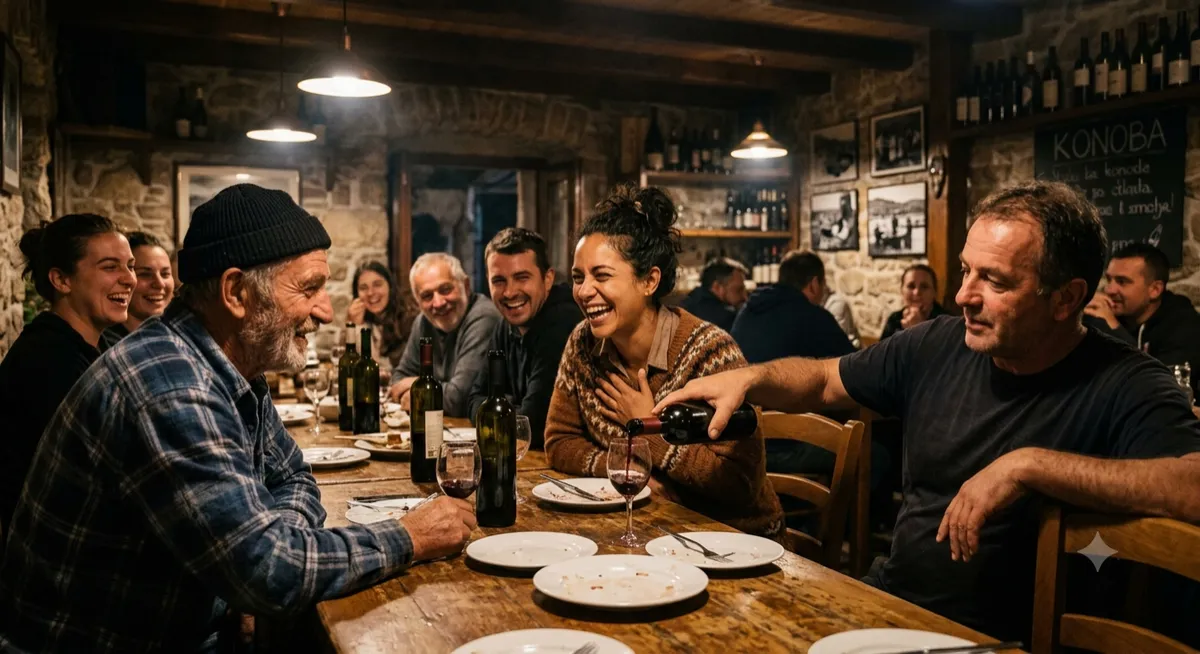
There is a konoba I know on an island I will not name, because the last thing it needs is more of us, and one evening last September I watched a woman cross a threshold that no examiner will ever be able to certify. She was from somewhere in the Southern Hemisphere, third generation, and she had spent the whole of the dinner being handled the way we handle guests, which is to say with a gentleness that is also a kind of distance. People slowed down for her. They chose easier words. They translated the punchlines. And then, late, when the plates had been cleared and the second bottle had appeared without anyone asking for it and the talk had loosened into that register I have spent this entire series trying to describe to you, something happened. An old man told a long, circular, filthy story about a priest and a donkey and a wedding in 1974, and at the exact moment the room broke, she broke with it. Not a beat late. Not translated. She laughedinsidethe joke, from within it, and the man beside her, without turning his head, without ceremony, without the special kindness he had been showing her all night, refilled her glass and said, to no one in particular,naša je— she’s one of ours.
That is the whole of what we have been reaching for, across twelve Saturday letters. Not the grammar. Not the accent. That sentence. Naša je.Said carelessly, in passing, by someone who has stopped keeping track.
I have been writing to you since May, and I have given you a great deal of linguistics. The four accents and the melody the bakery woman reads in three seconds. The three dialects and where your people sit on the map. Slavonia, the oldest štokavian, hiding in the east. Dalmatia and its Venetian sediment. The country folded inside the wordkaj. The small words that give you away,paandmaanddaj. The heritage grammar that is different and not broken. The accent you will never quite close. The six thresholds from the counter to the table. I have quoted phoneticians and dialectologists and heritage-language scholars at you, page number after page number, because I believe the shame so many of you carry is best dissolved by evidence, and because I am a scholar and it is the only way I know how to love a subject.
But this is the last letter in this series – the Konoba series. And in the last letter the linguist has to step back from the microphone, because the thing I actually want to say to you cannot be footnoted, or can only be footnoted at the edges, and I would rather say it plainly and let the citations stand at the back like witnesses.
Here it is. You did not undertake this in order to communicate. If communication were the goal you would have stopped years ago, because you can already communicate — in English, in Spanish, in German, in whatever language now does the heavy lifting of your days. Croatian is not, for you, a tool you lack. It is a room you are locked out of. And the difference between a language as a tool and a language as a room is the difference this whole series has been walking around, and it is time to say it out loud.
The scholars have a way of putting it that I have carried with me for years. When Jasna Čapo Žmegač studied Croats who had been resettled inside Croatia — people with the citizenship, the ethnicity, the passport, every credential belonging is supposed to require — she found that shared nationality was, in her words, “too general and too abstract to bind the two groups” together (Čapo Žmegač 13). They remained strangers. And the thing that gave them away, the thing that kept the door shut, was their speech — their own inherited Croatian, which sounded wrong to local ears, and which “immediately gave them away” as being from elsewhere (Čapo Žmegač 67). She called the bookStrangers Either Way. Either way. With the credentials and without them. The passport was never the door. The speech was the door.
And so the ones who were let in, in her fieldwork, were the ones who made a deliberate decision to change how they spoke — not to acquire Croatian, which they already had, but to acquirethisCroatian,here, the local variety of the specific place they now stood in (Čapo Žmegač 68). One of them, a man who had lived in Switzerland, said the thing that has stayed with me for a decade: “Just like I had to speak Swiss German there, I knew when I came here that I would have to change my speech. I must behave the way they behave here” (qtd. in Čapo Žmegač 68). He understood, from a life spent at borders, that belonging to a place and belonging to its language are two different acts, and that the second is work the first does not do for you.
This is not cruelty. I want to be careful here, because it would be easy to read all of this as a verdict, as the country standing at its own door with its arms folded, deciding who is Croatian enough. That is not what it is. Caroline Hornstein Tomić and Sarah Scholl-Schneider, studying Croatian returnees, borrowed a phrase from the sociologist Pierre Bourdieu that gets it exactly right: belonging to a place is agame, with rules that are unwritten, assumed, enacted unconsciously by everyone who grew up inside them, and that therefore must be learned, deliberately and from outside, by anyone who arrives (Hornstein Tomić and Scholl-Schneider 314). Coming home, they concluded, is more often “an ‘away match’ than a ‘home game’” (Hornstein Tomić and Scholl-Schneider 314). Nobody is being unkind to you when they hear that you are not from here. They are simply playing the game they have always played, at the speed they have always played it, and waiting — usually with enormous goodwill — to see whether you will learn the rules well enough to be playedwithrather thanaround.
The rules are the registers. That is the argument I have been making since the first letter, dressed in a hundred different linguistic costumes. There is the Croatian of the counter and the Croatian of the konoba, and every Croatian alive moves between them without thinking, and what you are learning is not “Croatian” but themovement— the switch from the official person to the konoba person, the thing your grandmother did ten thousand times a day and never once explained, because she could not have. And you learn it in order, one register at a time. The standard first, because it is the door into adult life, the bank and the clinic and the office, the register that lets you be understood by every Croatian regardless of where they are from. And then, slowly, over years, the local variety of your own people, because that is the door into the other thing. The table. Thenaša je.
I promised you, back in the very first letter, that the second door was not a wall. That it only looked like a wall, and that once you understood its structure it became what it actually was, which is a door, one that opens to the people who keep standing in front of it. I have spent eleven Saturday letters showing you the structure. Now I want to tell you why the door is worth all of this, when the tool you already have would let you order the coffee and read the sign and ask the way to the pharmacy for the rest of your life.
It is worth it because of Oliver.
The summer Oliver Dragojević died, the whole coast sang him down to the sea, and I wrote to you about it in the Saturday letter on accent — the thousands of people on the Riva in Split, the boats, the vowels opening in the same shape at the same time. But I did not tell you, then, the thing I actually think about when I think about Oliver, and it belongs here, at the end, because it is the emotional centre of everything.
Oliver was not, by the measures a conservatory would use, doing anything a hundred other singers could not do. What he had was the thing you cannot be taught and cannot fake and cannot buy: he sounded like the place. When he sangča je život vengo fantažija— what is life but fantasy, and note theča, the coastalča, the word that is the whole of Dalmatia compressed into one syllable — nobody in the country checked his pitch. Nobody graded his vowels. The voice was enough. The rhythm was enough. He opened his mouth and the sea came out, and a whole nation heard, in the first phrase,one of ours, and gave him the thing it gives to almost no one, which is to be believed completely. The phoneticians who have studied the Split accent describe its particular music, that rising-then-falling double lift, as “a prestige and well-liked variety in Croatia, associated with popular music and sporting personalities” — a sound the whole country recognises as coming “from somewhere warm and specific,” and places instantly, and places with affection (Tabain et al. 207).
Here is what I want you to take from that. The ear that placed Oliver in half a phrase, that gave him its whole trust on the strength of a vowel — that ear is not your enemy. It is the same ear that will, one day, placeyou. Not as Oliver. You will never sound like you are from Split, and I told you that honestly in the Saturday letter on accent, and I meant it. But the ear that rewards the sound of belonging does not, it turns out, require perfection. It requiresdirection. It rewards the voice that is turned toward the sea rather than away from it. The locals were never going to expect you to sound like them. They were only ever going to listen for whether you were trying to come toward them, rather than asking them to come toward you — and that, in this country, is very nearly the whole of it.
So no. You are not a tourist. A tourist stands outside and photographs the door. You were born on the inside of something and then carried, by an ocean and a century and somebody’s brave decision to leave, to a place where the door had quietly closed, and what you are doing now — with your grammar book, with your grandmother on a video call, with your ridiculous, unglamorous shadowing of Oliver in the kitchen while the pasta boils — is not learning a foreign language. It is walking back in. One register at a time. The long way round.
The table from the first letter is still there. The wine is still open. Only now I am not asking you to come and sit down. I am telling you that the chair was always yours, and that the work of these twelve Saturday letters was never to earn it, but to learn to hear that it was already set.
If you're only just starting out, this is where to begin: Learn Croatian: Where to Start.
Works Cited
Hornstein Tomić, Caroline, and Sarah Scholl-Schneider. “An Easy Game? Experiences of ‘Homecoming’ in the Post-Socialist Context of Croatia and the Czech Republic.”Return Migration and Regional Development in Europe: Mobility Against the Stream, edited by Robert Nadler et al., Palgrave Macmillan, 2016, pp. 309–328.
Polinsky, Maria.Heritage Languages and Their Speakers.Cambridge University Press, 2018.
Tihana Klepač is anAssociate Professor at the University of Zagreb's Department of Englishand the founder of TalkTime Croatian. She teaches theCroatian Quadrant™,a structured, culturally immersive course designed to help learners stop translating and start thinking in Croatian. Find out more at:talktimecro.com.
Originally published on the Saturday Letter from Zagreb — read the rest, or listen to the full episode, [on Substack →]https://talktimecroatian.substack.com/p/your-saturday-letter-from-zagreb-faf?r=7l683a&utm_campaign=post&utm_medium=web
Keep learning Croatian with Tihana
Listen and watch
Ćakula Café podcast, on Spotify — Slow Croatian for heritage speakers and diaspora adults at A2–B1.
Ćakula Café, on Apple Podcasts — The same podcast, for listeners on iPhone and Mac.
Ćakula Café, on Castbox — The same podcast, for listeners who prefer Castbox.
TALK TIME on YouTube — Free Croatian lessons and films, with cultural context.
Podcast episodes on Substack — Audio companions to the Saturday Letters.
Start here, free
Learn Croatian: Where to Start — A beginner’s orientation for adults learning Croatian.
The Free Masterclass — An introduction to the 4-Pillar Method and the logic of Croatian grammar.
The Konoba Test — A short quiz on where you are actually standing in Croatian.
Saturday Letter from Zagreb — A weekly essay on language, culture and belonging, free in your inbox.
Courses and books
Croatian Entry Point — A1 self-study: eight weeks of culture-driven lessons, lifetime access.
The Croatian Quadrant™ — A1–A2 flagship live programme, one cohort a year; join the waitlist.
Level Up Croatian — A2 self-study: daily fifteen-minute lessons in weekly themes.
Short Stories in Croatian — Ebook for A2–B1: nine original stories with audio, glossary and grammar notes.
Croatian Nexus — Post-A2 live seminars: where the language becomes literature.
More Saturday Letters
The Silence Between Generations — What is lost when a language is not passed on, and what can still be recovered.
Coming Home in a Language You Half Remember — The returnee’s wall at the counter, and why the language is closer than you think.
Inat — The word your grandfather lived by, and where it came from.
The Word That Will Not Cross — Why čežnja is not longing and fjaka is not laziness.
Does Croatian Make You Think Differently? — What is real, and what is beautiful nonsense, in the idea that a language shapes a mind.
The Kitchen Was a Language Policy — Why Croatian was, or was not, passed down to you.
What English Does to Your Croatian While You Sleep — Why your grandmother’s Croatian did not stay frozen the day she left.
Why You Feel Like a Different Person in Croatian — Why volim te weighs more than I love you.
You Are Not a Tourist in Your Own Language — The emotional case for coming home one register at a time.
The Konoba Test: Where Are You Actually Standing? — Why “what level is my Croatian” is the wrong question.
The Small Words That Give You Away — Why flawless Croatian can still mark you as a stranger: pa, ma, daj and the third rakija.
The Country Inside the Word Kaj — How the old language of the north became a place you carry.
Slavonia: The Gateway Dialect — The oldest Croatian štokavian is hiding in the east.
Who Gets to Tell the Story — Postcolonial theory, a nineteenth-century pamphlet and your grandmother’s Croatian.
Follow