Nobody Let Croatian Go
Mobitel.
The word did not exist when your grandmother left. It could not have. There was nothing yet for it to name.
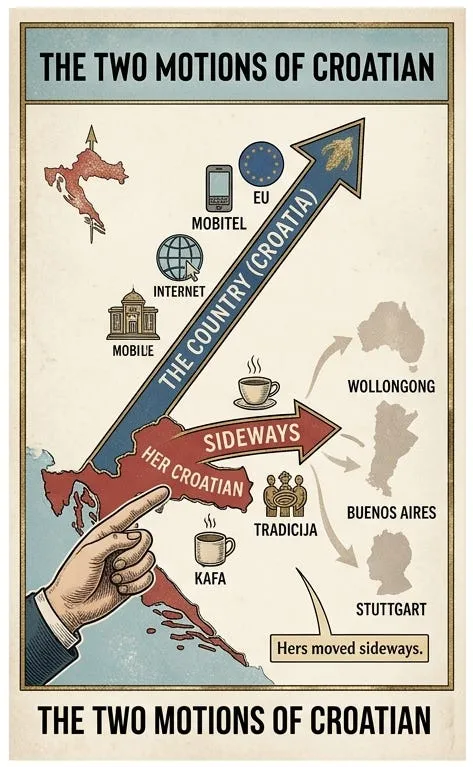
Which points at something ordinary and almost never noticed about the Croatian she carried out of the country. It stopped being able to describe the place she came from at more or less the moment she boarded. Not because there was anything wrong with it. Because Croatian went on without her, inventing words for objects she would never watch arrive, and quietly retiring words for things that stopped existing, and she was not in the room for any of it.
That is the first motion. Here is the second, and it is the one nobody warns you about.
Her Croatian did not sit still either. It went on changing too, in her own mouth, in a kitchen in Wollongong or Buenos Aires or Stuttgart, under sixty years of steady pressure from a language she had to learn in her twenties in order to survive. The country’s Croatian moved forward. Hers moved sideways. And the distance you feel when you speak to a relative in Zagreb and they smile at something you said, and you cannot work out what was funny, is the sum of those two motions running in opposite directions for half a century.
Last week I wrote to you about why Croatian reaches a part of you that English cannot, and I ended on the finding that the feeling never went anywhere, only the access did. Today I want to take the other half of that sentence seriously and ask what actually happens to the access. What English has been doing to your Croatian, quietly, for years, whether or not you were using it.
It has a name, and a literature, and a set of laws. And the laws turn out to be a great deal kinder than the story you have been telling yourself.
Native speakers lose their first language too
Start with the fact that undoes the whole moral framework.
You have almost certainly assumed that losing a language is something that happens to people who did not try hard enough. That a real native speaker, one who grew up inside the language, who had all of it, is safe. That whatever is wrong with your Croatian is a story about your family and their choices, and that if your grandmother’s Croatian was strange by the end it was because she let it go.
None of that survives contact with the evidence.
The phenomenon is called first language attrition, and Monika Schmid, who has done more to establish the field than anyone alive, defines it with almost no ceremony at all: the gradual loss of a language by an individual (First Language Attrition7). Not by a community. Not across generations. By one person, inside one lifetime, in the language they were born into and had complete.
It happens to adults. It happens to people who were monolingual until they were thirty. It happens to writers and teachers and people who love their language and have never once thought of themselves as letting it go. When Schmid tested a group of German speakers who had emigrated to Canada as adults, against a matched group who had stayed in Germany, the emigrants were measurably behind on lexical access after decades abroad. And in a larger study across two languages and two countries, with two hundred and forty-nine speakers, the migrants were outperformed by the people who had stayed on nearly every measure of retrieval: fewer words produced in a timed naming task, lower lexical variety in free speech, and a marked tendency to repeat themselves while hunting for a word (Schmid and Keijzer 93).
These were native speakers. Every one of them. There is no membership card that protects you.
Why it happens, and why it is not neglect
Now the mechanism, because the mechanism is the part that changes how you feel about your own family.
The standard account comes from Michel Paradis and is called the activation threshold hypothesis. Every item you know, every word and ending and sound, sits behind a threshold, and how easily you can get at it depends on two things: how often you have called on it, and how recently (Schmid and Keijzer 86). Use a word this morning and it comes when called. Leave it for twenty years and it has to be dug for.
So far this sounds like ordinary forgetting, and if that were all, the moral story would survive. Use it or lose it. Your fault.
But there is a second half, and it is the half that matters. When you reach for a word, all the similar items in your head compete to be the one that surfaces, and in order for the right one to win, the others have to be actively pushed down. That suppression is not free. Inhibiting a competitor raises its threshold, which means it will be harder to reach the next time you want it (Schmid and Keijzer 87).
Sit with what that means if you live in English.
Every time you saywater, some part of you is holdingvodadown. Every single time. Not once, not occasionally, but every hour of every day for however many years you have been doing it, thousands upon thousands of small suppressions, each one a fraction harder on the Croatian than the last. You were not neglecting the language. You were actively, continuously, and successfully pushing it out of the way, because that is the only way to speak English fluently at all.

Your Croatian did not fall out of use. It was pushed, by you, in order for you to function. The very competence you built in the new country is made out of the mechanism that buried the old one.
There is no version of this in which anyone did anything wrong.
The first ten years, and why the panic stops
Here is a related finding that I would like every recent emigrant to have.
When a person arrives in a new country, the new language comes at them at enormous volume, and simultaneously they have to work extremely hard to hold down a first language that is still fully active and keeps trying to answer. That effort produces a sudden and steep rise in the threshold of the mother tongue. Which the person experiences, from the inside, as what Schmid and Keijzer describe as a fast and often startling sense of language loss, right in the first decade (87).
Anyone who has emigrated knows this. The terror at about year four when you cannot find a word in your own language, in front of your own mother, on the telephone.
And then, they note, the curves flatten. As the second language settles and the switching becomes routine, the forgetting slows down with it (Schmid and Keijzer 87). The panic of the first decade is not the beginning of an unbroken slide into silence. It is the loudest part of the process, and it is loud precisely because the language being suppressed is still so strong.
The people who describe this most vividly are usually the ones who have lost the least.
What actually goes, and what does not
Now to the question you actually want answered, which is how much of it is gone.
Far less than you think, and not the parts you fear.
In 2014 Schmid ran a study designed to settle something else entirely, and produced a result that matters enormously here. She took twenty long-term German emigrants in Canada, most of them decades abroad, and compared them not only to monolingual Germans but to twenty highly advanced learners of German, matched for proficiency and for how much German they used. She then measured eleven separate morphological and syntactic features in their free speech: case, gender, plural, verb morphology, word order.
The emigrants did not differ from the monolinguals on a single one of them (Schmid, “Maturational Constraints” 400). Not one, across eleven features, after an average of thirty-seven years away, with some of them having lived abroad for more than fifty. The advanced learners, meanwhile, were significantly less accurate than both groups on almost everything, and not a single learner in the study reached the emigrants’ range across the board (402).
The grammar holds. The system you were given as a child holds, in adults, for decades, under conditions of near-total disuse. What Schmid says of it is that these speakers show interference and increased optionality in their native language, but no representational deficit, because they acquired it monolingually in childhood (386).
So what does go?
The words. And the speed. In that same study, the one place the emigrants did fall significantly behind the monolinguals was a timed task asking them to name as many things in a category as they could inside a minute (398). Retrieval. Not knowledge, retrieval. The same thing the two-hundred-and-forty-nine-speaker study found: fewer words, more repetition, more hunting.
Which means that when your grandmother hesitated, and reached, and repeated herself, and finally used the English word with a Croatian ending on it, you were not watching a language disappear. You were watching a filing system get slow. Everything was still in there. It was taking longer to come out.
Thirty-five people from Düsseldorf
And now the study that I have been walking toward all letter, and which I want to handle carefully, because it concerns something that ought to be handled carefully.
In the late 1990s, the Düsseldorf Holocaust Memorial Center collected interviews with German Jews who had escaped Germany between 1933 and 1939. Fifty-four of them, around two hundred and seventy thousand words, recorded in England and the United States, where they had lived ever since. All of them had grown up in the same city, in a monolingual German environment, and all of them had left it between the ages of eight and thirty. By the time they were recorded, every one of them had been away for at least sixty years (Schmid,First Language Attrition63, 190).
Schmid took thirty-five of these interviews, the ones that were German enough throughout to be analysed as German, and asked the obvious question. What predicts how much of the language a person keeps?
The candidates were the ones anyone would name. How old they were when they left. How long they had been gone. How much German they had used since, at home, with a spouse, with friends, with their children.
The factor that outweighed all of them was the date of emigration.
She had divided the group into three, along the fault lines of the persecution itself. Those who got out in the first two and a half years, before the Nuremberg race laws of September 1935. Those who left after the laws but before the pogrom of November 1938. And those who left between that November and the closing of the door in September 1939, a group that includes one woman who did not get out, and survived Auschwitz, and was liberated in 1945 (First Language Attrition72).
The later they left, the more German they had lost. And Schmid is direct about what she found: the emigration date outweighed every other factor, and it did so on six of the seven linguistic variables she measured (185, 189).
What she concludes from it is the sentence this whole letter exists to bring you:
It appears that what is at the heart of language attrition is not so much the opportunity to use the language, nor yet the age at the time of emigration. What matters is the speaker’s identity and self-perception. (First Language Attrition191)
And then, going further:
Someone who wants to belong to a speech community and wants to be recognized as a member is capable of behaving accordingly over an extremely long stretch of time. On the other hand, someone who rejects that language community, or has been rejected and persecuted by it, may adapt his or her linguistic behavior so as not to appear to be a member any longer. (191–92)
Two of her informants say it themselves, and I want to put them next to each other and leave them there. One woman: for a long time she did not wish to speak German, she felt she wanted to cut herself off, from Germany and from its language. And a man in the same corpus, who left earlier: he loves his German mother tongue, he speaks and reads a great deal of it, and the more emotional the subject he is talking about, the more he finds himself using it (77, 76).
Same city. Same language. Same six decades away. Opposite relationships with the thing they carried, for reasons that had nothing at all to do with diligence.
I should say what the finding does not claim, because Schmid is scrupulous about it and I will be too. The effect showed up in the errors and in how native the speakers sounded to Germans rating them. It did not show up in the richness of their vocabulary or in the complexity of their grammar, where the three groups were essentially indistinguishable (186, 192). What persecution changed was the surface. What was underneath was the same in all of them.
What that means for a Croatian family
Croatian departures were rarely neutral either.
I am not going to compare them to what happened to the Jews of Düsseldorf, and Schmid’s finding does not require me to. The Düsseldorf study is the extreme case that makes a general law visible, the way a fracture makes a bone visible. The law is that a language moves in the mouth according to how its speaker stands toward the community that owns it. The Düsseldorf case simply happens to be the one where the stakes were absolute.
But look at your own family in that light.
People left Croatia in the sixties and seventies because there was no work, and some of them were not sentimental about a country that had failed to feed them. People left for politics, in both directions, and carried the argument with them across an ocean and did not put it down. People left in the nineties with a war behind them and a set of feelings about home that could not be spoken about at a dinner table for twenty years. And some people left with nothing but longing, and taught their children the songs, and cried at the sound of aklapain a shopping centre in Melbourne.
Whichever of those your family did, it is in the language. Not as sentiment. As an actual, measurable difference in how much of the grammar survived the crossing.
Which means the strangeness of your grandmother’s Croatian, the gaps in it, the hesitations, the English words with Croatian endings clipped onto them, may be telling you something about what she felt and never said. That the shape of the language in her mouth is a record of her relationship with a place she may have loved, or resented, or both at once, and never once discussed with you.
That is not a defect in her Croatian. That is her Croatian doing what all Croatian does, which is carry the person who is speaking it.
Four pillars, and which two erode
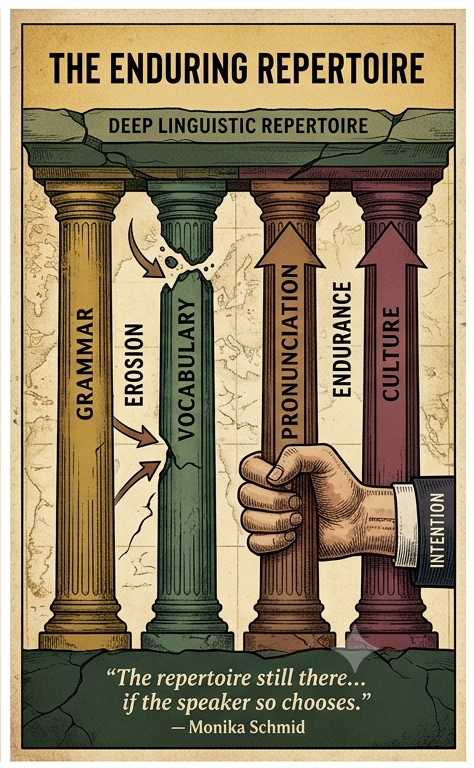
Grammar, vocabulary, pronunciation, culture. The four faces of the one object, and on all four together stands what I call the Croatian Mind.
Vocabulary is where attrition lands hardest and first, and everything in this letter says so. The retrieval slows, the range narrows, the words go under the threshold and have to be dug for. If you have watched an elderly relative struggle, it was almost certainly here.
Grammar is far more robust than anyone expects. Eleven features, decades abroad, no difference from the people who never left.
And pronunciation and culture, the two you were given in the body, are the two least touched of all. The accent survives emigration by decades. The sense of when to speak and when to feed somebody survives it by a lifetime.
So the pillars that erode are the two you can rebuild, and the ones that hold are the two you could never have built in the first place. I do not think that is a coincidence. The things that were laid down early and physically stay. The things that live on shelves, in words and in the order of them, are the things that gather dust.
What Schmid actually found under all of it
I will end the open half of this letter with her own conclusion, because I have not been able to improve on it in the three weeks I have been carrying it around.
Having spent a book establishing that these speakers had drifted, that persecution had marked their language, that sixty years abroad had left visible traces, Schmid looks at the whole corpus and writes:
These findings suggest very strongly that what is affected by prolonged non-contact with the L1 is only actual and momentary control. The deeper linguistic repertoire, including the range and breadth of the lexicon, appears to remain untouched by any systematic process of “erosion” or “attrition”. (First Language Attrition190)
And two pages later, at the very end of the book:
The findings from this study suggest that such insecurities on the part of even long-term emigrants are unfounded. The fact that the full range of the repertoire is still there suggests that full proficiency can be reactivated, if the speaker so chooses. (192)
Sixty years. Persecution. Another continent. Another language in every room. And the repertoire still there, intact underneath, waiting.
Notice that this is the same shape as last week’s finding, arriving from a completely different direction. The feeling did not go anywhere, only the access did. The repertoire did not go anywhere, only the control did.
Two different literatures, two different decades, two different questions, and the same answer both times. The language is not gone. It has been put down.
Things that have been put down can be picked up.
Not sure where your own Croatian stands right now? Start here: Learn Croatian: Where to Start.
Works Cited
Paradis, Michel.A Neurolinguistic Theory of Bilingualism. John Benjamins, 2004.
Tihana Klepač is anAssociate Professor at the University of Zagreb's Department of Englishand the founder of TalkTime Croatian. She teaches the Croatian Quadrant™,a structured, culturally immersive course designed to help learners stop translating and start thinking in Croatian. Find out more at:talktimecro.com.
Originally published on the Saturday Letter from Zagreb — read the rest, or listen to the full episode, [on Substack →] https://talktimecroatian.substack.com/p/your-saturday-letter-from-zagreb-877?r=7l683a&utm_campaign=post&utm_medium=web
Keep learning Croatian with Tihana
Listen and watch
Ćakula Café podcast, on Spotify — Slow Croatian for heritage speakers and diaspora adults at A2–B1.
Ćakula Café, on Apple Podcasts — The same podcast, for listeners on iPhone and Mac.
Ćakula Café, on Castbox — The same podcast, for listeners who prefer Castbox.
TALK TIME on YouTube — Free Croatian lessons and films, with cultural context.
Podcast episodes on Substack — Audio companions to the Saturday Letters.
Start here, free
Learn Croatian: Where to Start — A beginner’s orientation for adults learning Croatian.
The Free Masterclass — An introduction to the 4-Pillar Method and the logic of Croatian grammar.
The Konoba Test — A short quiz on where you are actually standing in Croatian.
Saturday Letter from Zagreb — A weekly essay on language, culture and belonging, free in your inbox.
Courses and books
Croatian Entry Point — A1 self-study: eight weeks of culture-driven lessons, lifetime access.
The Croatian Quadrant™ — A1–A2 flagship live programme, one cohort a year; join the waitlist.
Level Up Croatian — A2 self-study: daily fifteen-minute lessons in weekly themes.
Short Stories in Croatian — Ebook for A2–B1: nine original stories with audio, glossary and grammar notes.
Croatian Nexus — Post-A2 live seminars: where the language becomes literature.
More Saturday Letters
The Silence Between Generations — What is lost when a language is not passed on, and what can still be recovered.
Coming Home in a Language You Half Remember — The returnee’s wall at the counter, and why the language is closer than you think.
Inat — The word your grandfather lived by, and where it came from.
The Word That Will Not Cross — Why čežnja is not longing and fjaka is not laziness.
Does Croatian Make You Think Differently? — What is real, and what is beautiful nonsense, in the idea that a language shapes a mind.
The Kitchen Was a Language Policy — Why Croatian was, or was not, passed down to you.
What English Does to Your Croatian While You Sleep — Why your grandmother’s Croatian did not stay frozen the day she left.
Why You Feel Like a Different Person in Croatian — Why volim te weighs more than I love you.
You Are Not a Tourist in Your Own Language — The emotional case for coming home one register at a time.
The Konoba Test: Where Are You Actually Standing? — Why “what level is my Croatian” is the wrong question.
The Small Words That Give You Away — Why flawless Croatian can still mark you as a stranger: pa, ma, daj and the third rakija.
The Country Inside the Word Kaj — How the old language of the north became a place you carry.
Slavonia: The Gateway Dialect — The oldest Croatian štokavian is hiding in the east.
Who Gets to Tell the Story — Postcolonial theory, a nineteenth-century pamphlet and your grandmother’s Croatian.
Follow