Can You Learn Croatian from Songs? What the Research Says
Originally published on Substack, in the Saturday Letter from Zagreb, as part of the series The Language You Carry.
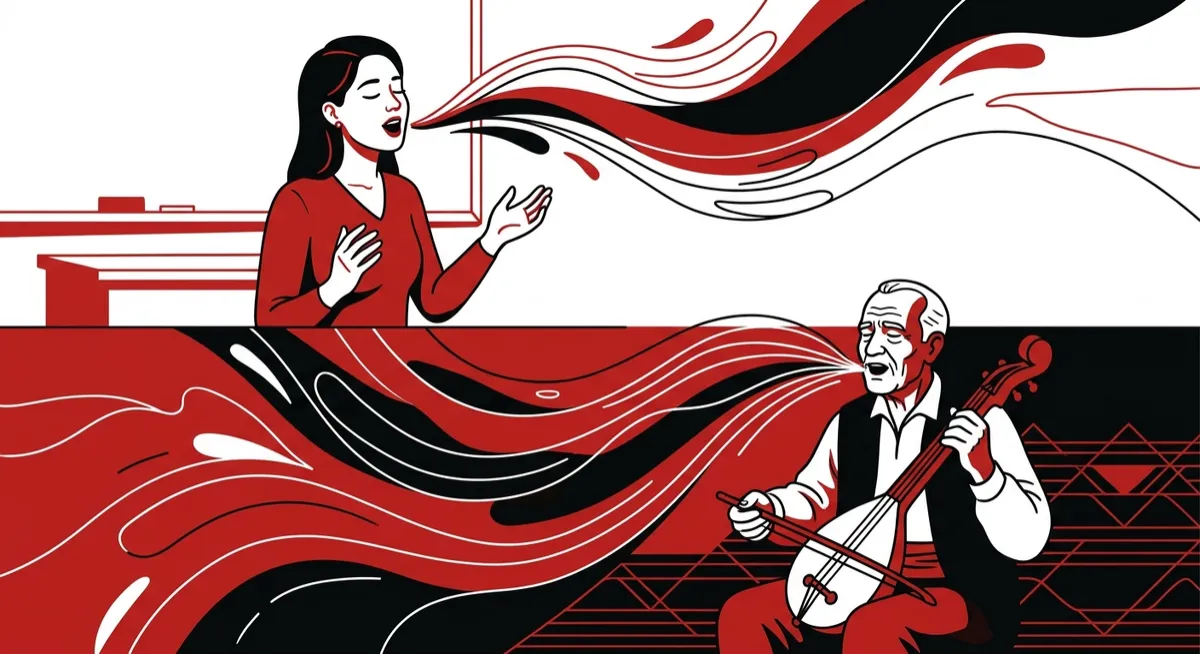
A woman in one of my classes sang me four verses of a song, from memory, with the vowels in the right shape and the phrasing exactly where a Dalmatian would put it.
And then I asked her what it meant, and she could not tell me. Not roughly. Not approximately. She knew it was sad a
nd she knew it involved the sea, which is a safe guess with that repertoire, and beyond that she had nothing.
She apologised, the way people do. She said it was just something her father used to play.
And I remember thinking that she had it precisely backwards, because what she had just done was the difficult half, and the half she was apologising for is the half you can fix in an afternoon with a dictionary.
I have been wanting to write about music for a long time, and I have been putting it off because it is the place where this subject is most sentimental and I did not want to add to that. But there is real research here, and there is a tradition from this part of the world that sits at the centre of the entire world literature on oral memory, and there is one honest limitation that nobody ever tells you.
So let us do it properly.
What actually happened in that classroom
That woman had not performed a party trick. She had demonstrated a pattern that has been measured in a laboratory.
Karen Ludke, Fernanda Ferreira and Katie Overy took sixty adults and taught them phrases in a language none of them knew, which was Hungarian, in a fifteen-minute session. And they split them into three conditions: listen and repeat by speaking, listen and repeat by rhythmic speaking, and listen and repeat by singing (Ludke et al. 41).
The singing group came out ahead. And the interesting part is where they came out ahead. The advantage was statistically significant specifically on the tests that required verbatim production of the Hungarian phrases (41).
And now the part that matters more than the headline, and that gets left out of every article about this study I have ever seen. The singing advantage did not extend to the vocabulary test, to recognising the phrases, or to recalling the English meanings; on those three tests the groups did not differ significantly (Ludke et al. 49).
Read that carefully, because it describes my student exactly.
Singing delivers the string. It does not add the meaning. What you get from a song is the exact sequence of sounds, in the right order, with the right shape, and you get it better than you would have got it from repeating the same words in speech: in that study, roughly twice as many phrases as the speaking group (Ludke et al. 47). What you do not get, as far as this study can tell, is any extra help with what the words mean. The meaning came from the English phrase played before each Hungarian one; the singing did not supply it.
Which is not a failure of song. It is a description of what song is for.
The men with the gusle
Now the tradition, and I want to spend some time on it, because it is material from the South Slavic lands, recorded in what was then Yugoslavia, that changed how the entire world understands Homer, and hardly anybody in the diaspora knows it happened.
In 1933, and then again from June 1934 to September 1935, a young American classicist named Milman Parry came to Yugoslavia with a recording machine, and he and his assistants, Albert Lord among them, went from village to village recording epic singers. The collection that resulted is now at Harvard, and it runs to more than three and a half thousand twelve-inch aluminium discs, along with recorded conversations with the singers about their lives and their art (Lord 10; “Milman Parry Collection”).
Parry had a question about Homer. He wanted to know how a poet without writing could hold tens of thousands of lines. And he reasoned that if such singers still existed anywhere in Europe, they would be here, in the Dinaric mountains, with the gusle across their knees.
They were. And what he found rearranged classical scholarship.
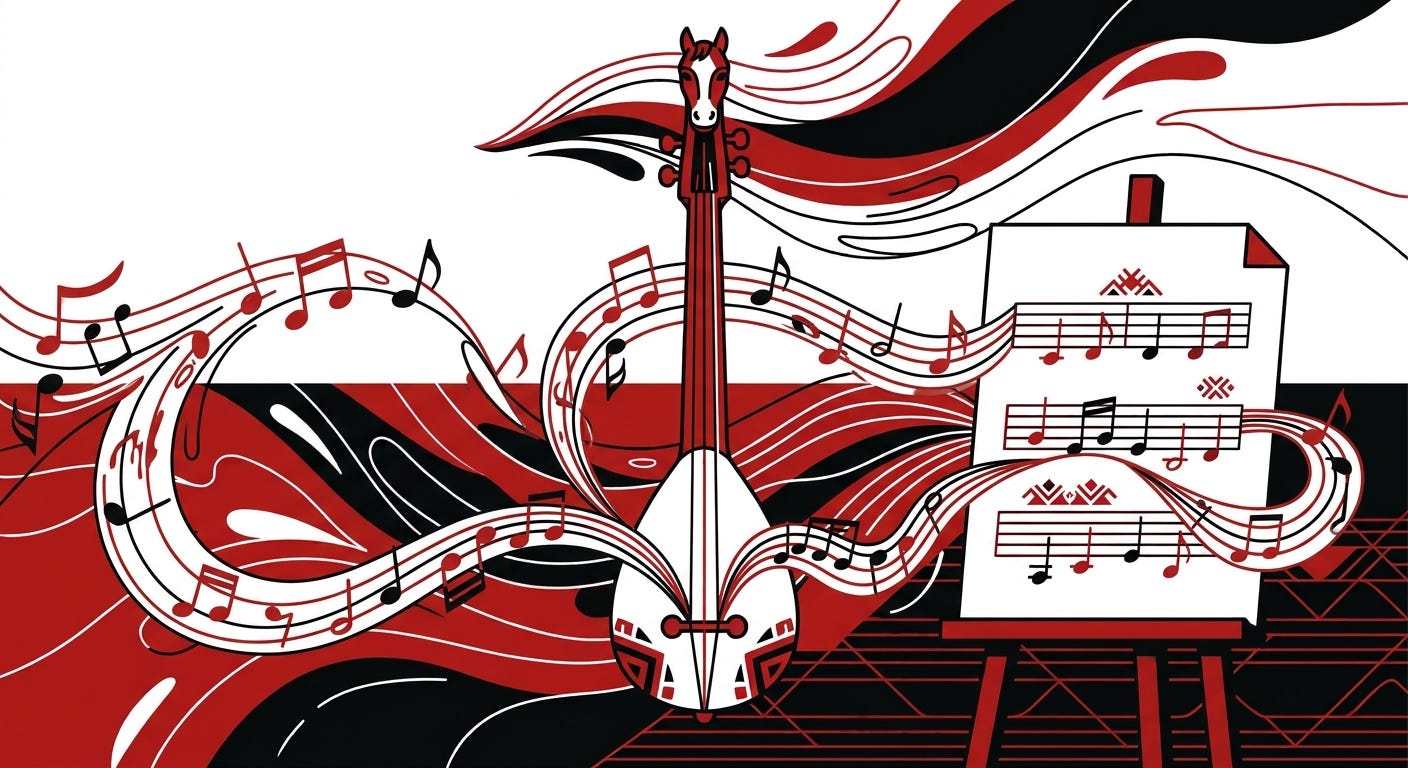
The singers were composing. Not reciting a memorised text, not improvising freely either, but composing in performance, out of ready-made pieces that were pre-fitted to the line. Parry’s definition of the unit, the one every student of oral literature still learns, is this: a formula is a group of words which is regularly employed under the same metrical conditions to express a given essential idea (Parry, qtd. in Lord 31).
The metrical condition, here, is the decasyllable. Ten syllables, with a break after the fourth. And the singer’s stock of phrases is shaped to fit that line, so that when he needs to say that a hero mounted his horse, he has a phrase that says it and that also happens to fill exactly the space available.
He is not remembering a poem. He is speaking a language whose words are line-shaped.
And here is the sentence I would like you to have
Lord, describing how a young singer acquires this stock, writes something that I think is the most useful sentence in this entire article.
He does not memorise formulas, Lord says, any more than we as children memorise language. He learns them by hearing them in other singers’ songs, and by habitual usage they become part of his singing as well (Lord 35).
And elsewhere, on the same process: he will pick them up from any singer whom he hears (34).
That is language acquisition. It is exactly language acquisition, described by a Harvard comparatist watching an illiterate man in a village in the Dinaric mountains, and it is the same mechanism by which you got whatever Croatian you have.
Lord goes further and says that in this world oral learning, oral composition and oral transmission almost merge, and seem to be different facets of the same process (5–6).
Learning, making and passing on, all the same act. That is what a song is, in a culture that has no other way of holding on to things.
Which is still running, by the way
I do not want to leave this in the nineteen-thirties, because it is not in the nineteen-thirties.
When UNESCO inscribed klapa singing on its representative list in 2012, the description it wrote is worth reading as a technical document rather than as a tourist brochure. Klapa singers stand in a tight semicircle. The first tenor begins and the others follow. The bearers are skilled amateurs who inherit the tradition from their predecessors, with younger people singing alongside older ones. In traditional klapa, the knowledge is transferred orally. The singers have the ability to sing freely, without the help of notation. And younger singers now gain experience by attending performances and listening to recordings (“Klapa”).
Every single element of Lord’s account is in that paragraph. Transmission by ear. No text. The young learning by standing next to the old. And, in the modern version, the recording taking the place of the village.
The mechanism that carried the epics is still operating, on that coast, this summer.
Why it lodges where study slides off
So why does this work when a vocabulary list does not?
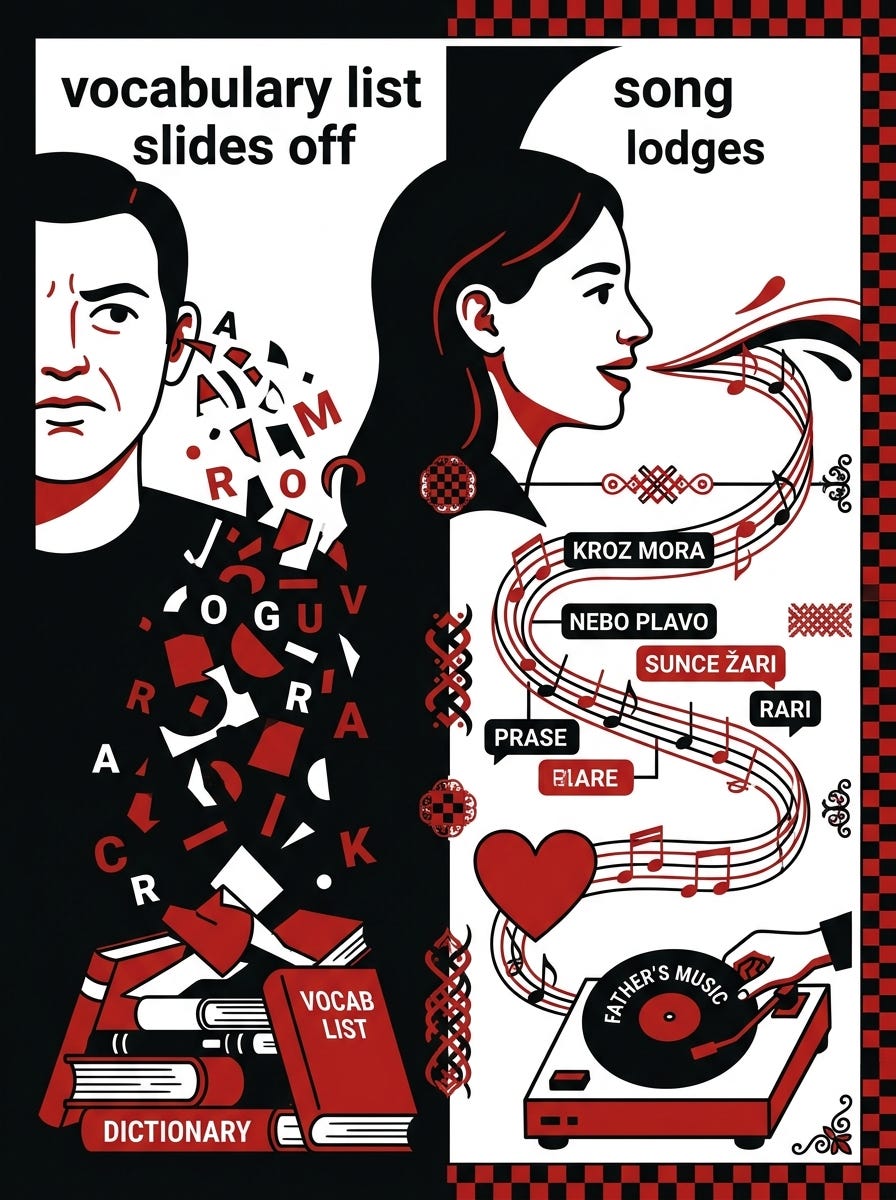
Part of it is the scaffold. A melody is a fixed sequence with a fixed length and a fixed shape, and a string of words hung on it inherits all three. The tune tells you how many syllables are coming and where the phrase ends, which is precisely the information a learner of a foreign language does not have and cannot get from a page.
Part of it is that a song hands you the phrase whole. Already inflected. Already in the right case, with the right preposition, in an order a Croatian would actually use. You are not assembling anything, which means you cannot assemble it wrongly. This is the formula in Parry’s sense, arriving in your mouth pre-fitted.
Part of it is that repetition in a song is not boring, and repetition anywhere else is. You will listen to a song you love two hundred times. Nobody has ever listened to a dialogue from a textbook twice.
And part of it, and I say this as a scholar rather than to be warm about it, is that the material is emotionally loaded, and emotion generally strengthens how information is encoded and retrieved, though it can impair memory when it turns into anxiety or stress (Tyng et al.). Your father playing that record is doing something a workbook structurally cannot do.
Which is why, in family after family, the songs outlast the grammar. When a household is losing a language, the last things standing are the greetings, the swearing, the food words and the songs. And of those four, the songs are the only ones that carry whole sentences.
The thing nobody tells you
And now the honest limitation: singing will not reliably give you the Croatian accents.
I do not mean the regional accent. I mean the four accents, the rising and falling tones on the stressed syllable that I have written about before and that are the actual music of spoken Croatian.
They are not reliably there in a song, and the reason is mechanical rather than cultural. Croatian accent is carried in pitch. A melody is also carried in pitch. I know of no study of Croatian, but the conflict is well documented in tone languages, where songwriters must reconcile the pitch of the word with the pitch of the tune, and where the answer differs from language to language (Ladd and Kirby; Wong and Diehl). As a linguist I would put it this way for Croatian: when you sing a Croatian word, the tune decides what your voice does, and the word’s own tone has little room left. The composer has taken the parameter.
So a person who learns Croatian from songs can end up with excellent vowels, excellent rhythm, excellent phrasing, a large stock of correct whole phrases, and a spoken accent that is still not right, and be completely baffled as to why.
Anybody who tells you that singing along will fix your accent is half correct, and the half that is wrong is the half that decides whether you sound local.
I will tell you what to do about that further down, and it is not difficult, and it takes about ten minutes a week.
Back to the woman in my class
She sang four verses and could not tell me what they meant, and she apologised.
What she actually had was a set of correctly inflected Croatian phrases, delivered in her father’s dialect, with the vowel lengths right and the phrasing right, sitting in her mouth ready to be used, and requiring only that somebody tell her what they meant and show her how to say them without the tune. For learners who arrive with fragments like these, I built the Croatian Entry Point.
That is a considerably better position than the one most learners are in after a year of study, and she had arrived at it by loving something.
The guslar picked up his phrases from any singer he heard, and by habitual usage they became part of his singing as well. Your father put a record on. It is the same mechanism, running in a smaller room.
What a song is and is not for
Everything below rests on what the first part of this blog established, so let me state it as a working rule.
Song is a delivery system for production and prosody. In the one experiment we have, it gave no measurable help with comprehension, and the authors themselves discuss the possibility that a sung presentation favours the sound of words over their meaning (Ludke et al. 50). So treat comprehension as a separate job.
Which means you must do the comprehension separately, deliberately, in a different session, with a dictionary, and you must never let the pleasure of the singing stand in for it. The moment somebody says they are learning Croatian from music and cannot tell you what the chorus means, they have stopped learning and started enjoying, and those are both fine but they are not the same activity.
Half an hour with the text of one song, properly understood, is worth more than a year of singing it beautifully in ignorance.
Choosing the voice
This is the part that people get wrong and that costs the most, because it is invisible.
Croatian music is dialectally marked. Deeply. The klapa repertoire is Dalmatian, and it will give you Dalmatian vowels, Dalmatian rhythm and a coastal phrasing. The tamburica tradition is Slavonian and will give you something quite different. The songs of the north carry the kajkavian world.
So if your family is from Slavonia and you spend two years singing along to the coast, you will acquire, at some cost and with real effort, an accent that belongs to somebody else’s grandmother.
I am not saying do not listen to it. I am saying know what you are absorbing.
The rule is simple. Find out where your family is from, to the level of the region at least and the town if you can, and then build your listening around that. Ask the oldest person available what was played in the house. That question, incidentally, will get you a better answer than almost any other question you can ask an elderly relative, because music is one of the few subjects on which people who do not think of themselves as having anything to say will talk for an hour.
And within your region, look for the singers with the clearest diction rather than the ones with the best voices. Those are not always the same people. You want a singer you can hear the consonants through.
What kind of song works
Not all of them, and the differences matter more than taste.
Slow is better than fast. You need time to hear the word boundaries.
Few words are better than many. A song with a repeated refrain and four verses will teach you more than a dense one, because you will hear the same phrase forty times.
Clear diction beats beauty. Heavy ornamentation, whispered production and very high registers all destroy consonants.
Older recordings are often better than new ones, because the production is drier and the voice sits further forward.
And avoid, for learning purposes, anything with a lot of English in it, which is a great deal of the current chart, because your ear will lock onto the English and rest there.
The practice, step by step
Here is the actual method. It takes one song about two weeks at ten minutes a day, and it produces something permanent.
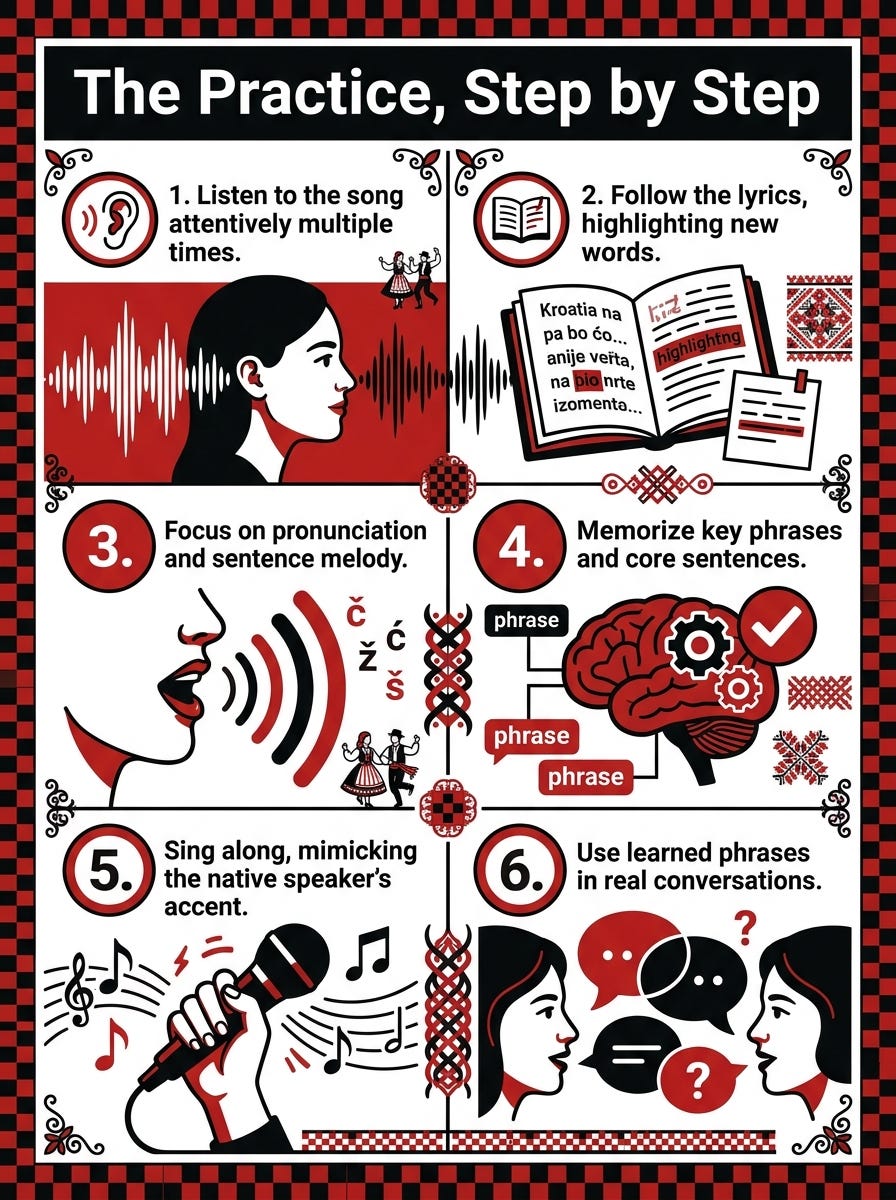
Step one. Listen with nothing. Three or four times, no text, no translation. You are letting the shape arrive. Prosody before parsing, always. If you look at the text first, you will read the song rather than hear it, and everything after that will be reading.
Step two. Listen with the text in front of you. Croatian text only, not a translation. Follow the words with your eye and let them attach to the sounds you already have. You will be surprised how many words you had been hearing wrongly.
Step three. Now understand it. Separate session, separate day. Dictionary out. Work out the whole thing, including the grammar, including which case that noun is in and why. This is homework and it is meant to feel like homework.
Step four. Shadow it. Sing along, at the same time as the recording, not after it. Not in gaps. Simultaneously, over the top, at the same speed, which will be too fast at first and then suddenly will not be. Shadowing has experimental support as a way of improving pronunciation (Foote and McDonough), and I think it works because it removes the gap in which your own habits would reassert themselves.
Step five, and this is the one nobody does. Say the lyrics without the music.
Speak them. Out loud. As sentences. In your ordinary voice, at conversational speed, with no tune at all.
This step is the whole difference between a person who can sing in Croatian and a person who can speak it. Sung material stays sung unless it is deliberately moved, and the moving is not automatic and does not happen on its own. Almost everybody who has ever told me they learned a language from music has skipped this step, and almost every one of them can still only produce the material with the melody attached.
Step six. Use one phrase this week. One. From that song. In a real conversation, out loud, at somebody. That is the moment the formula stops being a lyric and becomes part of your Croatian, and it is exactly what Lord describes happening to the young guslar: by habitual usage they become part of his singing as well.
The ten minutes that fix what song cannot
The accents. Since the melody has taken the pitch, you need a spoken source to get it back.
So pair every song with a spoken recording from the same region, and preferably from the same person. My slow-Croatian podcast, Ćakula Café, is one place to start.
Almost every Croatian singer of any standing has given interviews, and they are on the internet, and they are free. So the practice is: learn the song, and then find that singer talking, and shadow ninety seconds of the talking with exactly the same technique.
You will hear immediately what the melody had been hiding. The same voice, the same dialect, the same person, and now with the rises and falls of the actual language rather than of the tune.
Ten minutes a week of this, alongside the singing, closes the gap that singing alone opens. And it is the only part of the whole method that most people have never heard of.
Harvesting the formulas
Finally, the lesson from Parry and Lord, applied.
A song is a supply of ready-made phrases that are already grammatical, already inflected, already idiomatic, and already in the mouth of a native speaker. This is precisely what the guslar’s stock was, and precisely what a learner most lacks.
So harvest them. From every song you work through, take three phrases that are usable outside the song, write them down as whole units, and never break them into words.
Not the poetic ones. The ordinary ones. Songs are full of small ordinary phrases hiding among the poetry: things people say when they arrive, when they refuse, when they miss somebody, when they give up. Those are your formulas. They travel.
And the poetic ones are worth keeping too, but keep them separately and know what they are, because a phrase from a fifty-year-old song used in a shop will make people laugh, which is sometimes exactly what you want and should be done deliberately.
And if there is a child
I want to end here because it is the highest-leverage thing in this blog and it takes no method at all.
Sing to them.
Not teach. Sing. In the car, in the kitchen, at bedtime, badly, in whatever dialect you have, with no explanation and no comprehension check and no follow-up.
Everything in this blog says that song is the most durable format a language has. It survives when the grammar goes. It carries whole sentences when nothing else does. It attaches to emotion and it therefore attaches to memory. It is how an entire literary tradition crossed six centuries in the mouths of men who could not read.
A child who is sung to in Croatian will still have those songs at fifty, when everything else has gone quiet, and one day one of them will be standing in a classroom somewhere singing four verses and apologising for not knowing what they mean.
And whoever is teaching them will understand, as I did, that they have been handed the difficult half.
Tihana Klepač is an Associate Professor in the Department of English at the Faculty of Humanities and Social Sciences, University of Zagreb, with about twenty years of teaching experience. She is the founder of TalkTime Croatian, where she teaches Croatian to heritage speakers and diaspora learners through grammar, vocabulary, pronunciation and culture.
She writes the free weekly Saturday Letter from Zagreb and hosts the slow-Croatian podcast Ćakula Café and a YouTube channel Talk Time: Learn Croatian With a Cultural Twist.
Works Cited
Foote, Jennifer A., and Kim McDonough. “Using Shadowing with Mobile Technology to Improve L2 Pronunciation.” Journal of Second Language Pronunciation, vol. 3, no. 1, 2017, pp. 34–56, https://doi.org/10.1075/jslp.3.1.02foo.
“Klapa Multipart Singing of Dalmatia, Southern Croatia.” UNESCO Intangible Cultural Heritage, Representative List, 2012, ich.unesco.org/en/RL/klapa-multipart-singing-of-dalmatia-southern-croatia-00746. Accessed 15 Aug. 2026.
Ladd, D. Robert, and James P. Kirby. “Tone-Melody Matching in Tone Language Singing.” The Oxford Handbook of Language Prosody, edited by Carlos Gussenhoven and Aoju Chen, Oxford UP, 2020.
Lord, Albert B. The Singer of Tales. Harvard UP, 1960.
Ludke, Karen M., et al. “Singing Can Facilitate Foreign Language Learning.” Memory & Cognition, vol. 42, no. 1, 2014, pp. 41–52, https://doi.org/10.3758/s13421-013-0342-5.
“The Milman Parry Collection, 1933–35.” Milman Parry Collection of Oral Literature, Harvard University, mpc.chs.harvard.edu/milman-parry-collection-1933-35. Accessed 29 Oct. 2026.
Tyng, Chai M., et al. “The Influences of Emotion on Learning and Memory.” Frontiers in Psychology, vol. 8, 2017, article 1454, https://doi.org/10.3389/fpsyg.2017.01454.
Wong, Patrick, and Randy Diehl. “How Can the Lyrics of a Song in a Tone Language Be Understood?” Psychology of Music, vol. 30, 2002, pp. 202–09.
Keep learning Croatian with Tihana
Start here, free
Learn Croatian: Where to Start— How I teach, and which programme to start with.
The Free Masterclass— An introduction to the 4-Pillar Method and the logic of Croatian grammar.
The Konoba Test— A short quiz on where you are actually standing in Croatian.
Saturday Letter from Zagreb— A weekly essay on language, culture and belonging, free in your inbox.
Listen and watch
Ćakula Café podcast, on Spotify— Slow Croatian for heritage speakers and diaspora adults at A2–B1.
Ćakula Café, on Apple Podcasts— The same podcast, for listeners on iPhone and Mac.
Ćakula Café, on Castbox— The same podcast, for listeners who prefer Castbox.
TALK TIME on YouTube— Free Croatian lessons and films, with cultural context.
Podcast episodes on Substack— Audio companions to the Saturday Letters.
Courses and books
Croatian Entry Point— A1 self-study: eight weeks of culture-driven lessons, lifetime access.
The Croatian Quadrant™— A1–A2 flagship live programme, one cohort a year; join the waitlist.
Level Up Croatian— A2 self-study: daily fifteen-minute lessons in weekly themes.
Short Stories in Croatian— Ebook for A2–B1: nine original stories with audio, glossary and grammar notes.
Croatian Nexus— Post-A2 live seminars: where the language becomes literature.
More Saturday Letters
The Silence Between Generations— What is lost when a language is not passed on, and what can still be recovered.
Coming Home in a Language You Half Remember— The returnee's wall at the counter, and why the language is closer than you think.
Inat— The word your grandfather lived by, and where it came from.
The Word That Will Not Cross— Why čežnja is not longing and fjaka is not laziness.
Does Croatian Make You Think Differently?— What is real, and what is beautiful nonsense, in the idea that a language shapes a mind.
The Kitchen Was a Language Policy— Why Croatian was, or was not, passed down to you.
What English Does to Your Croatian While You Sleep— Why your grandmother's Croatian did not stay frozen the day she left.
Why You Feel Like a Different Person in Croatian— Why volim te weighs more than I love you.
You Are Not a Tourist in Your Own Language— The emotional case for coming home one register at a time.
The Konoba Test: Where Are You Actually Standing?— Why "what level is my Croatian" is the wrong question.
The Small Words That Give You Away— Why flawless Croatian can still mark you as a stranger: pa, ma, daj and the third rakija.
The Country Inside the Word Kaj— How the old language of the north became a place you carry.
Slavonia: The Gateway Dialect— The oldest Croatian štokavian is hiding in the east.
Who Gets to Tell the Story— Postcolonial theory, a nineteenth-century pamphlet and your grandmother's Croatian.
Tihana as a scholar: interviews in Croatian
Tribina „Čitanje kazališta“ before the premiere of Svjetlo pada (Zagreb Youth Theatre)— Tihana on British drama, in Croatian, at Zagrebačko kazalište mladih.
Tko se boji Virginie Woolf? (mi)— Tihana on Virginia Woolf, in Croatian, with Bookaravision.
Roald Dahl, autor scenarija za Hitchcocka a da to niste znali— Tihana on Roald Dahl, in Croatian, with Bookaravision.
Press and reviews
Behind the Language: Talk Time Croatian— Interview with Tihana Klepač by Rebecca Wicker, The Strategic Linguist, July 2026.
Student reviews on Google— What learners say about studying with Tihana.