What Is the Difference Between Croaticum and a Private Tutor?
I have sent people to Croaticum from my own inbox. Not often, but often enough that I should probably explain the reasoning in public rather than one email at a time, because the question arrives most weeks in some form. Someone has found the Croaticum page, seen that it is run by a university, seen the price, and then found me, and wants to know which of us to give their year to.
The honest answer starts with a number that is not in my favour.

The number
Croaticum's semester course costs 850 euros. For that you get 225 lessons of 45 minutes each, spread across fifteen weeks, five days a week, taught at the Faculty of Humanities and Social Sciences in Zagreb, at one of six levels from A1 to C1, ending in 14 ECTS credits if you attend and pass ("Semester Course").
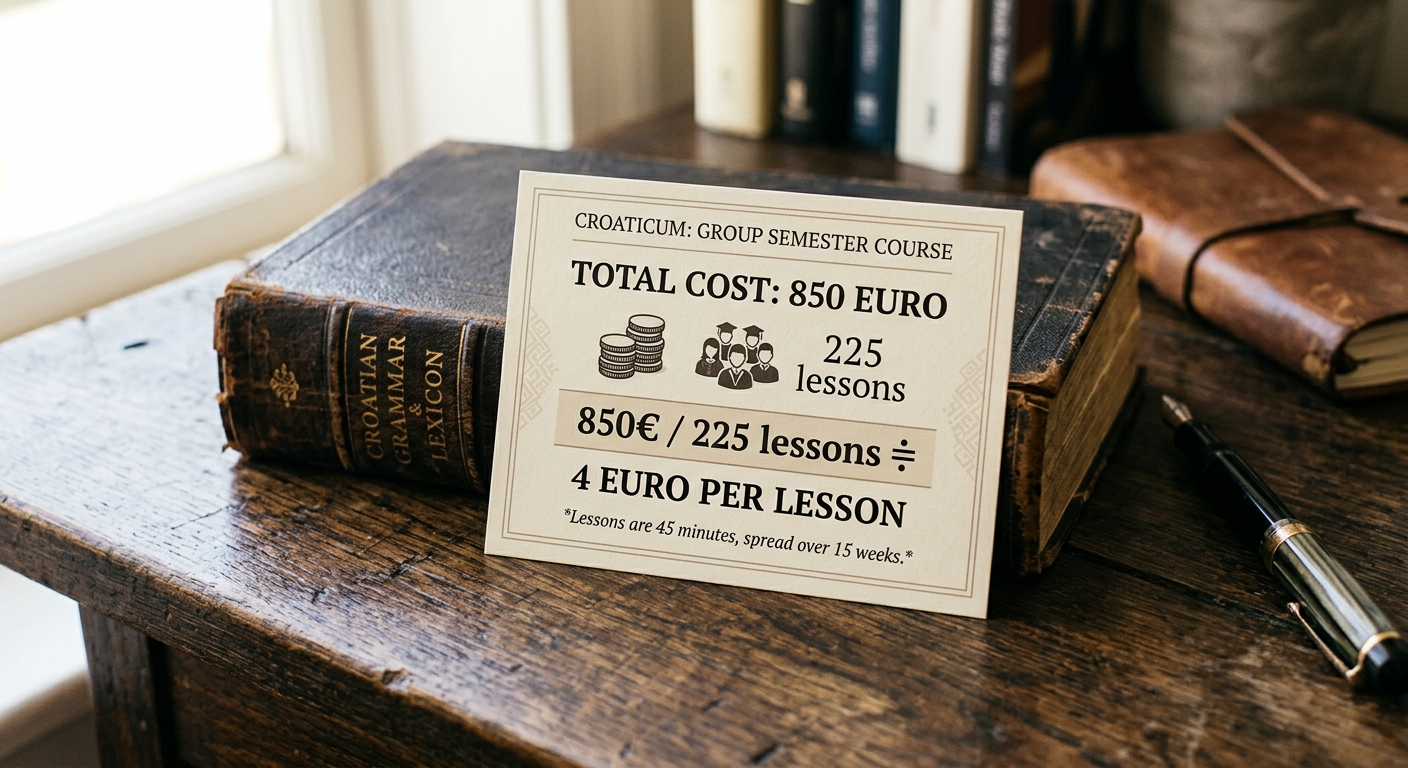
Do the division. That is under four euros per lesson.
There is nothing in private teaching, mine or anyone else's, that comes close to that per hour, and anyone who tells you otherwise is selling. Croaticum can price like that because it is a university centre inside a public faculty, teaching a full room, with a building it does not have to rent. It is the best value in Croatian language teaching anywhere in the world, and I say that as someone whose office is one corridor away from it and who therefore has every professional reason to be measured about it.
So if you can be in Zagreb, five mornings a week, for fifteen weeks, the answer to your question is Croaticum, and you should stop reading this and go and register. If you also have a Croatian parent or grandparent, look at the Ministry of Demography and Immigration scholarships before you pay anything, because the state may well cover it, and I wrote about that in Where to Actually Learn Croatian as a Diaspora Croatian.
That is the whole answer for a minority of the people who ask me. Now the complicated part.
Croaticum will also teach you one to one, online
This is the fact that most people comparing us do not know, and it changes the shape of the question, so I want it stated plainly rather than buried.
Croaticum offers individual lessons, and they are explicitly available "in person at Faculty of Humanities and Social Sciences in Zagreb or online, e.g. via Zoom or Skype" ("Individual Lessons"). Forty-five minutes each, minimum five to enrol, content adapted to you, certificate of attendance at the end. The price is 45 euros for a single lesson or 430 euros for a package of ten ("Prices").
So the comparison is not institution versus individual. Croaticum does individual. It is not classroom versus screen either, because Croaticum does screens. If your reason for looking at a private teacher was that you live in Melbourne or Mississauga and cannot move, that reason does not distinguish us. You can have a University of Zagreb teacher on Zoom next week.
They will also teach you for nothing if you want to work alone. A1.HR and A2.HR are free, eighty units of forty-five minutes each, with the interface and instructions in English and Spanish ("Free Online Courses"), and there is now a B1 application, LearnCro, described as intended for descendants of Croatian emigrants. I recommend these to people every week and I will keep doing it.
What that per-lesson pricing does reveal is the real economics underneath both of us. Croaticum's own one-to-one rate works out at roughly eleven times the per-hour cost of their group semester course. That gap is not greed. It is what individual attention costs, anywhere, from anyone. When you compare a private teacher's fee to an institution's course fee, you are usually comparing attention to hours, which is not a comparison at all.
So what actually differs
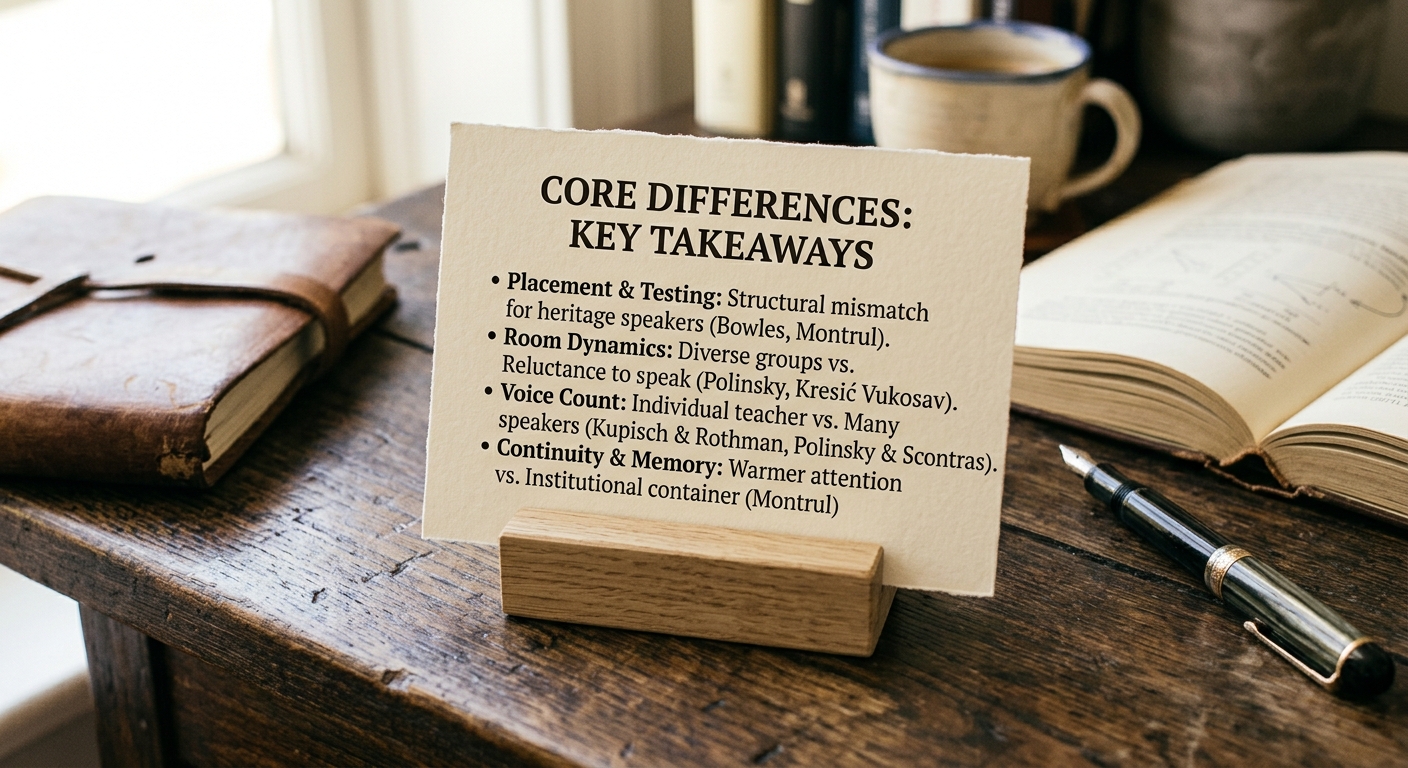
Four things, and none of them are the ones people expect.
Where you get placed, and what that does to you
Croaticum forms its groups "on the basis of the results of Croatian language placement tests" ("Semester Course"). That is standard practice, and for a foreign learner it works fine. For a heritage speaker it can go badly wrong, for a reason that is well documented and almost never discussed.
Heritage speakers, meaning people who heard a language at home in early childhood, hold their knowledge in a different shape from people who learned it in a classroom as adults. Silvina Montrul reports the pattern from several studies: second language learners were more accurate on written gender tasks, while heritage speakers "showed exactly the opposite pattern, higher accuracy in oral production than in the written tasks" (280). In Bowles's comparison, heritage learners beat second language learners on every implicit oral measure, 78.8 against 46.7 on oral imitation, 95.9 against 47.9 on oral narration, and lost only on the metalinguistic test, 57.4 against 72.4 (Montrul 282).
Read that spread again, because it is the whole problem. On the oral tasks the heritage learners roughly doubled the foreign learners. On the grammar-about-grammar task they came second.

A written placement test measures the one column where you are weakest. If you sit it having never studied Croatian formally, and you cannot name a case or fill a paradigm, you will place low. You will then spend fifteen weeks in a room with lovely, motivated adults who genuinely cannot yet hear the difference between č and ć, while you have been hearing it since you were three. Some people find that restful. Most find it humiliating in a way they cannot say out loud, and they leave.
This is not Croaticum's failing. It is a structural mismatch between how heritage knowledge is shaped and how any group programme has to sort people. But it is knowable in advance, and if you are a heritage speaker considering the semester course, the single most useful thing you can do is contact them before the test, say plainly that you grew up hearing Croatian, and ask how they place people like you. They know the issue exists. Ask anyway.
Who is in the room with you
The related question is who you are placed among, once you are placed.
Croaticum's own description is that classes are "organised in diverse groups of students speaking different languages and belonging to different nationalities and age groups" ("Semester Course"), which is true and is part of the appeal for many people. But there is research on what mixed heritage and foreign learner classrooms actually deliver, and it is not entirely comfortable. In one study, both kinds of learner reported seeing the classroom interaction as a greater opportunity for the foreign learners' development than for the heritage learners', which Montrul says calls into question "whether classroom contexts like this one meet the needs of HL learners" (292).
Maria Polinsky describes the teaching side of the same problem: practitioners "often hold contradictory expectations of heritage speakers," expecting on one hand that they "should already know everything," an expectation "reinforced by their target-like pronunciation," and on the other treating them through "the stereotype that heritage speakers do everything wrong, speak 'corrupted' language" (74–75). Both expectations land on the same person, sometimes in the same lesson.
She also records something that anyone teaching diaspora Croatians should have to read once a year. Heritage speakers, she writes, "may be reluctant to speak their home language for fear of being criticized," and they feel more at ease speaking to foreign learners than to native speakers, particularly older ones "whom they may associate with their caretakers or Sunday school teachers" (80). Her account of the spiral is seven words long: "The less they practice, the rustier is their performance" (80).
And for Croatian specifically there is a finding I cannot leave out, even though it is about us. In a study of Croatian speakers in Lower Saxony, second-generation speakers reported having been corrected, and having been mocked or criticised, significantly more often than the first generation, and specifically when speaking Croatian in Croatia. For their German in Germany, no such generational difference appeared (Kresić Vukosav and Šimičić 230).
So one honest input into your decision is not pedagogical at all. It is whether you are ready to be in Zagreb, being corrected, this year. For some people the answer is yes and the immersion is worth every uncomfortable minute. For others it is not yet, and there is no shame in sequencing it differently.
How many voices you hear
Here is the argument that runs against hiring any single teacher, including me, and it is the strongest one there is.
Tanja Kupisch and Jason Rothman compared German-dominant heritage speakers of French, who had been schooled in French, with German-dominant heritage speakers of Italian, who had been schooled in German and had at most a weekly heritage class. The French group performed at or near monolingual levels across gender assignment, gender agreement, adjective placement, generic noun phrases and pronunciation. The Italian group did not, scoring 33 percent on generics. The difference the authors identify is not the quality of any single teacher. The French group had the language as the daily medium of instruction from many different speakers; the Italian group had it once a week, as the object of instruction, often from one teacher. Their conclusion is that for teaching to have lasting effect, input "needs to be continuous and come from a variety of different native speakers."
Maria Polinsky and Gregory Scontras arrive at the same place from the data on community size, noting that more exposure "will only get heritage speakers so far; they also need exposure from a variety of sources."
Now apply that honestly. A private teacher is one voice. One accent, one speech rate, one set of habitual constructions, one repertoire of jokes. A semester at Croaticum puts you in a building where Croatian is the medium and not the subject, taught by several people, surrounded by a city that does not slow down for you. On the evidence, that is the better shape of input, and no amount of individual attention substitutes for it.
Which is why, if you are working with me and you are not also finding other Croatian in your week, we are doing it wrong. I say this to my own students. The class is a spine, not a diet.
Whether anyone notices you stopped
And here is what an institution structurally cannot do, not through any fault of its own.
A semester course has a start date, an end date, an attendance requirement and a final exam. It is a container. Inside it you will work hard, because the container works. What happens after it is not its problem, and this is the honest gap in the research too: Montrul, reviewing the studies on whether heritage language instruction produces lasting gains, asks directly whether gains are "retained beyond the classroom, say, a year later, forever," and answers that "these questions are still awaiting answers" (305).
I have watched people come back from a semester in Zagreb transformed and then plateau by the following autumn, for the same reason people come home from summer school elated and stall by October. Fifteen weeks of intensity followed by nine months of nothing is not a method. It is an experience, and experiences fade.
What a person can offer that a programme cannot is continuity and memory. I know why you are doing this. I know that your grandmother was from Sinj and that you want to read her letters, and I know that you disappeared for three weeks in March and I asked where you went. That is not a warmer version of teaching. It is a different mechanism, and for adults learning at the edges of a full life, it is often the mechanism that decides whether anything happens at all.
What I cannot give you
Let me be exact about this, because it is the part people discover too late.
I give no ECTS credits. Croaticum's semester course gives 14. I give no certificate that the Croatian state recognises, and Croaticum sells a proficiency test at 140 euros per level that does carry institutional weight. If you need a document for a citizenship file, a university application, an employer, or any process where somebody official will look at a piece of paper, do not come to me first. Go to Croaticum, or to CEHAS in Split, sit the test, get the certificate. I will tell you this in our first conversation anyway, so you may as well save the conversation.
I am also one person with a fixed number of hours, which means I am often full, and which means the variety-of-input problem above is mine to solve and not always solvable.
So who should go where

If you can physically be in Zagreb for a semester, go to Croaticum, and check the state scholarship first.
If you need a recognised certificate or credits, go to Croaticum or CEHAS, regardless of what else you do.
If you have never studied Croatian and want to know whether you can stand it before spending anything, do A1.HR. It is free, it is good, and it costs you nothing but the finding out.
If you are a heritage speaker considering a group course, ask about placement before you sit the test, and go in knowing what a written test does and does not measure about you.
And if you are choosing between a Croaticum online lesson and me, on price and institutional backing, choose them. On whether anyone will notice in March, choose the person who will.
The question is not which of us is better. Croaticum is a serious institution doing serious work at a price that embarrasses the private market, and I am one teacher who knows your name. Those are not competing answers. They are answers to different questions, and the useful thing is to work out which question you are actually asking before you pay anyone.
If you are not sure which one that is, write to me. I will tell you honestly when the answer is the building down the corridor.
Svako dobro, Tihana
Tihana Klepač is anAssociate Professor at the University of Zagreb's Department of Englishand the founder of TalkTime Croatian. She teaches theCroatian Quadrant™,a structured, culturally immersive course designed to help learners stop translating and start thinking in Croatian. Find out more at:talktimecro.com.
Works Cited
Croaticum – Centar za hrvatski kao drugi i strani jezik. "Free Online Croatian Courses – A1.HR and A2.HR." Faculty of Humanities and Social Sciences, University of Zagreb, croaticum.ffzg.unizg.hr/?page_id=5024. Accessed 5 Sept. 2026.
---. "Individual Lessons in Croatian Language and Culture." Faculty of Humanities and Social Sciences, University of Zagreb, croaticum.ffzg.unizg.hr/?page_id=1095. Accessed 5 Sept. 2026.
---. "Prices and Fees." Faculty of Humanities and Social Sciences, University of Zagreb, croaticum.ffzg.unizg.hr/?page_id=1089. Accessed 5 Sept. 2026.
---. "Semester Course of the Croatian Language and Culture." Faculty of Humanities and Social Sciences, University of Zagreb, croaticum.ffzg.unizg.hr/?page_id=1106. Accessed 5 Sept. 2026.
Kresić Vukosav, Marijana, and Lucija Šimičić. "Some Aspects of Language Contact among Croatian-Speakers in Lower Saxony, Germany." Diaspora Language Contact: The Speech of Croatian Speakers Abroad, edited by Jim Hlavac and Diana Stolac, De Gruyter Mouton, 2021, pp. 217–49.
Kupisch, Tanja, and Jason Rothman. "Terminology Matters! Why Difference Is Not Incompleteness and How Early Child Bilinguals Are Heritage Speakers." International Journal of Bilingualism, vol. 22, no. 5, 2018, pp. 564–82, https://doi.org/10.1177/1367006916654355.
Montrul, Silvina. The Acquisition of Heritage Languages. Cambridge UP, 2016.
Polinsky, Maria. Heritage Languages and Their Speakers. Cambridge UP, 2018. Cambridge Studies in Linguistics 159.
Polinsky, Maria, and Gregory Scontras. "Understanding Heritage Languages." Bilingualism: Language and Cognition.