The Lost Ending: Re-discovering Your Name in Croatian
This letter first appeared in the
Saturday Letter from Zagreb on Substack on 7 November 2026. Read the original post on Substack.
The case that exists only to call somebody, the hooks that fell off your surname, and what happened at the port that did not happen at the port
At the beginning of a lesson some years ago I read out a student’s name from my list.
I said it the way it is spelled. All of it. The š with its hook, the ć with its accent, the stress where a Croatian would put it.
And there was a silence on the line long enough that I thought the connection had dropped.
Then she said that nobody had said her name like that since her grandmother died.
She was fifty-one. She had been introducing herself, for four decades, with a version of her own name that had been made by a typewriter.
This is the most personal letter in this seriesand I have been circling it for months. Everybody reading this owns a name. Most of you own a wound about it, and most of you have decided the wound is too small to mention, which is precisely why it has never been examined.
So let us examine it.
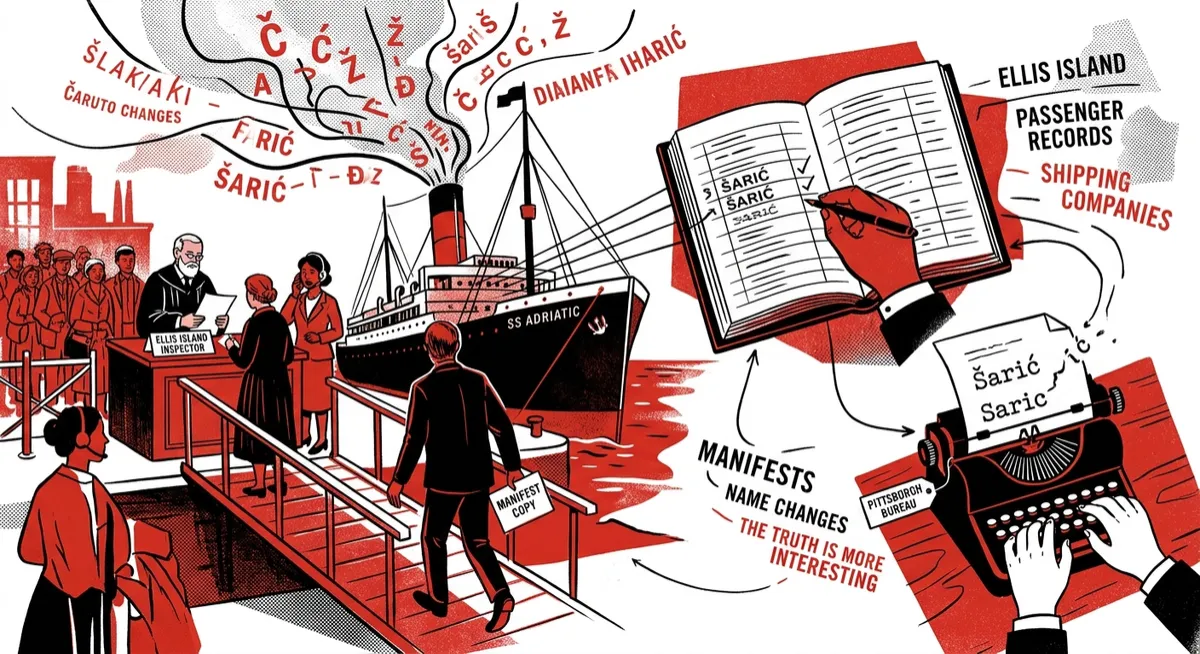
First, what did not happen at Ellis Island
I want to clear this away before anything else, because the story is in almost every diaspora family and it is almost never true, and the truth is more interesting.
Names were, almost without exception, not changed by officials at Ellis Island.
The reason is procedural and completely decisive. Inspectors at Ellis Island did not create passenger records. They checked them. The lists came from the manifests of the steamships, which were filled out by the shipping companies’ employees in Europe, at the point of sale, before anybody boarded. The clerk on Ellis Island worked through interpreters, asking questions from the manifest, and his job was to establish that the answers matched what was already written. If he touched a name at all, it was to correct a mistake on the list, not to invent a new one (Sutton).
Which leaves the obvious question that historians have been asking for years. If names were changed there, where is the paperwork? Ellis Island issued no document that recorded a new name, because there was no such procedure. When a librarian at the New York Public Library went looking through the newspapers of the years the station was open, he found exactly one man who claimed an inspector had renamed him. One. And he is remembered precisely because he is alone (Sutton).
The people who changed the names were the immigrants themselves, and they did it afterwards. To sound less foreign. To get work. To stop repeating themselves. Sometimes at naturalisation, and very often with no legal process at all, because none was required (Sutton).
I am not telling you this to take a story away from you. I am telling you because the true version puts the decision back where it belongs, which is in the hands of a frightened adult in a new country deciding what it would cost to keep something. That is a harder and better story than a bored clerk with a pen.
What actually flattened your name
So if not a clerk, what?
A machine.
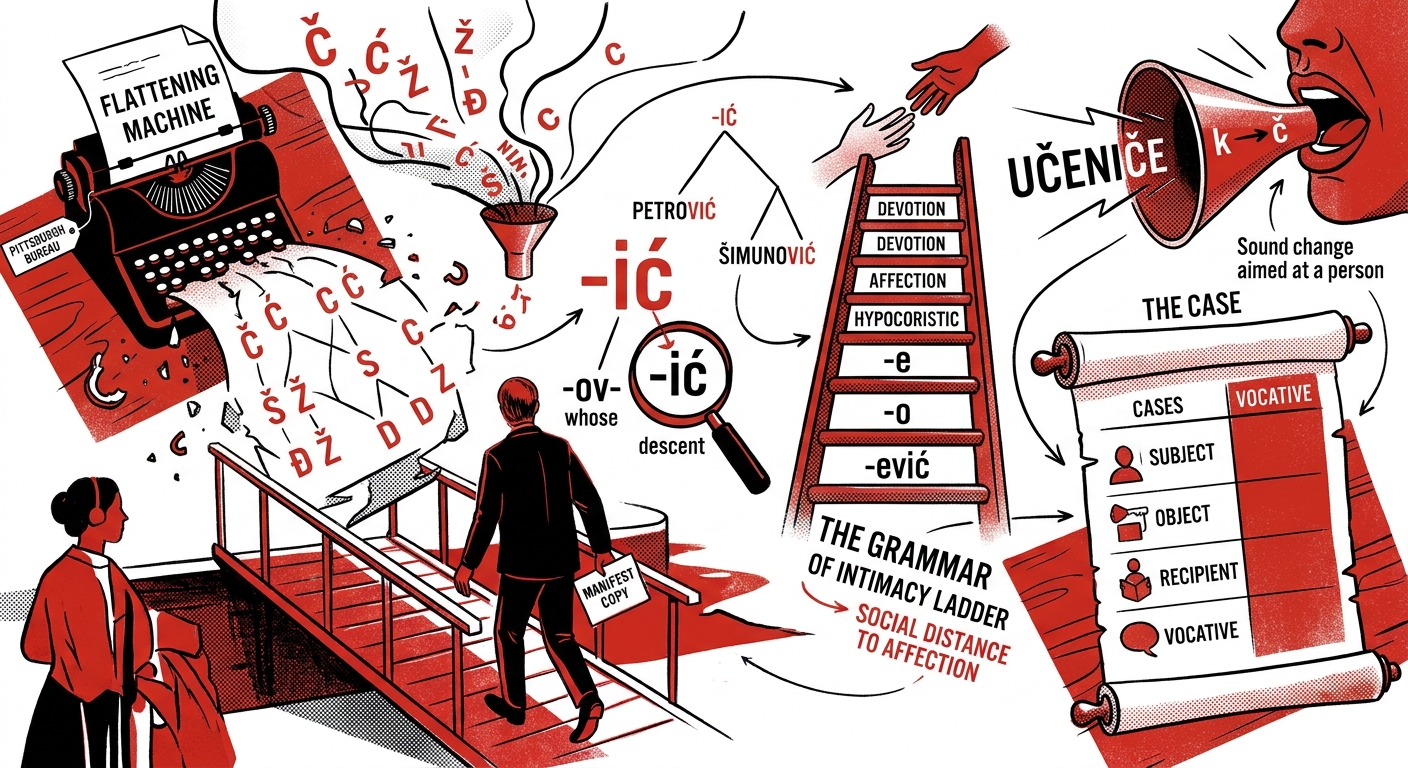
Croatian is written with five letters that Anglophone and Hispanophone and Germanophone bureaucracy has never had a key for. Č. Ć. Š. Ž. Đ.
And here is the thing that everybody outside this language misunderstands. Those are not letters with decorations on them.They are separate letters.Č is not a fancy C. In Croatian, č and c and ć are three different sounds, as different from each other as p and b, and a Croatian reading them makes no more of a leap between them than an English speaker does between sh and s.
So when a typewriter in Pittsburgh or Wollongong or Rosario had no key for the hook, the hook did not go missing. The letter did.
Šarić became Saric, which is not a simplified spelling of the name. It is a different word, containing sounds the family never had, unpronounceable in the original language, and unrecoverable by anybody who has not been told.
And it happened without a decision, in a form, in an office, a thousand times a year for a century, to millions of people, and nobody ever announced it. There is no villain in this story at all. There is a keyboard.
What a Croatian name actually is
Now the part that will be new to a great many of you, because it is not something families tend to pass on.
A very large proportion of Croatian surnames end in -ić. Of the thousand most common surnames in Croatia, six hundred and twenty end in -ić, -ović or -ević (Šimunović, qtd. in Bašić and Baričević 104). And that ending is a patronymic. It means, roughly, of, or son of, or belonging to. Marković is Marko’s. Petrović is Petar’s. Šimunović is Šimun’s.
And the -ić itself is, in origin, a diminutive suffix. The same suffix that makes a small thing out of a big thing. In a name like Petrović, the -ov- says whose, and the -ić, which was primarily a diminutive, stopped making things small and began to mark descent instead (Rogić 35).
Which means that an enormous number of Croatian people are walking around with a surname whose literal architecture is little Marko, Petar’s little one. A great part of a nation carrying a diminutive as a legal identity.
Other surnames come from trades, from places, from the shape or temper of an ancestor, from a nickname that stuck to a man in the sixteenth century and then to everybody descended from him. Which means a Croatian surname is almost always a sentence about somebody, compressed, and the compression is still legible to anybody who knows the vocabulary.
Your surname says something. It has probably not said it out loud in three generations.
The grammar of intimacy
Now the second system, and this is where Croatian does something English simply does not have.
English has nicknames. Robert becomes Bob, Elizabeth becomes Liz, and the process is unsystematic, and there is one step to it, and then you stop.
Croatian has a productive morphological system for encoding affection, and it is a grammar rather than a habit.
Živko Bjelanović, writing on the hypocoristic in Croatian onomastics, puts the function precisely. The meaning of such a form is positive, and it differs from a plain diminutive in that the derived word expresses affection, tenderness or devotion toward the person whose identity it marks (Bjelanović 2).
Not smallness. Devotion. The suffix is carrying the relationship.
And because it is a system rather than a set of nicknames, it has steps. There is the full name, which is what a document says. There is the hypocoristic, which is what your family says. There is often a further form beyond that, which is what one person says. And there are regional patterns in which forms exist at all, so the shape of the affectionate version of your grandfather’s name can tell you which part of the country he was from.
An English speaker has a name and a nickname. A Croatian has a ladder, and every rung is a different distance.
And now the case
Which brings me to the thing this letter is named for.
Croatian has seven cases, and I wrote about them recently. Six of them do the work you would expect a case to do: mark the subject, the object, the possessor, the location, the instrument, the recipient.
And then there is the vocative, which does none of that, because the vocative is not for talking about somebody.
It is for talking to them.
It is a grammatical case whose entire function is being addressed. It has its own endings, it sits in the paradigm alongside the others, and the standard grammarlists it exactly as it lists the rest, without ceremony (Silić and Pranjković 38).
And it is strong enough to change the shape of a word. Učenik, a pupil, becomes učeniče when you speak to him. Bog becomes Bože. The k turns into a č, the g turns into a ž, because a sound change fires when the word is aimed at a person (Silić and Pranjković 28).
Think about what a language is saying about itself when it does that. Croatian will alter the consonants of a word in your mouth in order to mark the fact that you are speaking to somebody rather than about them.
There is one more detail I find almost unbearably good, and it is in the grammar’s own examples. When Silić and Pranjković illustrate the category of mood, they need a command and a wish, and the sentences they reach for are Uči, učeniče and Učio, učeniče, jednom, da Bog da (38).
Study, pupil. May you study one day, God grant it.
Both of them addressed. Both of them in the vocative. The grammarians, reaching for an ordinary example, produced a teacher speaking to a child and blessing him.
The part that costs
So here is the thing I actually wanted to tell you.
Your name has a vocative.
If your name is Marija, there is a form, Marijo, which exists for one purpose, which is for somebody who loves you to call you by it.
If your name is Ivan, there is Ivane. If it is Ana, there is Ano. If it is Marko, the vocative happens to be identical to the nominative, which is its own kind of luck.
And for a very large number of you, that form has never been said.
Not misused. Not mispronounced. Never used. It has been sitting inside your name since you were born, a room in a house that nobody has opened, because the people who would have opened it either died or stopped speaking the languagein which the room exists.
That is a strange kind of loss and it is not one that anybody has a word for. Nothing was taken. Something was simply never activated.
And it is recoverable, which is not true of most of the things I have written about in this series. You cannot get back the jokes you were not in the room for. You can get back your own vocative in an afternoon, and you can teach it to two people, and then it exists again.
Back to the woman on the line
She was quiet for a long moment and then she told me about her grandmother, and we did not do much grammar in that lesson.
But I want to be precise about what had happened, because it was not sentiment.
For decades, ever since her grandmother died, that woman’s name had been said to her in a language that has no hooks on its letters, no case for being addressed, and no productive system for encoding tenderness in a suffix. Every single time. Thousands of times. And each of those times was fine, and none of them was wrong, and cumulatively they amounted to her not once, in all those years, hearing her own name as her own language says it.
Then somebody read it off a list correctly, hooks and stress and all, and it went through her like a current.
That is not because names are magic. It is because a name said in its own language is a piece of grammar whose only content is you, and she had not received it since her grandmother died. And behind it, still unopened, was the vocative, the form her language keeps in reserve for calling her.
Finding out what it actually was
Start here, because a surprising number of you do not know, and the sources are better than you think.
The ship manifest is your best document, and this is the delicious part. The manifest was filled out in Europe, by the shipping company, at the point of sale, before departure. Which means it very often carries the name as the family gave it, in something close to its original spelling, written by somebody who had at least heard it said. The document that popular memory blames for destroying your name is in fact the document most likely to have preserved it.
Those manifests are digitised and searchable and largely free. Search by the mangled version and by the sound, not by the spelling, and search the given name too, because a Josip may appear as Giuseppe or Joseph depending on which port and which clerk.
Parish records are the deep layer. Croatian parishes kept baptismal, marriage and death registers for centuries, in Latin and later in Croatian, ever since the Council of Trent made them obligatory in the sixteenth century, and they are the reason genealogy in this country is possible at all (Šimek Cvitković and Cvitković 172). If you can get to the village, the diocesan archive will have them. If you cannot, many are microfilmed and some are online.
And the surname itself will tell you where to look. Croatian surnames cluster geographically to a remarkable degree, and a distinctive one may be concentrated in a handful of villages. The Hrvatski prezimenik, Petar Šimunović’s great register of Croatian surnames, records for every surname how many people and families carry it in every settlement in the country (Filipović 131). If you have a spelling, a competent local genealogist can often narrow it to a region in an afternoon.
What you are looking for is three things. The spelling with its diacritics. The stress, which nobody writes down and which you will have to ask a person. And the place.
Forming your own vocative
Here are the patterns. They are not complicated and no textbook gives them to you in the order you need.
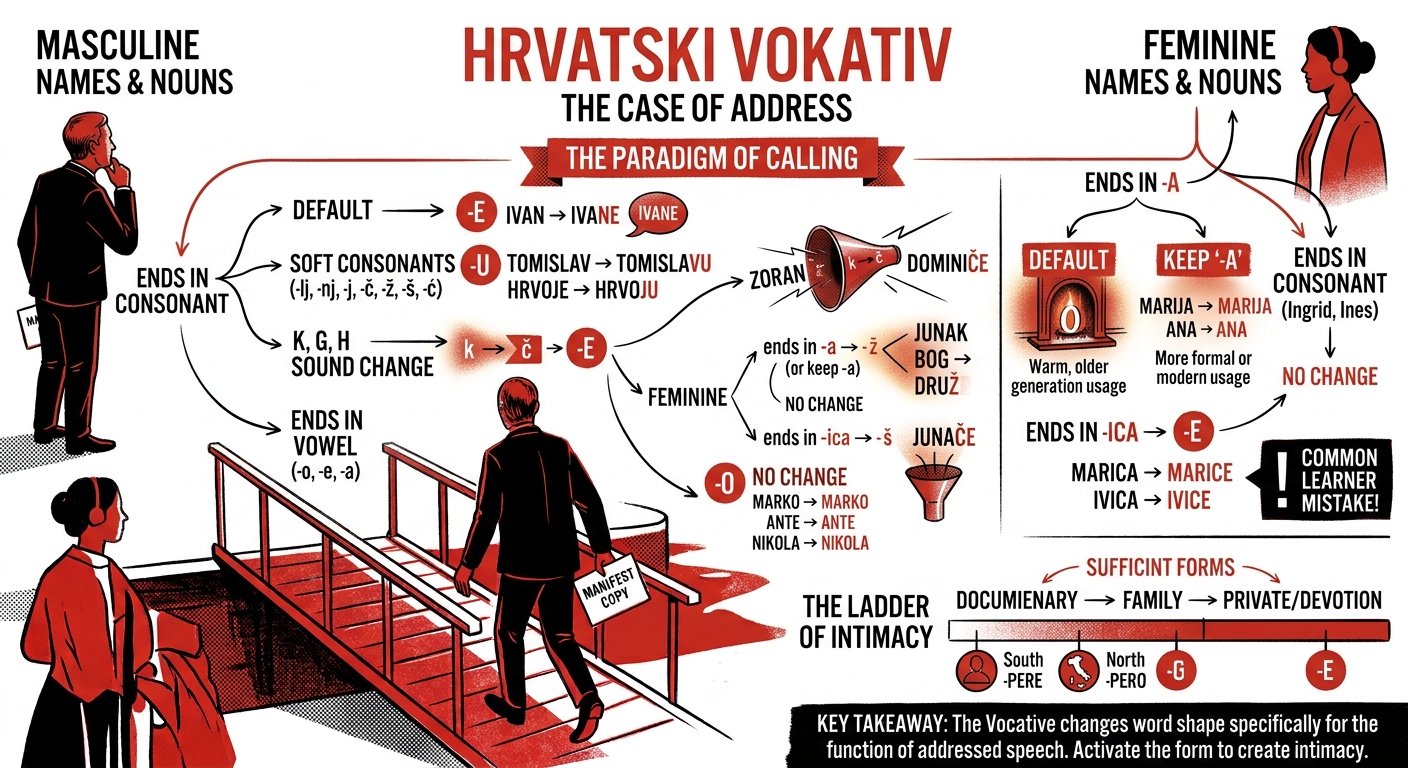
Masculine names ending in a consonant take -e. Ivan becomes Ivane. Tomislav becomes Tomislave. Zoran becomes Zorane.
But if the name ends in k, g or h, that consonant softens before the -e. This is the same sound change that turns učenik into učeniče and Bog into Bože. So Dominik becomes Dominiče (Silić and Pranjković 28, 98).
Masculine names ending in a soft consonant take -u. Names in -lj, -nj, -j, -č, -ž, -š, -ć generally go this way (Silić and Pranjković 98).
Masculine names ending in -o or -e do not change at all. Marko stays Marko. Hrvoje stays Hrvoje. Ante stays Ante. Ivo stays Ivo (Silić and Pranjković 102). And masculine names ending in -a stay as they are too: Nikola, Matija, Luka (Silić and Pranjković 108). If your name is one of these, your vocative has been hiding in plain sight your whole life.
Feminine names ending in -a take -o, or keep their -a, and the standard grammar allows both: Marijo and Marija, Ljiljano and Ljiljana (Silić and Pranjković 108). Ana can be Ano or Ana. Ivana can be Ivano or Ivana.
Names ending in -ica take -e, and this holds for women and men alike. Marica becomes Marice. Anica becomes Anice. Ivica becomes Ivice (Silić and Pranjković 108). This is the pattern most often got wrong by learners and most often noticed by natives.
And feminine names that end in a consonant, like Ingrid or Ines, do not change at all, in the vocative or in any other case (Babić 67).
One honest note. Because the grammar allows both forms, you will hear Ana as often as Ano. The -o form is not archaic, and it is warmer, and it is what an older relative would use, and I would learn it even if you choose not to use it.
The ladder
Now the hypocoristics, which is where the real intimacy lives.
The system runs, roughly, in steps, and the steps correspond to social distance.
The full name is documentary. It is what a teacher uses at the start of the year and what appears on an envelope. In many families, hearing it from a parent meant you were in trouble.
The standard hypocoristic is what the family uses. Petar gives Pero or Pere. Ivan gives Ivo or Ive. Josip gives Joso or Joze. Marija gives Mara or Mare. Katarina gives Kate or Kata.
And here is a detail worth having. The -o forms and the -e forms are not spread evenly across the country. Petar Šimunović, mapping Croatian names and surnames, placed the two-syllable forms in -e in the Croatian south, where personal names and nicknames in -e are everywhere (Filipović 132–33). Which version of your grandfather’s name the family used is a clue to where he was from, and if two branches of your family use different forms of the same name, you may be looking at a marriage between two regions.
The further form is what one or two people use, and it is often a diminutive built on the hypocoristic rather than on the name. This is the rung that does not survive emigration, because it requires a speech community of about four people, and when they die it goes.
And then there is the whole separate apparatus of endearments, which are not names at all but which do the same work: dušo, my soul, in the vocative. Srce, heart. Zlato, gold. Mila and mili, dear. These are used constantly, to children, to spouses, to friends, and by shopkeepers to customers in a way that startles visitors.
Notice that dušo is itself a vocative. The most common Croatian endearment is a noun that exists, in that form, only in order to be said to somebody.
Women’s names, which are unstable even here
If you are trying to reconstruct a woman’s name, expect trouble, and know that the trouble is not yours.
Branko Kuna, writing on the Croatian name formula for women, documents how unstable the independent use of a woman’s surname still is compared with a man’s, and how frequently female surnames are modified in public communication even where that runs against the norm (Kuna 83).
In the records this compounds. A woman may appear under her maiden name in a baptismal register, her husband’s name in a parish death record, an anglicised form on a naturalisation paper, and a possessive-adjective form in a village nickname, and all four are the same person.
The practical advice is to search for women by their husbands, their fathers and their villages rather than by their names, which is unjust and is also what works.
Teaching people to say it
You are going to have to decide whether to reclaim the pronunciation, and I am not going to tell you that you must. Some of you have built a professional life on the flattened version and the cost of changing it is real.
But if you want it back, here is the approach that works, and it is not the one people try.
Do not explain. The instinct is to say something like, actually it’s pronounced, and then deliver a small lecture about Croatian orthography, and everybody’s shoulders go up.
Instead, just say it, once, as an answer. They say Saric, you say your name properly, in the same tone, as though completing their sentence rather than correcting it, and then you carry on with what you were saying. Most people will adjust within two exchanges and nobody will have had to be embarrassed.
Give them a handle if they ask.One approximation they can actually produce is worth more than a correct version they cannot. Šarić is closer to Sharitch than to Saric, and an English speaker can say that.
And write it correctly, everywhere, from now on. Email signature, name badge, the way you spell it out on the phone. The diacritics are available on every device made in the last fifteen years, and nobody has to go hunting for them among special characters any more.
And a child
If there is a child in your family with a Croatian name, or about to have one, two things.
The first is to use the vocative to them. Not as a lesson. Just call them by it, in the form the language keeps for calling. A child who has been called Ivane by somebody who loves them has that form for life and will feel its absence in every other language.
The second is to give them the ladder. Full name when it is serious, hypocoristic in the ordinary run of things, and something small and private for the moments that need it. That is how a Croatian family builds intimacy, and it is a technology, and it works even if the rest of your Croatian is poor.
You do not need the language to do this. You need three forms of one name.
One last thing
I have written a great deal in this series about things that cannot be recovered, and I have tried not to soften any of them.
This one can.
Your name in its own spelling is on a document, and the document is findable. Your name in the vocative is a form that already exists, that has always existed, and that requires nothing from you but that you learn it and tell somebody.
And then the next time somebody says it to you, it will be the second time.
Tihana Klepač is an Associate Professor at the University of Zagreb’s Department of English and the founder of TalkTime Croatian. This letter belongs to the series The Language You Carry. She teaches the Croatian Quadrant™, a structured, culturally immersive course designed to help learners stop translating and start thinking in Croatian. Find out more at talktimecro.com.
Works Cited
Babić, Stjepan. “Sklanjanje ženskih prezimena na -a.”Jezik, vol. 53, no. 2, 2006, pp. 66–68.
Bašić, M., and Sanja Baričević. “Sklonidbeni uzorci prezimena zadarskoga područja u normi i uporabi.”Lingua Montenegrina, vol. 15, no. 2, 2022, pp. 101–32.
Bjelanović, Živko. “Hipokoristik kao oznaka za tvorbeni način i kao oznaka za vrstu značenja.”Folia Onomastica Croatica, vol. 15, 2006, pp. 1–14.
Filipović, Ivana. “Hrvatska antroponimija na početku 21. stoljeća.” Review ofHrvatska u prezimenima, by Petar Šimunović.Filologija, no. 52, 2009, pp. 131–34.
Kuna, Branko. “Morfosintaksa i pragmatika hrvatske imenske formule ženskih osoba.”Fluminensia, vol. 26, no. 2, 2014, pp. 71–90.
Rogić, Pavle. “Patronimijski rječnik ili onomastikon kao krajnji cilj skupljanja i izučavanja antroponimijske građe.”Jezik, vol. 10, 1962, pp. 34–39.
Silić, Josip, and Ivo Pranjković.Gramatika hrvatskoga jezika za gimnazije i visoka učilišta. Školska knjiga, 2005.
Šimek Cvitković, Sonja, and Iskra Cvitković. “Sisačka prezimena.” hrcak.srce.hr/file/495539.
Sutton, Philip. “Why Your Family Name Was Not Changed at Ellis Island (and One That Was).”New York Public Library, 2 July 2013, www.nypl.org/blog/2013/07/02/name-changes-ellis-island. Accessed 15 Aug. 2026.
Quick answers
Did Ellis Island officials change immigrants' names?
Almost never. Inspectors checked passenger records, they did not create them. The lists came from steamship manifests filled out in Europe by shipping company employees before departure, and Ellis Island issued no document recording a new name. Most names were changed by the immigrants themselves, afterwards.
What is the vocative case in Croatian?
The vocative is the Croatian case used only to address someone directly. It has its own endings and can even change the consonants of a word: učenik (pupil) becomes učeniče, and Bog (God) becomes Bože.
How do I form the vocative of my Croatian name?
Masculine names ending in a consonant take -e (Ivan becomes Ivane), and k, g or h soften first (Dominik becomes Dominiče). Masculine names ending in -o, -e or -a stay the same (Marko, Ante, Luka). Feminine names in -a take -o or keep -a (Marijo or Marija). Names in -ica take -e (Marica becomes Marice). Feminine names ending in a consonant do not change (Ingrid, Ines).
Keep learning Croatian with Tihana
Listen and watch
Ćakula Café podcast, on Spotify — Slow Croatian for heritage speakers and diaspora adults at A2–B1.
Ćakula Café, on Apple Podcasts — The same podcast, for listeners on iPhone and Mac.
Ćakula Café, on Castbox — The same podcast, for listeners who prefer Castbox.
TALK TIME on YouTube — Free Croatian lessons and films, with cultural context.
Podcast episodes on Substack — Audio companions to the Saturday Letters.
Start here, free
Learn Croatian: Where to Start — How I teach, and which programme to start with.
The Free Masterclass — An introduction to the 4-Pillar Method and the logic of Croatian grammar.
The Konoba Test — A short quiz on where you are actually standing in Croatian.
Saturday Letter from Zagreb — A weekly essay on language, culture and belonging, free in your inbox.
Courses and books
Croatian Entry Point — A1 self-study: eight weeks of culture-driven lessons, lifetime access.
The Croatian Quadrant™ — A1–A2 flagship live programme, one cohort a year; join the waitlist.
Short Stories in Croatian — Ebook for A2–B1: nine original stories with audio, glossary and grammar notes.
Croatian Nexus — A2–B1 year-long live programme, one cohort a year; see the programme.
Croatian Colloquium — B2 live programme, monthly subscription; see the programme.
More Saturday Letters
The Silence Between Generations — What is lost when a language is not passed on, and what can still be recovered.
Coming Home in a Language You Half Remember — The returnee’s wall at the counter, and why the language is closer than you think.
Inat — The word your grandfather lived by, and where it came from.
The Word That Will Not Cross — Why čežnja is not longing and fjaka is not laziness.
Does Croatian Make You Think Differently? — What is real, and what is beautiful nonsense, in the idea that a language shapes a mind.
The Kitchen Was a Language Policy — Why Croatian was, or was not, passed down to you.
What English Does to Your Croatian While You Sleep — Why your grandmother’s Croatian did not stay frozen the day she left.
Why You Feel Like a Different Person in Croatian — Why volim te weighs more than I love you.
You Are Not a Tourist in Your Own Language — The emotional case for coming home one register at a time.
The Konoba Test: Where Are You Actually Standing? — Why “what level is my Croatian” is the wrong question.
The Small Words That Give You Away — Why flawless Croatian can still mark you as a stranger: pa, ma, daj and the third rakija.
The Country Inside the Word Kaj — How the old language of the north became a place you carry.
Slavonia: The Gateway Dialect — The oldest Croatian štokavian is hiding in the east.
Who Gets to Tell the Story — Postcolonial theory, a nineteenth-century pamphlet and your grandmother’s Croatian.
Follow