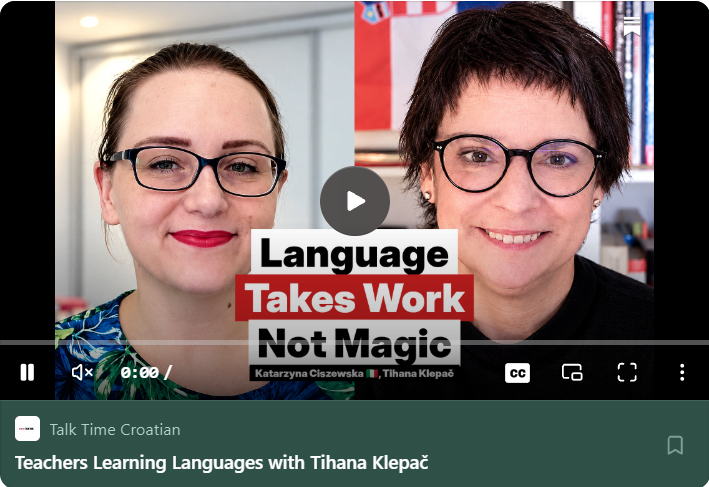
Teachers Learning Languages with Tihana Klepač
I was Katarzyna Ciszewska's guest on Teachers Learning Languages, her live series on Substack about teaching languages and learning them. Katarzyna teaches Italian; I teach Croatian to heritage speakers. We recorded this conversation live on the morning of 11 November 2026, and it was first published on Substack. The video is below, followed by a short summary, four questions from the conversation, and the full transcript at the bottom of the page.
We talked about learning languages as an adult, about my own Italian, which began in Opatija with a kindergarten teacher, cherries and paper money, and about the shame so many heritage speakers carry for the Croatian they do not speak. I explain why adults need to understand the why before a language will stick, and why I teach grammar, pronunciation, vocabulary and culture together.
Why do so many heritage speakers feel ashamed of their Croatian?
Because they do not speak the language they feel they belong to. Many are embarrassed to speak it at all, and some grew up in places where their parents, children of Croatian emigration themselves, would not let them speak Croatian and spoke it in another room, so that the children would assimilate and never be embarrassed by an accent or an ancestry. I address this shame openly in the monthly masterclasses of my programme, and I tell my students that they are not the first to feel it, and that it is not their fault.
Why do adults need to understand the why?
Children learn without having to understand. Adults learn better when I explain why something is happening and what they can do about it. I also ask them to speak to themselves the way they would speak to a friend: if we were talking about somebody else, we would say, don't be hard on yourself.
What is the four-pillar method?
It is the way I teach Croatian: grammar, pronunciation, vocabulary and culture together, in everything I teach. I take the grammar of the lesson and use it inside a culture lesson. In a class just before this interview, for example, my students described dresses from Slavonia, where their great-grandparents came from, while practising how to decline adjectives and nouns. Because it means something to them, it sticks, as cognitive linguistics says. By the end of the hour they were already building longer sentences, at A2 level.
Is it ever too late to learn the language of your family?
No. Most of my heritage students start when their own children have grown up or left home, when they finally have time for something they have set aside their whole lives. Katarzyna told me that her great-grandmother began learning Italian at 94, so that she could understand the Polish Pope when he spoke it.
Full transcript
The transcript below was generated automatically by Substack and edited for names, Croatian terms and obvious recognition errors. The wording is otherwise as spoken. Open it to read the whole conversation.